
Wireless Charging Market Size, Share & Growth 2030
The wireless charging market is undergoing a transformative evolution, driven by the global demand for convenience, efficiency, and wireless power delivery. What once seemed like a futuristic innovation has now become a mainstream necessity across consumer electronics, automotive, industrial automation, and healthcare sectors. As devices become more compact, interconnected, and intelligent, the need for wireless charging solutions continues to accelerate.
At Wired and Wireless Technology (WAWT), we observe that wireless power is no longer just an alternative to wired charging it is rapidly becoming the preferred standard across multiple applications. The convergence of advanced technologies, increasing device ecosystems, and evolving user expectations is pushing the wireless charging market toward good growth.
Let’s discuss wireless charging market trends
Market Size and Growth Outlook
The wireless charging market, which is gradually growing since last few years, is set to see some faster growth due to increase in adoption across wide range of application markets and sectors. The wireless power receiver and transmitter shipments, in terms of volume are expected grow around 16% in next five years. Cumulatively around 5 billion wireless power receivers and transmitters are expected to be shipped in the next five years.
Global Wireless Charging Market Ecosystem Analysis
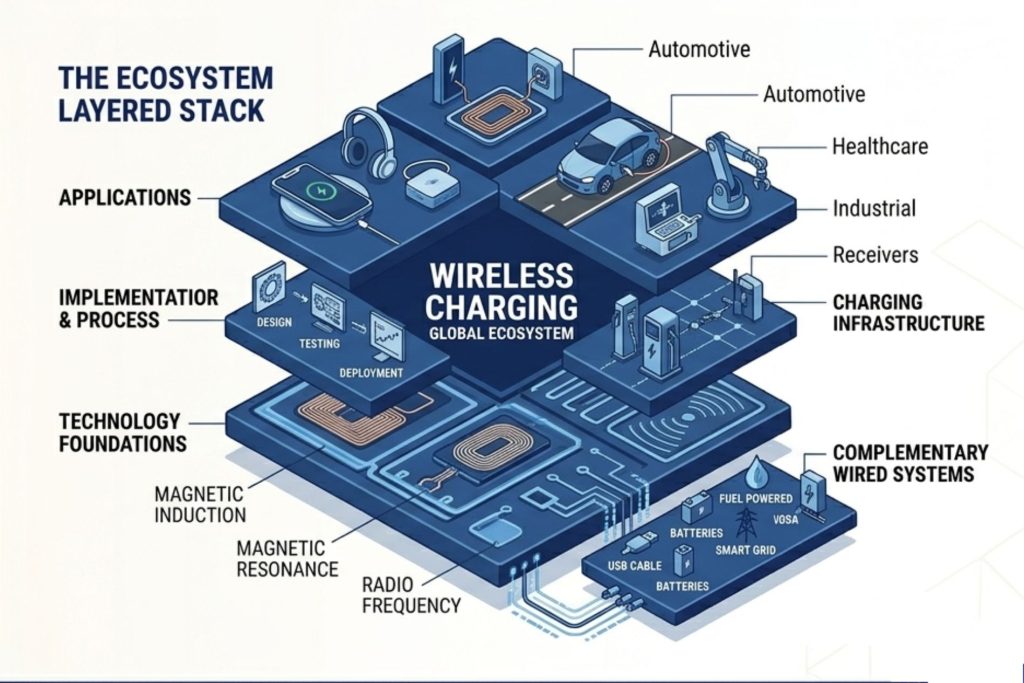
At WAWT, we track the intricate evolution of the wireless power sector. This ecosystem is including Magnetic Induction, Magnetic Resonance, and Radio Frequency (RF) which are currently redefining how energy is transferred across the globe.
Our analysis identifies a multi-layered market where sophisticated charging infrastructure must seamlessly coexist with legacy wired systems, batteries, and emerging smart grid integrations. From the rapid electrification of the Automotive sector to mission-critical deployments in Healthcare, Industrial, and Consumer Electronics, WAWT provides the deep-dive intelligence needed to navigate this cable-free future. As demand for safety and convenience accelerates, this multifaceted ecosystem continues to scale, supporting the next generation of wireless power innovations.
Key Market Drivers
Growing Consumer Demand for Convenience
Modern consumers demand simplicity and efficiency in their daily lives. Wireless charging eliminates the need for cables, connectors, and physical ports, offering a cleaner and more user-friendly experience. From bedside charging pads to embedded charging surfaces in furniture, wireless power is redefining how users interact with their devices.
Proliferation of Smart Devices & Wearables
The exponential growth of smartphones, smartwatches, earbuds, tablets, and other connected devices is a major catalyst for the wireless charging market. As consumers own multiple devices, the need for unified charging solutions becomes critical.
Expansion of Wireless
EV Charging
The automotive sector is emerging as a significant growth driver. Wireless charging solutions for electric vehicles (EVs), including passenger cars, e-bikes, and autonomous vehicles, are gaining traction. These solutions enhance convenience, reduce mechanical wear, and enable automated charging systems.
Industrial Automation and Robotics AGV & AMR
Industries are increasingly adopting automated guided vehicles (AGVs) and autonomous mobile robots (AMRs). Wireless charging enables these systems to operate continuously without manual intervention, reducing downtime and improving operational efficiency.
Opportunities in the Wireless Charging Market
The wireless charging market presents significant opportunities for innovation and growth:
- • Development of high-power wireless charging systems
- • Expansion into new application areas such as smart cities and public infrastructure
- • Integration with IoT ecosystems
- • Collaboration between technology providers and OEMs
- • Growth in emerging markets with increasing digital adoption
Emerging Trends in Wireless Charging
Multi-Device Charging Ecosystems
As users rely on multiple devices daily, there is a growing demand for charging solutions that can power several devices simultaneously. Multi-device charging hubs and surfaces are becoming increasingly common in homes, offices, and public spaces.
Long-Distance Wireless Charging
One of the most exciting developments is the evolution of long-distance wireless charging. This technology allows devices to charge without direct contact with a charging pad, enabling true over-the-air power delivery. It has significant potential in industrial automation, retail environments, and smart infrastructure.
Integration into Furniture and Infrastructure
Wireless charging is being embedded into everyday environments such as desks, kitchen counters, vehicles, and public infrastructure. This integration supports the concept of ubiquitous charging, where devices are powered seamlessly in the background.
Energy Harvesting Technologies
Energy harvesting is gaining traction as a complementary approach to wireless charging. Devices can draw power from ambient sources such as light, heat, vibration, and radio waves, reducing dependence on traditional charging methods.
Growth in E-Mobility Applications
Wireless charging is playing a crucial role in the evolution of e-mobility. From electric cars to scooters and bikes, wireless charging solutions are enhancing convenience and supporting the development of autonomous transportation systems.
Adoption in Healthcare and Medical Devices
Wireless power is increasingly being used in medical devices, including implants and wearable health monitors. It enables safer, more reliable, and maintenance-free operation, especially in critical healthcare environments.
Industrial Robotics and Automation
Wireless charging is enabling continuous operation of industrial robots and automated systems. By eliminating the need for manual charging, it enhances productivity and reduces operational downtime.
Cordless Kitchen and Home Appliances
The concept of a fully cordless kitchen is becoming a reality. Small appliances can now be powered wirelessly, offering greater flexibility, safety, and convenience for users.
Competitive Landscape
The wireless charging market is highly dynamic, with participation from technology providers, semiconductor companies, OEMs, and solution integrators. Companies are focusing on:
- • Product innovation and differentiation
- • Strategic partnerships and collaborations
- • Expansion into new markets and applications
- • Investment in research and development
The ecosystem is also witnessing increased collaboration among industry players to accelerate the adoption of standardized solutions and drive market growth.

Wireless charging market forecast 2030
The future of the wireless charging market is defined by the vision of a fully connected, wireless world, where power is delivered seamlessly across devices and environments. By 2030, wireless charging is expected to be deeply embedded into everyday life, transforming how consumers and industries access energy. The wireless charging market forecast 2030 indicates strong growth smart cities and infrastructure, and increasing deployment across homes, offices, and public spaces. These innovations will enable effortless, continuous charging experiences while supporting the expanding ecosystem of connected devices.
At the same time, the rise of autonomous systems, including electric vehicles, industrial robots, and smart healthcare devices, will significantly boost the adoption of wireless power solutions. Improvements in efficiency and faster charging capabilities will further strengthen the position of wireless charging as a preferred alternative to traditional wired systems. As adoption expands across industrial and healthcare sectors, the wireless charging market growth will accelerate, positioning wireless power as a core component of modern energy ecosystems. Ultimately, wireless charging will evolve from a convenience feature into a fundamental infrastructure layer powering the future digital and connected world.
Why Choose WAWT for Wireless Charging Market Insights
Wired and Wireless Technology (WAWT) is a leading strategic research and consulting firm specializing in wireless power and power supply markets. Our expertise lies in delivering comprehensive, data-driven insights that help businesses navigate complex market dynamics and make informed decisions.
Our Wireless Power Intelligence Service offers:
- • In-depth analysis of market trends and growth opportunities
- • Coverage of over 30 application markets
- • Insights into emerging technologies and innovations
- • Detailed forecasts and market data
- • Strategic guidance for businesses and investors
Our subject matter experts actively participate in global industry events and engage with key stakeholders to provide the most accurate and up-to-date insights.

QnA on wireless charging market
View AllWhat is the current size of the wireless charging market?
The wireless charging market is experiencing strong growth in recent years. With increasing adoption across consumer electronics, automotive, and industrial sectors, the wireless charging market size is expected to grow significantly and reach new heights by 2030, driven by continuous technological advancements and rising demand for cable-free solutions.
What are the key drivers of wireless charging market growth?
The wireless charging market growth is primarily driven by the rising demand for convenient and cable-free charging, the rapid expansion of smart devices, and increasing adoption in electric vehicles (EVs). Additionally, advancements in wireless charging technology, growth in industrial automation, and the emergence of IoT ecosystems are further accelerating market expansion.
Which industries are adopting wireless charging technology the most?
Wireless charging technology is widely adopted in consumer electronics, including smartphones, wearables, and earbuds. However, its adoption is rapidly growing in automotive (EV wireless charging), industrial robotics (AGVs/AMRs), and healthcare devices, making the wireless charging industry highly diverse and dynamic.
What is the future outlook of the wireless charging market by 2030?
The wireless charging market forecast 2030 indicates a strong growth with innovations such as wireless charging, smart infrastructure integration, and autonomous systems. By 2030, wireless charging is expected to become a core part of modern energy ecosystems, enabling seamless, efficient, and continuous power delivery across various applications and industries.