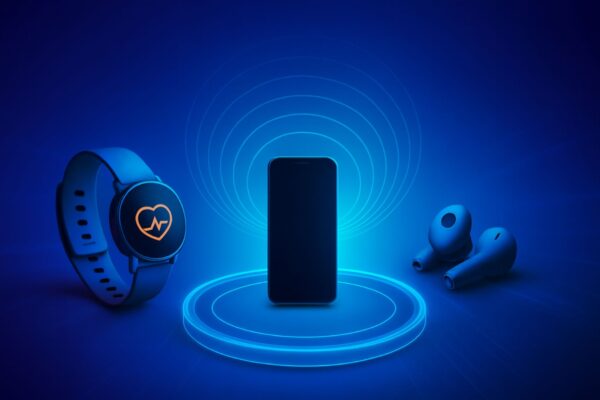
Wireless Charging 2.0: How NFC Wireless Charging Will Transform Wearables, Hearables, and Smart Accessories
As consumer electronics continue to shrink by design, become smarter, and integrate deeper into daily life, the need for compact, efficient, and seamless charging technologies has never been greater. The next major evolution in wireless power is the ‘Wireless Charging 2.0’ which is poised to reshape the future of small battery-powered devices. By 2026, WAWT expects NFC wireless charging to become one of the most important enablers for next-generation of wearables, hearables, and other smart battery-powered accessories.
WAWT’s Wireless Power Intelligence Service tracks key advancements and market movements in wireless power market across technology types, be it inductive, resonant, NFC, RF, and infrared or others. Based on our ongoing close monitoring of chipset developments, OEM roadmaps, and ecosystem trends, NFC wireless charging is emerging as a breakthrough solution for low and ultra-low-power devices (<3W) where traditional charging methods fall short of expectations or current use-cases.
Technology Roadmap – 2026 and beyond
NFC Forum’s NFC wireless charging technology is going through regular advancement and upgrade, thanks to its strong innovation-led member companies. The latest, NFC Wireless Charging 2.0 is set to become one of the most transformative technologies for compact devices over the next decade. Companies that integrate NFC charging early will gain significant advantages in design, performance, and ecosystem control.
What Is Driving the Rise of NFC Wireless Charging?
NFC wireless charging is built on the NFC Forum’s Wireless Charging Specification (WLC), which enables devices to use the existing NFC antenna for both communication and power transfer. Unlike inductive or resonance systems requiring relatively larger coils/antennas, NFC charging relies on a small antenna that already exists in billions of devices for connectivity and authentication.
Four major factors will be accelerating expected adoption:
1. Perfect for Ultra-Small Battery-Powered Devices: Device makers want thinner, lighter, portless devices. Traditional inductive-based coils are too large for:
- Smart rings
- Wireless earbuds (TWS) and hearing aids
- Digital stylus pens
- Smart fitness trackers and other health sensors
- Smart jewellery
- Medical patches (wearable types)
- Others
NFC’s smaller antenna and simplified design enables entirely new form factors.
2. Unified Communication + Power: Because NFC inherently supports secure communication, it allows:
- Accurate power negotiation
- Authentication between devices and chargers
- Smarter, more interactive charging experiences
This dual capability makes it highly attractive for branded ecosystems and accessories.
3. Lower Cost and Faster Integration: OEMs can:
- Reuse the existing NFC antenna
- Reduce component count
- Shrink PCB size
- Avoid complex thermal and shielding considerations
For mass-market hearables and wearables, these advantages accelerate time-to-market and reduce BOM costs.
4. More Durable and Sustainable Designs: Removing charging ports improves:
- IP ratings
- Product longevity
- Water and sweat resistance
- Overall mechanical durability
This directly benefits wearables used for health tracking, fitness, or outdoor activities.
NFC Wireless Charging is expected to go mainstream in the next few years
WAWT’s ongoing market analysis shows a clear inflection point approaching in 2026 as semiconductor suppliers, accessory brands, and consumer electronics OEMs integrate NFC charging into next-generation products. Improving standards, new chipset introductions, and growing interoperability are setting the foundation for wide-scale adoption.
Key Growth Sectors/Applications which are expected to gain adoption
1. Hearables: Wireless Earbuds (TWS) and Hearing Aids: Hearables represent one of the fastest-growing categories globally. NFC charging could possibly enable:
- Smaller, more discreet charging cases
- Lower-power continuous operation
- Smart charging communication for battery health
- Secure accessory pairing
- Reduced component size for hearing aids
For medical-grade devices, NFC charging supports better reliability, water resistance, and user convenience.
2. Wearables: Smart Rings, Smart Health and Fitness Trackers and Bands: The surge of biometric monitoring and digital health devices is pushing manufacturers toward minimalistic designs. NFC charging could be ideal for:
- Smart rings
- Slim fitness trackers and bands
- Temperature and sleep monitors
- Stress and heart-rate trackers
- Wellness wearables
These devices benefit from a charging solution that fits their compact, ergonomic form.
3. Smart Digital Styluses, Pens, and Productivity Accessories: With tablets, laptops projectors already incorporating NFC for communication and security, enabling power transfer is a natural next step. In 2026, NFC charging will elevate:
- Active digital styluses
- Digital pens
- Presentation remotes
- Gesture-based productivity tools
Users will be able to recharge accessories directly from their smartphones, tablets, and laptops – no cables required.
4. Smart Cards and Ultra-Thin Devices: NFC charging enables:
- Digital business cards
- Access badges
- Security authentication cards
- Medical identity cards
- Ultra-thin IoT trackers
These devices can operate longer and smarter without bulky charging hardware.
5. Smart Home & IoT Accessories: Homes are becoming more connected, and NFC charging will simplify the user experience for:
- Bluetooth and object trackers
- Smart jewellery
- Personal safety wearables
- Key fobs
- NFC-enabled sensors
For ecosystem brands, NFC charging offers easy integration and high scalability.
Market Outlook: How the Ecosystem Is Shifting: Some of the Strong Growth Factors:
WAWT’s Wireless Power Intelligence Service indicates accelerating adoption due to:
- Broadening chipset availability
- Increasing OEM integration in wearables and hearables
- Expanding accessory ecosystems
- More standardised WLC compliance (thanks to efforts of every NFC Forum’s member)
Based on WAWT’s latest comprehensive research on wireless power market, NFC wireless charging is expected to transition from niche utilization to mainstream deployment across multiple categories from mid-2026.
Ecosystem Lock-In and Brand Advantage
NFC’s inherent security and communication allow OEMs to create:
- Smart charging experiences
- Accessory authentication
- Proprietary ecosystem benefits
- Premium user interaction models
This is especially attractive for smartphone brands, hearable companies, and PC manufacturers.
Complementary Role to WPC’s Qi and Qi2 standard-based wireless power solutions
NFC wireless charging is not a replacement for higher-power inductive standards. Instead:
- Qi / Qi2 will dominate smartphones and mid-to-high power devices
- NFC charging will dominate ultra-low-power and micro-device categories
This complementary dynamic situation will strengthen the overall wireless charging landscape through 2030.
How WAWT Can Support Your Wireless Charging Strategy
WAWT is a leading strategic technology analyst and consulting firm specializing in wireless power and power supply technologies. Through our Wireless Power Intelligence Service, we deliver:
- Comprehensive market estimates and 10-year forecasts
- Technology and standards evolution analysis
- OEM adoption tracking across 30+ key applications
- Competitive landscape and chipset vendor insights
- Roadmaps and business opportunities for manufacturers
- Develop Market prioritization and Go-To-Market Strategy
- Develop Patent Monetisaiton Strategy
- Custom research tailored to product strategy and go-to-market plans
We monitor wireless charging developments across mobile ecosystem and other consumer electronics, wearables/hearables, computing, medical/healthcare, smart home, industrial automation, robotics, automotive, healthcare, retail ecosystems and infrastructure market.
Contact our SME: analyst@wawt.tech
Book your FREE 30-minute Discovery call
Subscribe to our “Power Bulletin” monthly newsletter (email and LinkedIn editions)
Follow WAWT on LinkedIn for the latest wireless power trends, insights, and forecasts