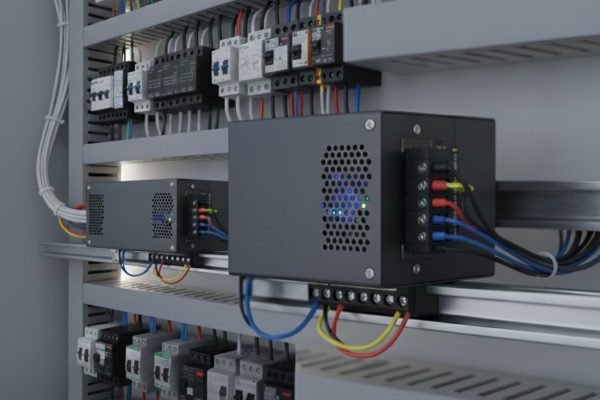
The global DIN rail power supply market is entering a renewed growth phase this year, supported by expanding industrial automation, increasing emphasis on energy efficiency, and rising demand for intelligent power supplies with advanced monitoring and control features are driving additional adoption of DIN rail power supplies in new installations and retrofit projects.
Based on WAWT’s latest comprehensive research on the global AC-DC and DC-DC power supply market, the DIN rail power supply market is expected to grow at a CAGR of around 4.9%. As smart manufacturing and digitalized infrastructure continue to expand, these power supplies have become essential components across multiple industries.
DIN rails are standardized metal strips used worldwide for mounting electrical and control equipment inside cabinets. They ensure the secure installation of components such as circuit breakers, terminal blocks, power supplies, actuators, and solenoids. The specifications for DIN Rail are formally embraced as both European (EN) and International (IEC) standards that ensure compatibility, safety, and interoperability of electrical components globally.
There are various types of DIN rails, designed to meet the multiple size, strength, mounting, and environmental requirements of different electrical and industrial applications. Below are the common DIN rail types:
- Top-hat rail (TS35): A standard hat-shaped rail; most common for circuit breakers, relays, and terminal blocks.
- Mini top-hat rail (TS15): A smaller hat-shaped rail; used for compact electronics or low-power devices.
- C-rail: A channel-shaped rail: Supports heavy-duty electrical components like transformers or power blocks.
- G-rail: A G-shaped rail; used for heavy or specialized components, but is less commonly used today.
- Slotted rail: A rail with pre-cut slots; it allows adjustable mounting and easy positioning of components.
With such a wide variety of DIN rail types, it’s clear how essential and widely used they are across industries worldwide, setting the stage for exploring the global DIN rail market.
Key Market Drivers
1. Expansion of Industrial Automation
- Factories worldwide transition to Industry 4.0 practices that drive the need for stable, compact, and reliable power sources. DIN rail power supplies are widely used in industrial automation (Source – DigiKey) control cabinets, precisely for powering control and automation systems in factories and manufacturing environments.
2. Rising Importance of Energy Efficiency
- Regulations, sustainability commitments, and cost-reduction strategies are pushing industries to adopt more efficient components.
- Modern DIN rail power supplies now achieve efficiency ratings of up to 90%, reducing energy waste, limiting heat output, and cutting long-term operating costs.
- The focus on sustainability is driving accelerated product upgrades and modernization initiatives.
3. Shift Toward Smart and Connected Systems
- The evolution toward smart power systems has transformed the role of DIN rail power supplies. Modern units now include features such as:
- UPS Function
- Smart Communication Options
- Comprehensive System Monitoring and Control
Key Market Challenges
Despite the expected growth, the industry also faces several challenges:
- Regulatory & Compliance Burden: DIN rail manufacturers must comply with multiple international standards (IEC, EN, UL). Strict regulations increase production complexity and costs, affecting market entry and expansion.
- Raw Material Price Volatility & Cost Pressure: DIN rails require steel, aluminum, and copper, and changes in these materials’ prices have an immediate effect on production costs. This pressure can reduce profit margins and force companies to adjust pricing strategies.
- Supply Chain Disruptions & Component Shortages: Market supply and dependability are impacted when DIN rail production and delivery are slowed down by delays in components or raw materials. When sourcing alternative materials, businesses frequently incur higher costs.
- Intense Price Competition & Commoditization: Competition drives down prices because many manufacturers offer comparable DIN rails. Commoditization limits differentiation, making innovation and value-added solutions crucial for market success.
- Technical & Integration Complexity: DIN rails that support complex parts and integrated systems are necessary for modern industrial automation. This increases research and development costs and extends development cycles, impacting the ability to quickly meet market needs.
Emerging Industry Trends Impacting the DIN Rail Market
1. Miniaturization and Higher Power Density: DIN-rail power supplies and modules are becoming smaller yet more powerful. Manufacturers are packing higher wattages into narrower, slimmer housings, enabling more efficient use of space in crowded control cabinets or automation racks.
2. Rugged / Wide-Input-Range & Environment-Resilient Designs: DIN-rail units are increasingly engineered to tolerate wider input-voltage ranges, harsh ambient conditions (temperature extremes, dust, vibration), and to meet robustness requirements for demanding industrial / harsh-environment applications.
3. Integration with Digital Platforms: IIoT / SCADA / Smart Monitoring / Diagnostics
DIN-rail power supplies are evolving as more are built with embedded communication interfaces, remote monitoring capabilities (voltage, load, temperature, fault detection), and compatibility with digital control/automation/IIoT/SCADA platforms.
4. Increased Focus on Redundancy and Reliability: There is growing demand for redundant DIN-rail power supply configurations and high-reliability modules especially in sectors where uptime is critical, like data centers, utilities, process industry, telecom, and infrastructure.
DIN Rail Power Supply Market Overview
The global DIN rail power supply market continues to expand in response to automation, digitalization, and sustainability pressures. With rising expectations for compactness, ruggedness, efficiency, and intelligence, manufacturers are shifting from conventional transformer-based units toward high-density, digitally integrated, and environmentally resilient designs.
Continued expansion of Industry 4.0, smart infrastructure, and mission-critical digital ecosystems will ensure sustained long-term demand for next-generation DIN rail power supplies across industrial, infrastructure, and energy sectors.
About WAWT – Power Supply Market Intelligence
WAWT’s specialized and comprehensive research solution, Power Supply Market Intelligence, provides end-to-end coverage of the power supply market across segments, including ones listed below:
- AC-DC, DC-DC, SMPS, and linear power supplies
- AC-DC & DC-DC Merchant Power Supply Market Report
- External Power Adapters & Chargers Market Report
- Application-specific power supply reports (datacenter, railway, medical, EV, industrial)
- Global vendor market share rankings
- Technology landscape, competitive insights & regional shifts
We help businesses identify opportunities, benchmark competition, and make informed strategic decisions. WAWT’s two core reports on the power supply industry, AC-DC and DC-DC Merchant Power Supply Market, and External Power Adapters and Converters Report – 2025 Edition, were recently released.
Our brochure and sample reports highlighting the scope and coverage of our research solutions.
Subscribe to our monthly Power Bulletin Newsletter and follow WAWT on LinkedIn to stay updated with the latest research insights, forecasts, and technology trends across wireless power, power supplies, and EV charging. Feel free to contact our subject matter expert to schedule a free 30-minute call to discuss the latest trends and insights on wireless power, power supply, and other allied markets.