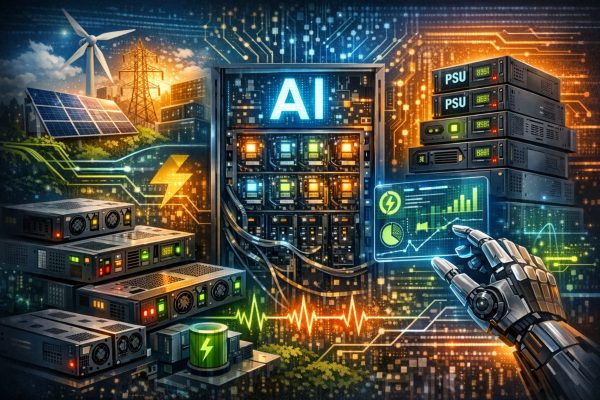
As artificial intelligence (AI) compute demand accelerates toward unprecedented scales, data centers are being reimagined from the inside out not only in terms of compute hardware, but also in how power is delivered, managed, and optimized.
How AI Workloads Are Redefining Power Supply Design for Data Centers: Insights from CES 2026
At CES 2026, the global technology ecosystem highlighted how AI-centric infrastructure is shaping the future of computing. From next-generation AI accelerators to modular data center architectures, one message was clear: power supply design has become a strategic pillar of AI infrastructure. These developments carry profound implications for power efficiency, scalability, reliability, and long-term energy strategy in modern data centers.
Physical AI — What It Means & Why It Matters
Physical AI refers to systems where intelligence is fused with real-world action not just data processing. It is about interpreting sensory inputs (vision, touch, motion), reasoning about them, and executing physical tasks autonomously. This year at CES:
- Robotic systems like Hyundai’s strategy for human-centered AI robotics and Boston Dynamics’ next-gen humanoids showcased how robots are being designed for real-world interaction lifting, walking, navigating, and collaborating with people.
- Nvidia and partners pushed Physical AI stacks (hardware + models + simulation) that let machines learn and adapt in dynamic environments rather than follow fixed commands.
- Edge intelligence is enabling robots and autonomous systems to operate with local reasoning and real-time reaction, crucial for safety, latency-sensitive tasks, and offline environments.
AI Workloads Are Driving New Power Demands
AI training and inference workloads particularly at the “yotta-scale” levels discussed at CES 2026 require significantly more power than traditional enterprise computing. AMD’s Helios rack blueprint, for example, illustrates how future AI racks will integrate far more CPUs, GPUs, and accelerators per rack. This results in:
- Much higher peak and average power consumption
- Increased power density per rack
- Stricter requirements for reliability and uptime
Implications for Power Supplies
- Higher continuous and transient load handling capability
- Modular and scalable power supply architectures
- Optimized rack-level power distribution
Traditional PSUs designed for predictable workloads are giving way to dynamic power systems capable of responding instantly to fluctuating AI compute demand.
Efficiency Has Become a Core Competitive Advantage
CES 2026 announcements made it clear that performance alone is no longer enough. AI platform leaders are increasingly focused on energy efficiency and total cost of ownership (TCO). Reducing energy consumed per AI task is now a critical metric for data center operators.
Implications for Power Supplies
- Advanced power factor correction (PFC)
- Adaptive load balancing across power modules
- Cooling-aware PSU designs that minimize thermal losses
- Intelligent energy management aligned with variable AI workloads
Power supplies are evolving from passive conversion components into active energy management systems.
Modular and Integrated Infrastructure Is Gaining Momentum
Modularity was a strong theme at CES 2026, with solutions such as GIGABYTE’s GIGAPOD AI data center racks showcasing pre-engineered, scalable infrastructure designs.
Implications for Power Supplies
- Pre-integrated power modules aligned with compute and cooling
- Hot-swappable PSU designs to support high availability
- Rack-level integration of power, cooling, and compute subsystems
This approach allows data centers to scale AI capacity faster without repeatedly redesigning power distribution architectures.
Supporting Next-Generation Memory and Compute
Advanced memory technologies such as HBM4 and CXL memory, highlighted at CES 2026, are enabling higher bandwidth and lower latency for AI systems. However, they also place new demands on power quality and stability.
Implications for Power Supplies
- Ultra-low noise and ripple designs
- Tightly regulated multi-rail outputs
- Support for dynamic voltage and frequency scaling (DVFS)
In high-performance AI clusters, even minor power instability can reduce throughput or trigger performance throttling.
AI Is Making Power Supplies Smarter
Another key CES 2026 theme was the use of AI to optimize infrastructure itself. AI-assisted hardware management is increasingly being applied to power systems.
Implications for Power Supplies
- AI-driven predictive maintenance
- Real-time optimization of power delivery
- Early anomaly detection to prevent downtime
The next generation of PSUs is expected to incorporate embedded intelligence, allowing power systems to learn, adapt, and self-optimize based on workload behavior.
Power Supplies Within a Broader Energy Ecosystem
CES 2026 also highlighted innovations in energy generation, storage, and sustainability, reinforcing that data centers are becoming integral components of the broader energy ecosystem.
Implications for Power Supplies
- Grid-responsive PSU architectures
- Support for renewable energy integration
- Coordination with energy storage systems
- Demand-response and load-shifting capabilities
As AI workloads increase overall energy consumption, power supplies must support both performance and sustainability goals.
Conclusion: Designing Power Systems for the AI Era
AI workloads are not only redefining compute they are fundamentally reshaping power delivery, efficiency, scalability, and intelligence in data center design. CES 2026 reinforced that the future of AI infrastructure depends on sophisticated power architectures that can support high-density compute while maintaining efficiency and reliability.
Power supplies are no longer static components. They are becoming dynamic, intelligent, and strategically critical systems at the heart of next-generation AI data centers.
About WAWT
Wired and Wireless Technologies (WAWT) is a strategic technology analyst and consultancy firm specializing in power supply and wireless power markets. WAWT delivers in-depth market intelligence, insights, and competitive analysis across AC-DC power supplies, DC-DC converters, and wireless charging technologies.
WAWT’s flagship research offerings the AC-DC and DC-DC Merchant Power Supply Market Report and the External Power Adapters and Chargers Market Report provide accurate market sizing, five-year forecasts, technology trends, and competitive intelligence. These insights support organizations across data centers, servers, storage, networking, telecom, medical, industrial, lighting, and railway sectors in aligning strategies with rapidly evolving power requirements, including those driven by AI workloads.
Request our brochure and sample reports to explore the scope and coverage of our research solutions
Contact our analyst team at analyst@wawt.tech to schedule a FREE 30-minute discovery call for tailored research and advisory support
Subscribe to our monthly newsletter, “Power Bulletin,” and follow WAWT on LinkedIn for the latest market trends, insights, updates, and forecasts across power supply and wireless power technologies