
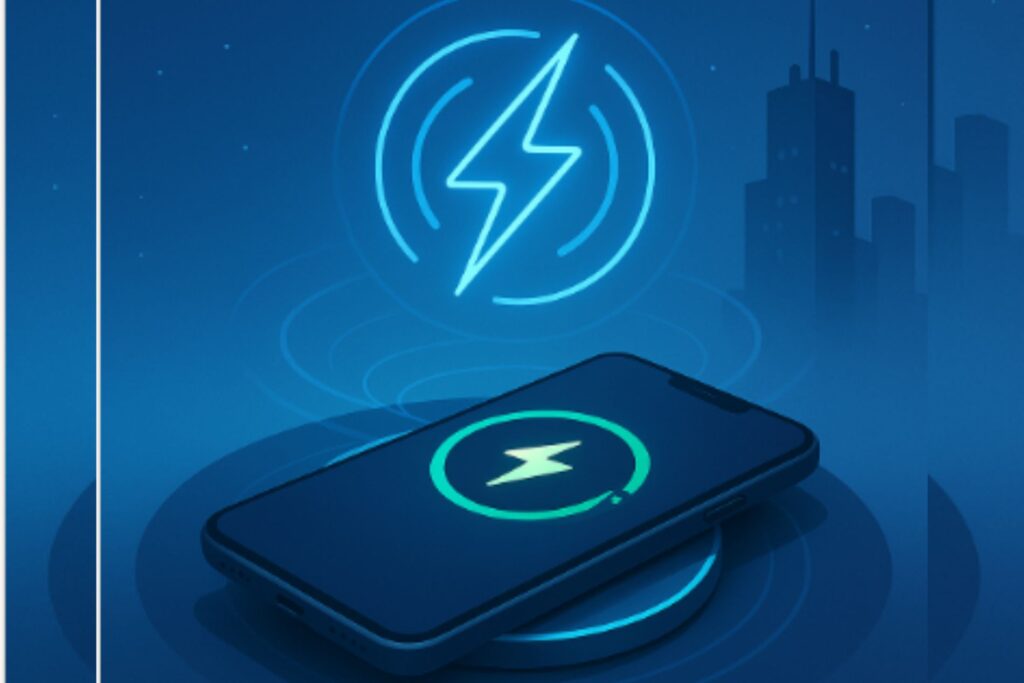

Wired and Wireless Technologies (WAWT) provides deep research, insights, and strategy around wireless power solutions—the technologies that enable energy transfer without cables or connectors.
We help OEMs, component suppliers, technology developers, and investors understand the growing landscape of wireless power technologies, from near-field consumer applications to long-range industrial and EV use cases.
Through our Wireless Power Solutions Intelligence Service, we deliver actionable insights to support technology development, standard adoption, and business decision-making in a rapidly transforming power ecosystem.
Wireless power solutions are redefining how products are designed, powered, and maintained. The shift from wired to wireless energy transfer enables safer, more efficient, and flexible systems that meet modern demands for convenience, miniaturization, and sustainability.
Key drivers shaping the wireless power solutions market include:
Efficiency: Improving power transfer accuracy and minimizing energy loss.
Design Freedom: Supporting compact, waterproof, and fully sealed enclosures.
Scalability: Enabling wireless energy delivery from milliwatts to kilowatts.
Safety and Reliability: Eliminating exposed electrical contacts.
The adoption of wireless power is expanding beyond consumer electronics, creating new possibilities across sectors such as:
Automotive: Wireless EV charging and autonomous vehicle integration.
Healthcare: Safe and sterilizable wireless medical devices and implants.
Industrial Automation: Cable-free power delivery for AGVs, AMRs, and robotics.
Smart Infrastructure: Wireless power for IoT sensors, home appliances, and smart cities.
Wireless power solutions today encompass a wide range of power classes, frequencies, and architectures. These include near-field and far-field systems, coupled and uncoupled designs, and use cases from portable gadgets to industrial automation. With continuous innovation, the technology is expanding its reach enabling dynamic charging environments, extended transmission distances, and universal compatibility that eliminates the need for cables or docking stations.
Inductive and Resonant Coupling for short to mid-range power transfer.
RF and Microwave Power Transfer for long-range, low-power IoT systems.
Dynamic Wireless Power Transfer (DWPT) for moving vehicles and machinery.
Future advancements aim to increase distance, efficiency, and interoperability, allowing seamless energy access across devices and environments.
Long-distance wireless charging gaining momentum
Integration across consumer electronics, wearables, and healthcare
Growing role in smart homes, robotics, and industrial automation
Automotive and EV adoption driving infrastructure innovation
Healthcare sector using sealed devices to improve hygiene and reliability
Trusted Expertise: 15+ years of wireless power and supply market leadership
Comprehensive Coverage: Spanning consumer, automotive, industrial, and healthcare sectors
Accurate Forecasting: 10-year detailed projections for adoption, revenue, and shipments
Tailored Insights: Access to reports, webinars, and strategic consulting
Forecasts: Historical, current, and 10-year projections
Metrics: Shipments, revenues, ASPs, and adoption rates
Technology: Near-field, far-field, coupled, and uncoupled architectures
Power Classes: From milliwatt to multi-kilowatt systems
Applications: Consumer electronics, healthcare, automotive, robotics, and industrial IoT
The rapid rise of artificial intelligence (AI) workloads is fundamentally transforming data center power architectures. From training large language models (LLMs) to supporting real-time inference, AI servers particularly GPU-accelerated systems […]
Read MoreEach year, MWC offers a glimpse into what the mobile ecosystem will prioritize next. In 2026, one theme is becoming increasingly clear: wireless power is evolving from a convenience feature […]
Read MoreAs factories, warehouses, and logistics hubs move toward full automation, the expectation is simple: robots must work continuously without human interruption. Autonomous Mobile Robots (AMRs) and Automated Guided Vehicles (AGVs) […]
Read MoreThe wireless power market is growing due to rising demand for faster, safer, and more efficient charging solutions. Consumers and industries alike are seeking convenience and durability in powering devices without the hassle of cords. Key factors include efficiency, adaptability, interoperability, and security. These drivers are further supported by technological innovation, making wireless charging more reliable and widely adopted across multiple industries.
Wireless power is making a strong impact in consumer electronics, medical devices, EVs, industrial machinery, and home appliances. It enables devices to be sealed, durable, and safer to operate in diverse environments. Healthcare in particular benefits from cordless and sealed solutions, improving sterilization and safety. Similarly, robotics, automotive, and industrial IoT applications are adopting wireless power to enhance performance and reduce downtime.
Wireless charging is advancing from short-range, near-field solutions to longer-distance, far-field power transfer. This evolution allows devices to charge dynamically in transit or in public spaces. The technology is also becoming more efficient and capable of handling higher power classes. This ensures that wireless charging moves closer to the reliability of traditional wired methods while offering added convenience.
WAWT combines 15+ years of expertise with deep industry connections to provide accurate research and actionable intelligence. Our reports cover forecasts, adoption trends, and competitive positioning. Businesses across OEMs, component makers, and solution providers benefit from our subscription services and tailored consulting. WAWT ensures clients stay ahead of market shifts with reliable data and strategic guidance.