Key Takeaways
- Solid-State Transformers (SSTs) emerged as one of the key power infrastructure technologies discussed at PCIM Europe 2026, reflecting growing industry focus on intelligent grid modernization.
- Unlike conventional transformers, SSTs combine power electronics, high-frequency magnetics, semiconductor devices, and digital control to enable voltage conversion, power quality management, and real-time grid intelligence.
- AI data centers are expected to be among the earliest adopters of SSTs due to increasing rack power densities and the shift toward 400V and 800V DC power distribution.
- SSTs can support bidirectional power flow, fast voltage regulation, fault management, and communication, making them well suited for future smart grids and DC-based power architectures.
- EV fast-charging hubs can benefit from SST technology by integrating medium-voltage power conversion, local energy storage, renewable energy, and vehicle-to-grid (V2G) capabilities within a single intelligent power node.
- Renewable energy systems and DC microgrids represent another major growth opportunity, as SSTs help improve voltage stability, power quality, and grid flexibility while managing distributed energy resources.
- Industrial facilities, semiconductor fabs, ports, railways, and marine electrification are emerging application areas where intelligent power conversion can deliver operational and efficiency benefits.
- While SST technology offers significant advantages, widespread deployment will depend on continued advancements in Silicon Carbide (SiC) semiconductors, high-frequency magnetics, thermal management, digital control, and system reliability.
- Rather than replacing every conventional transformer, SSTs are expected to see phased adoption in applications where intelligent power management, compact design, and bidirectional energy flow provide clear value.
- PCIM Europe 2026 highlighted a broader industry trend: power infrastructure is evolving from passive electrical equipment toward software-defined, digitally controlled, and semiconductor-driven power systems.
What if the transformer one of the oldest and most trusted pieces of electrical infrastructure is about to become one of the smartest devices in the power system?
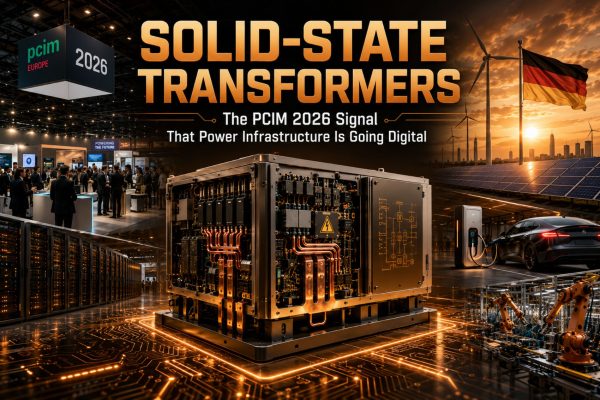
That question sat quietly underneath many of the most important discussions at PCIM Europe 2026. The event was not only about better semiconductors, smaller converters, or higher-efficiency modules. It was about a bigger market shift: power infrastructure is moving from passive, electromechanical equipment toward active, software-defined, solid-state architectures. And at the center of that shift is the solid-state transformer, or SST.
Traditional transformers are excellent at one job: changing voltage levels using magnetic coupling at grid frequency. They are robust, familiar, and widely deployed. But they are also heavy, passive, slow to respond, and limited in how much intelligence they can bring to a modern grid. A solid-state transformer performs the same basic voltage-conversion function, but does it through power electronic conversion stages, high-frequency magnetics, semiconductor switches, digital control, and communication capability.
According to the PCIM News Platform (2026), solid-state transformers are emerging conversion technologies designed for AC and DC power systems, industrial facilities, data centers, and e-mobility infrastructure. That wording is important. SSTs are no longer being discussed only as laboratory replacements for conventional transformers. They are now being positioned as active nodes in the future power architecture.
The reason is simple: future power systems will not be one-directional, slow-moving, and predictable. They will be bidirectional, dynamic, distributed, and increasingly DC-heavy. Solar, batteries, EV charging, AI data centers, microgrids, and industrial electrification all create power flows that are harder to manage with legacy infrastructure alone. A conventional transformer can step voltage up or down. An SST can potentially convert, regulate, isolate, protect, communicate, and manage power quality at the same time.
This is why PCIM 2026 felt like an important marker. Infineon placed a special focus on power infrastructure, including advanced technologies such as solid-state transformers and solid-state circuit breakers. The company’s PCIM messaging connected SSTs directly to future AI data centers, robotics, automotive, charging designs, DC microgrids, and high-voltage power distribution. For WAWT, that is a clear signal: SSTs are moving into the same strategic conversation as SiC, GaN, HVDC, and solid-state protection.
One of the strongest application areas is AI data centers. AI workloads are pushing rack power density toward levels that make traditional AC distribution increasingly difficult. Higher current means more copper, more heat, more distribution losses, and more complex protection. As data centers move toward 400V or 800V DC distribution concepts, the SST becomes attractive because it can connect medium-voltage AC directly into a controlled low-voltage DC bus, potentially reducing conversion stages and improving compatibility with DC-native loads.
A 2026 study by Xu and colleagues on SST-driven 800V DC data centers described exactly this direction. Their architecture converts 10 kV medium-voltage AC to an 800V low-voltage DC bus using an AC/DC stage and a dual-active-bridge DC/DC stage. The study notes that conventional UPS-based AC distribution chains involve multiple conversion stages and line-frequency transformers, compounding losses and making them less compatible with dynamic AI power profiles. That is precisely the kind of problem SSTs are designed to address.
But the SST opportunity is broader than AI. In EV charging, SSTs can support medium-voltage fast-charging hubs where multiple chargers draw large amounts of power at the same site. Instead of relying only on bulky grid-frequency transformers and separate conversion cabinets, SST-based architectures could integrate voltage transformation, rectification, isolation, bidirectional energy flow, and local control. This matters as charging sites evolve from simple chargers into energy nodes that may include batteries, solar, vehicle-to-grid capability, and load management.
Renewable energy is another natural application. Solar and wind introduce variability, while batteries introduce bidirectional flows. Distribution grids increasingly need devices that can regulate voltage, manage power quality, and respond quickly when generation or load changes. PCIM’s own article on SSTs as stabilizing influences in distribution grids highlights that smart SSTs can compensate for disturbances by regulating voltage and changing the grid operating point. In practical terms, this means SSTs can act less like static equipment and more like controllable grid assets.
Industrial power is also relevant. Factories, ports, mining sites, semiconductor plants, and process industries are becoming more electrified and automation-heavy. These facilities need cleaner power, faster protection, better monitoring, and easier integration of local generation and storage. SSTs can support this by enabling flexible AC/DC interfaces, modular expansion, and more granular control over power quality.
However, SST adoption will not be immediate or universal. This is not a technology that simply replaces every conventional transformer overnight. Engineers will still ask hard questions about cost, reliability, efficiency, thermal performance, insulation coordination, serviceability, standards, fault behavior, and lifetime under real operating conditions. PCIM’s SST coverage rightly points to challenges around high-frequency transformers, insulation coordination, power density, control hardware and software, modularity, redundancy, and efficiency.
This is where the market will separate serious SST platforms from attractive prototypes. A compelling SST is not just a pile of SiC devices and control code. It needs a complete engineering stack: robust power modules, high-frequency magnetics, thermal design, gate drivers, protection strategy, sensing, controls, cybersecurity, and field-proven redundancy. It also needs a service model that utilities and industrial operators can trust.
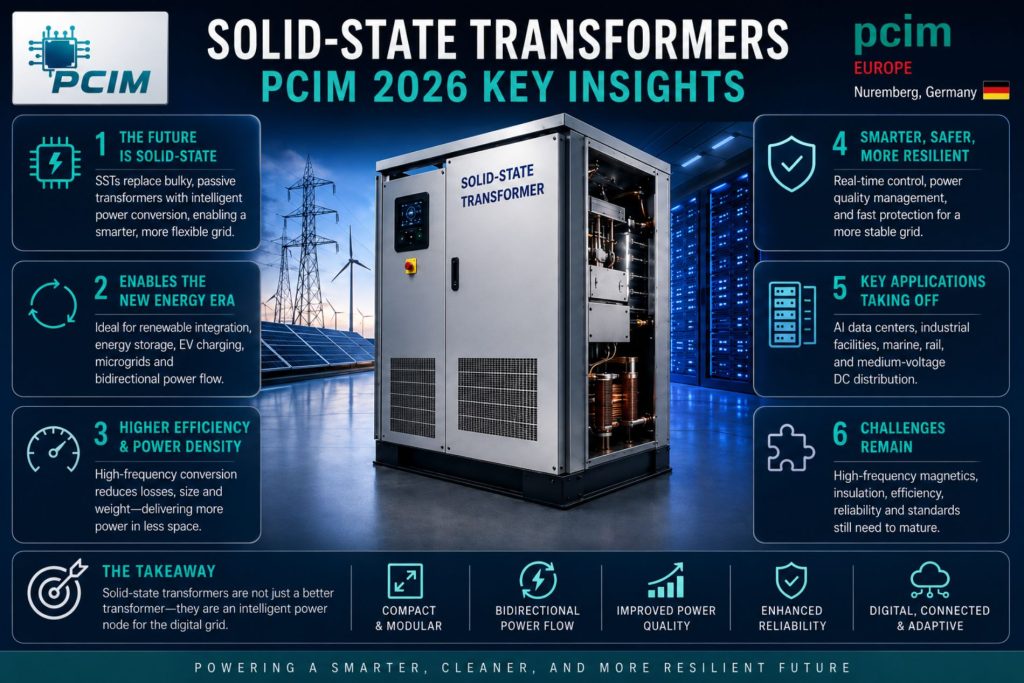
The more practical near-term path may be selective adoption. SSTs are most likely to appear first where conventional infrastructure is under the most pressure: AI data centers, medium-voltage EV fast-charging hubs, DC microgrids, renewable integration points, ships, rail, and high-reliability industrial sites. These are environments where the value of controllability, compactness, bidirectionality, and protection may justify the higher complexity.
The deeper message from PCIM 2026 is that the grid edge is becoming electronic. Transformers, breakers, converters, and protection devices are beginning to merge into smarter power nodes. The SST sits at that convergence point. It is not just a transformer replacement. It is a new class of infrastructure that reflects where power systems are heading.
For decades, transformers quietly enabled electrification by moving voltage up and down. The next generation may need to do much more.
It may need to think, switch, protect, stabilize, and communicate.
That is why the solid-state transformer deserves attention. It is not simply changing voltage. It is changing what power infrastructure can become.
About WAWT – Power Supply Market Intelligence
WAWT is a specialized market intelligence provider focused exclusively on the global power supply ecosystem. Through structured research frameworks and continuous industry monitoring, WAWT delivers actionable insights across AC-DC, DC-DC, SMPS, and application-specific power supply segments.
Our Power Supply Market Intelligence platform offers end-to-end visibility into technology evolution, competitive dynamics, and demand shifts across major verticals including data centers, electric vehicles, telecommunications, industrial automation, medical systems, and transportation infrastructure.
WAWT’s research methodology combines primary industry engagement, vendor benchmarking, supply chain analysis, and technology trend tracking to provide a comprehensive view of market developments. Our reports help stakeholders understand where value is shifting, which technologies are gaining traction, and how regional dynamics are influencing growth opportunities.
Key coverage areas include:
- AC-DC and DC-DC merchant power supply market analysis
- External power adapters and charging ecosystem intelligence
- Vendor market share rankings and competitive positioning
- Technology roadmap tracking including wide-bandgap adoption
- Application-level demand forecasting and use-case analysis
- Regional supply chain and manufacturing trends
WAWT’s flagship two research publications on power supply market includes ‘Global AC-DC & DC-DC Merchant Power Supply Market Report‘ and ‘External Power Adapters and Chargers Report – 2025 Edition‘, provide data-driven forecasts, market sizing, and strategic insights designed to support product planning, investment decisions, and competitive strategy.
Solid State Transformer FAQs (2026 Guide)
-
What is a Solid-State Transformer (SST)?
A Solid-State Transformer (SST) is an advanced electrical power conversion system that replaces the traditional line-frequency transformer with power electronic converters, high-frequency transformers, semiconductor switches, and digital control systems. Unlike conventional transformers, SSTs can regulate voltage, support bidirectional power flow, improve power quality, enable communication, and integrate seamlessly with AC and DC power systems.
-
How does a Solid-State Transformer work?
A Solid-State Transformer converts electrical energy through multiple power electronic stages rather than relying solely on magnetic induction. Typically, incoming medium-voltage AC is converted to DC, processed through a high-frequency isolated DC/DC converter, and then converted back to AC or distributed as DC depending on the application. Digital control continuously manages voltage, current, power quality, and protection functions.
-
What is the difference between a conventional transformer and a Solid-State Transformer?
Traditional transformers operate at grid frequency (50 or 60 Hz) using magnetic coupling and primarily perform voltage conversion. Solid-State Transformers operate using high-frequency power electronics, making them smaller, more intelligent, and capable of advanced functions such as voltage regulation, reactive power compensation, bidirectional energy flow, and communication with smart grid systems.
-
Why are Solid-State Transformers important for future power grids?
Future power systems are becoming increasingly distributed, digital, and bidirectional due to renewable energy, battery storage, electric vehicles, and AI data centers. Solid-State Transformers provide the flexibility, fast response, and intelligent control needed to efficiently manage these complex power flows while improving grid stability and power quality.
-
What are the biggest challenges of Solid-State Transformer technology?
Although SSTs offer significant benefits, they also face challenges including higher initial cost, thermal management, complex control algorithms, semiconductor reliability, insulation design, efficiency optimization, cybersecurity requirements, and long-term field validation compared with conventional transformers.
-
Why are Solid-State Transformers suitable for AI data centers?
AI data centers require high power density, fast load response, and efficient energy conversion. Solid-State Transformers can directly interface medium-voltage AC with low-voltage DC distribution, reducing conversion stages, improving efficiency, simplifying power architecture, and supporting rapidly changing AI workloads.
-
Are Solid-State Transformers replacing conventional transformers?
Not immediately. Conventional transformers remain highly reliable and cost-effective for many applications. In the near term, Solid-State Transformers are expected to complement rather than replace traditional transformers, especially in applications where digital control, power quality, bidirectional energy flow, and compact design provide significant value.
-
What is the future of Solid-State Transformer technology?
As wide-bandgap semiconductors, digital control systems, and high-frequency magnetic materials continue to advance, Solid-State Transformers are expected to play an increasingly important role in smart grids, AI data centers, renewable energy systems, industrial electrification, and medium-voltage DC distribution. Early adoption is likely to focus on specialized applications before expanding into broader power infrastructure.