Key Takeaways
- Power electronics has become the backbone of next-generation infrastructure, enabling AI data centers, humanoid robots, electric vehicles (EVs), renewable energy systems, drones, and industrial automation.
- AI data center power demand is increasing rapidly, with rack power expected to grow from around 120 kW today to 500 kW and potentially 1 MW in the coming years, driving the need for new power architectures.
- Higher-voltage DC distribution (800V HVDC) is emerging as a preferred solution for future AI factories and high-performance computing environments due to lower transmission losses, reduced copper usage, improved thermal performance, and greater energy efficiency.
- Solid-State Transformers (SSTs) are evolving into intelligent power management platforms by combining voltage conversion, galvanic isolation, bidirectional power flow, and digital control in a single system.
- Power electronics for robotics is becoming increasingly compact and power-dense, enabling improved efficiency, lower weight, better thermal management, and enhanced performance in humanoid robots, drones, and industrial automation.
- Megawatt Charging Systems (MCS) are transforming commercial EV charging into grid-integrated energy management solutions, incorporating medium-voltage connections, SiC power conversion, battery buffering, and dynamic power sharing.
- The industry is moving beyond the “SiC vs. GaN” debate, with both wide-bandgap semiconductor technologies increasingly deployed together to optimize different stages of power conversion.
- Wireless charging had relatively limited visibility at PCIM Europe 2026, although innovations such as advanced wireless power coils and high-power wireless EV charging solutions indicate continued long-term market development.
- Power electronics is shifting from component-level optimization to system-level architecture, becoming a strategic differentiator across AI, mobility, renewable energy, and industrial applications.
- Companies that optimize the complete power journey from the electrical grid to the end application will be best positioned to lead the next generation of electrification and intelligent energy systems.
What if the future of AI, humanoid robots, wider robotics, drones, MegaWatt EV charging and renewable energy is not limited by software, batteries or semiconductors alone – but by how intelligently power moves through the system?
That was the broader signal from PCIM Europe 2026 in Nuremberg this June. AI data centres are already exposing the limits of traditional power infrastructure. NVIDIA’s DGX GB200 rack-scale system consumes around 120kW per rack, while Infineon expects AI server rack power to rise toward 500kW and potentially 1MW by the end of the decade. At those densities, power supply design is no longer a background engineering function. It becomes the architecture that determines what can be built.
This is why the industry is moving beyond conventional 12V and 48V assumptions toward higher-voltage DC systems, including 800V HVDC architectures for future AI factories. Higher voltage lowers current for the same power, reducing cable losses, copper demand, heat and distribution complexity. The same logic is now appearing across EV charging, robotics, motor drives, DC microgrids and renewable energy systems.
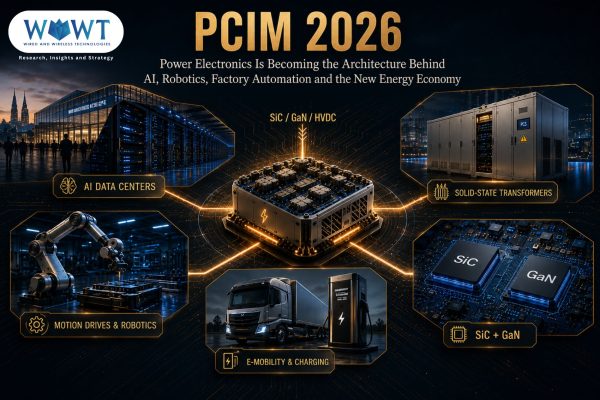
PCIM 2026 reflected this wider shift. The event brought together more than 650 companies from 27 countries across roughly 40,000 square meters of exhibition space, supported by more than 500 presentations. More importantly, it showed that power electronics is moving from component optimization to infrastructure-level design. Solid-state transformers, motor drives, megawatt EV charging, robotics, traction solutions, SiC and GaN are not separate stories. They are different expressions of the same market direction: electrified systems need smarter, denser and more controllable power architectures.
Four power electronics signals from PCIM 2026
- Solid State Transformers (SSTs) are becoming intelligent power nodes.
SSTs are not just lighter or more advanced transformer replacements. They combine voltage conversion, galvanic isolation, bidirectional power flow, digital control and power quality management. Next-gen SSTs are expected to even take up lesser space and be more efficient, ideal for large datacentres and side cars we are now expecting. PCIM’s SST coverage highlights their role in medium-voltage, MW-range applications where controllability and isolation matter. This makes them relevant for AI data centres, Megawatt EV charging hubs, DC grids, renewable integration, rail, marine and industrial facilities. The early adoption logic is clear: SSTs will gain traction first where conventional grid infrastructure struggles with dynamic loads, bidirectional energy flow and fast fault response.- On similar application market (data centre), most semiconductor companies were demonstrating their 800V or +/- 400V upto 48V to 12V to 6V and even <1V solution, open to various architectures.
- Motor drives are entering a new density and integration cycle.
Motor drives (traction solutions) sit at the centre of robotics, humanoids, drones, factory automation, pumps, fans, compressors and EV auxiliaries. At PCIM, intelligent motion was less about “better motors” and more about compact power electronics closer to the actuator. For humanoid robots especially, power density is not just a specification – it affects weight, heat, joint design, cable routing, runtime and safety. GaN and SiC are enabling faster switching, smaller passives, lower losses and tighter integration between drivers, sensing, control and thermal design. The next generation of robotics will depend heavily on how efficiently power can be converted and controlled inside very constrained mechanical spaces.
- Megawatt EV charging is becoming a grid-edge power electronics challenge.
PCIM’s e-mobility coverage points to Megawatt Charging Systems pushing beyond 1,000V and toward 1 MW+ output for trucks. At that scale, charging is no longer just a charger; it becomes a site-level energy system. Medium-voltage connection, SiC-based conversion, liquid-cooled cables, local battery buffers, grid constraints, power sharing and uptime all become part of the business case. This is especially important for logistics depots, commercial fleets and highway charging corridors, where utilisation and reliability matter as much as headline charging speed.
- SiC vs GaN is becoming the wrong debate
PCIM 2026 showed a more mature view: SiC and GaN are increasingly complementary. SiC is gaining strength in high-voltage, high-power and rugged applications such as EV traction, solar, energy storage, medium-voltage systems, fast charging and AI power infrastructure. GaN is advancing in high-frequency, high-density conversion, compact power supplies, robotics drives and emerging bidirectional architectures. The real advantage is not choosing one material over the other, but knowing where each creates the best system value. In many future architectures, SiC will handle the high-voltage front end while GaN supports dense intermediate or point-of-load conversion closer to the application.
- Wireless charging technology has minimal presence
This year at PCIM 2026, WAWT witnessed little presence of wireless power solutions, except some innovative wireless power coils and transformers from Wurth Electronics. And 1kW/22kW wireless On-Board Combo Charging solution exhibited first-time by UK-based Semtronics.
WAWT takeaway
PCIM 2026 made one thing clear: power electronics is now the connective architecture behind the next infrastructure cycle.
AI data centres need higher-voltage distribution and resilient power management. Humanoid robots (as well as drones) need compact, efficient and thermally disciplined power conversion. EV charging needs MW-scale grid-edge systems. Renewables and DC grids need bi-directional, controllable infrastructure. SiC and GaN need to be judged less by device physics alone and more by the system architectures they enable.
The next winners in power electronics will not simply be those that switch faster or convert more efficiently. They will be the companies that understand the full power journey – from grid to rack, from converter to motor, from battery to charger, from semiconductor to system reliability. Wireless charging had relatively less visibility at PCIM this year.
At PCIM 2026, the message was clear: power electronics are no longer hidden inside the application. It is becoming the application’s competitive edge.
About WAWT – Power Supply & Wireless Power Market Intelligence
WAWT is a specialized market intelligence provider focused exclusively on the global power supply and wireless power ecosystem. Through structured research frameworks and continuous industry monitoring, WAWT delivers actionable insights across AC-DC, DC-DC, SMPS, wireless charging, wireless power transfer , and application-specific power technologies.
Our Power Supply & Wireless Power Market Intelligence platform offers end-to-end visibility into technology evolution, competitive dynamics, and demand shifts across major verticals including data centers, electric vehicles, telecommunications, industrial automation, medical systems, consumer electronics, wearables, and transportation infrastructure.
WAWT’s research methodology combines primary industry engagement, vendor benchmarking, supply chain analysis, patent and technology tracking, and market trend monitoring to provide a comprehensive view of industry developments. Our reports help stakeholders understand where value is shifting, which technologies are gaining traction, and how regional dynamics are influencing growth opportunities.
Key coverage areas include:
- AC-DC and DC-DC merchant power supply market analysis
- Wireless power and wireless charging ecosystem intelligence
- External power adapters, chargers, and charging infrastructure analysis
- Vendor market share rankings and competitive positioning
- Technology roadmap tracking, including wide-bandgap semiconductor adoption (GaN and SiC)
- Wireless charging standards and technology developments across Qi, NFC Wireless Charging, and proprietary solutions
- Application-level demand forecasting and use-case analysis
- Regional supply chain, manufacturing, and sourcing trends
- Patent, innovation, and technology landscape assessment
WAWT’s flagship research publications include the Global AC-DC & DC-DC Merchant Power Supply Market Report, External Power Adapters & Chargers Report – 2025 Edition, and its industry-recognized Wireless Power Market Tracker. These reports provide data-driven forecasts, market sizing, competitive intelligence, and strategic insights designed to support product planning, investment decisions, technology roadmapping, and long-term growth strategies.
FAQs
-
What were the biggest power electronics trends at PCIM Europe 2026?
PCIM Europe 2026 highlighted the industry’s shift toward intelligent, high-density power electronics for AI infrastructure, electric mobility, robotics, and renewable energy systems. Key technologies included 800V HVDC power architectures, Solid-State Transformers (SSTs), Megawatt Charging Systems (MCS), Silicon Carbide (SiC), Gallium Nitride (GaN), and compact motor drives. Rather than focusing on individual components, the industry emphasized complete power system architectures that improve efficiency, scalability, thermal management, and overall system performance across multiple high-growth applications.
-
Why are AI data centers accelerating innovation in power electronics?
AI data centers require significantly more electrical power than conventional data centers, making advanced power electronics essential for future infrastructure. Modern AI server racks already consume around 120 kW, with future systems expected to approach 500 kW and even 1 MW. This rapid increase is driving demand for high-efficiency AC-DC and DC-DC power supplies, intelligent power management, higher-voltage DC distribution, and advanced cooling technologies to improve energy efficiency and reduce operational costs.
-
Why is 800V HVDC becoming important for AI infrastructure?
800V HVDC enables more efficient power distribution by reducing current, electrical losses, heat generation, and copper requirements. As AI factories, hyperscale data centers, and high-performance computing systems continue increasing power density, higher-voltage DC architectures offer better scalability and improved energy efficiency. The same architecture is also gaining attention across EV charging, industrial automation, renewable energy, and DC microgrids.
-
What is a Solid-State Transformer (SST), and why is it important?
A Solid-State Transformer (SST) is an advanced power conversion system that combines voltage transformation, power conversion, digital control, and bidirectional power flow into a single intelligent platform. Unlike conventional transformers, SSTs offer faster response, improved power quality, and greater system flexibility. They are expected to play an increasingly important role in AI data centers, renewable energy integration, Megawatt EV charging, railways, marine systems, and industrial power distribution.
-
How are GaN and SiC enabling next-generation power electronics?
Gallium Nitride (GaN) and Silicon Carbide (SiC) are complementary semiconductor technologies that improve power conversion efficiency, power density, and thermal performance. SiC is widely adopted in high-voltage applications such as EV traction, renewable energy, and utility-scale power systems, while GaN is increasingly used in compact power supplies, AI servers, robotics, and high-frequency power conversion. Together, they enable more efficient and intelligent power architectures.
-
Why are advanced motor drives critical for humanoid robots and industrial robotics?
Advanced motor drives improve the efficiency, precision, and compactness of robotic systems by delivering intelligent power control directly to the actuator. High-density power electronics reduce weight, improve thermal management, and enable smoother motion, making them essential for humanoid robots, drones, collaborative robots, and industrial automation. GaN and SiC technologies further enhance performance through faster switching speeds and lower energy losses.
-
What role did wireless charging play at PCIM Europe 2026?
Wireless charging had relatively limited visibility at PCIM Europe 2026 compared with AI infrastructure, EV charging, and wide-bandgap semiconductor technologies. However, WAWT observed several notable innovations, including advanced wireless power coils and transformers from Würth Elektronik, as well as a 1 kW/22 kW Wireless On-Board Combo Charging solution from UK-based Semtronics. These developments indicate continued innovation in high-power wireless charging despite the industry’s current focus on wired power infrastructure.
-
Why is power electronics becoming a strategic competitive advantage?
Power electronics is becoming a competitive advantage because it directly determines the efficiency, scalability, reliability, and performance of electrified systems. Whether powering AI data centers, humanoid robots, renewable energy plants, or EV charging infrastructure, intelligent power conversion is now a core differentiator. Companies that optimize the entire power journey—from the electrical grid to the end application—will be better positioned to deliver higher performance, lower energy consumption, and improved system reliability.
-
How does WAWT help companies understand the evolving power electronics market?
WAWT provides market intelligence that helps companies track technology trends, competitive developments, and growth opportunities across the global power electronics ecosystem. Its research covers AC-DC and DC-DC power supplies, wireless power, EV charging, GaN, SiC, AI infrastructure, and application-specific power technologies. Through detailed market forecasts, competitive benchmarking, technology roadmaps, and industry analysis, WAWT supports strategic decision-making for manufacturers, investors, technology developers, and supply chain stakeholders.