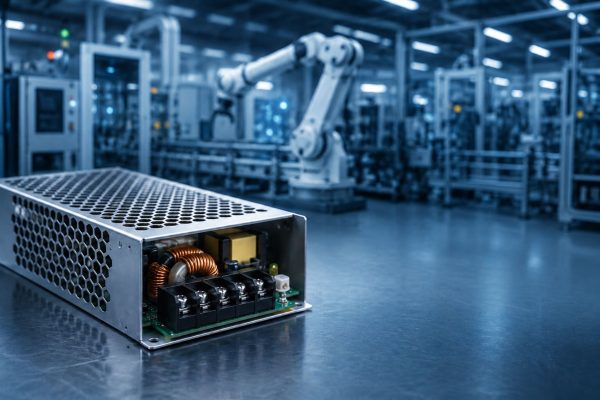
Key Highlights
- The industrial AC-DC power supply market is expected to witness strong growth between 2026 and 2030, driven by various market segments i.e. factory automation, robotics, semiconductor manufacturing, electrification, other smart manufacturing initiatives as well as railways.
- Overall, the industrial AC-DC and DC-DC power supply market is expected to grow at a CAGR of more than 5% in the next five years, with a varying level of growth in each of above and other industrial market segments
- Industry 4.0 adoption is accelerating demand for intelligent, high-efficiency, and digitally monitored power supply systems. And that is across regions, especially Asia (China and India).
- GaN and SiC semiconductor technologies are reshaping industrial power conversion through higher efficiency, compact form factors, and improved thermal performance.
- High power density, energy efficiency, and reliability are becoming the primary competitive differentiators among power supply vendors. Test and measurement segment is also growing steadily.
- Renewable energy integration, EV infrastructure, industrial robotics, and AI-enabled factories are generating new opportunities for advanced AC-DC power architectures.
- Asia-Pacific is expected to remain the largest regional market due to rapid expansion of industrialization and manufacturing sector.
The industrial AC-DC power supply market is entering a transformative growth phase driven by accelerating factory automation, industrial digitalization, electrification initiatives, and rising demand for highly efficient power architectures. Between 2026 and 2030, the sector is expected to witness substantial technological evolution, innovation, as manufacturers across industrial automation, transportation, telecom infrastructure, medical systems, renewable energy, and data-centric industries prioritize reliability, power density, efficiency, and intelligent energy management.
From competitive landscape, the industrial power supply market is also expected to see market consolidations with share of large players (power supply companies) continuing to grow, as well as entry of some small niche players, especially to cater to the robotics segment. Top 5 players hold more than 40% revenue share.
Industrial systems are no longer operating in isolated environments. Modern manufacturing ecosystems are increasingly interconnected through Industrial IoT, AI-driven monitoring, robotics, and edge computing. As a result, AC-DC power supplies are evolving from conventional energy conversion units into mission-critical infrastructure components supporting operational continuity, energy optimization, and system-level intelligence.
Rising Demand for High-Efficiency Industrial Power Architectures
One of the most influential trends shaping the industrial AC-DC power supply market is the growing emphasis on energy efficiency and sustainability. Governments and industrial operators worldwide are implementing stricter efficiency regulations and carbon reduction strategies. Consequently, OEMs and industrial integrators are demanding advanced power supplies with improved conversion efficiency, lower standby power consumption, and enhanced thermal performance.
High-efficiency architectures incorporating active Power Factor Correction (PFC), digital power management, and advanced switching technologies are becoming standard requirements across industrial applications. Manufacturers are increasingly investing in compact, high-density power supplies capable of delivering higher output performance while reducing energy losses and thermal stress.
Wide-bandgap semiconductor technologies, particularly Gallium Nitride (GaN) and Silicon Carbide (SiC), are expected to play a pivotal role during the 2026–2032 period. These technologies enable higher switching frequencies, reduced component sizes, and superior efficiency levels, making them ideal for next-generation industrial systems requiring compact and lightweight power conversion solutions.
Even the railways which many consider as part of industrial applications is seen to be growing across regions, not just Asia.
Industrial Automation and Smart Manufacturing Accelerating Market Expansion
The rapid expansion of Industry 4.0 initiatives is significantly reshaping the industrial power supply ecosystem. Smart factories require reliable AC-DC power infrastructures capable of supporting interconnected automation systems, robotics, machine vision, programmable logic controllers, and industrial communication networks.
As manufacturing facilities continue modernizing operations, demand for highly reliable DIN rail power supplies, redundant power systems, and intelligent monitoring-enabled power architectures is increasing. Industrial operators are prioritizing predictive maintenance and remote diagnostics to minimize downtime and improve operational efficiency.
This trend is creating strong opportunities for digitally controlled power supplies integrated with telemetry, fault diagnostics, and cloud-enabled monitoring capabilities. Intelligent AC-DC systems capable of real-time voltage regulation, load analysis, and thermal management are expected to gain substantial market traction over the forecast period. The shift in trend from analogue to digital is seen to be growing relatively faster than see in the past.
Growth of Electrification Across Industrial Sectors
Electrification trends across transportation, heavy industry, renewable energy, and infrastructure development are further contributing to market growth. Industrial facilities are increasingly deploying electrified equipment and energy-efficient systems to align with sustainability goals and regulatory frameworks.
Applications such as EV charging infrastructure, battery energy storage systems, railway electronics, industrial robotics, and renewable power integration require highly stable and resilient AC-DC conversion systems. This is driving demand for high-power industrial AC-DC supplies with enhanced reliability, ruggedization, and wide input voltage capabilities.
Additionally, the expansion of renewable energy infrastructure is creating demand for advanced industrial power conversion solutions capable of supporting distributed energy systems and hybrid power environments. Industrial operators require power supplies that can operate efficiently in fluctuating grid conditions while ensuring uninterrupted performance in mission-critical applications.
Miniaturization and High-Power Density Becoming Key Design Priorities
Industrial OEMs are increasingly seeking compact systems with higher functionality and reduced footprint. Consequently, power supply manufacturers are under pressure to develop smaller yet more powerful AC-DC units capable of operating in space-constrained industrial environments. This is where wide-band gap semiconductors (SiG and GaN) are playing a key transformative role.
High power density designs are emerging as a major competitive differentiator. Advanced thermal management technologies, improved magnetic materials, and next-generation semiconductor devices are enabling manufacturers to deliver compact solutions without compromising efficiency or reliability.
This trend is especially relevant in sectors such as factory automation, telecom infrastructure, industrial computing, medical electronics, and transportation systems where equipment miniaturization is critical for deployment flexibility and operational scalability.
Regional Market Outlook
Asia-Pacific is expected to remain the dominant region in the industrial AC-DC power supply market between 2026 and 2030, fueled by strong manufacturing activity, industrial automation investments, and rapid infrastructure development across China, India, South Korea, Taiwan, and Southeast Asia.
North America and Europe are also projected to experience relatively better growth than in the past, driven by smart manufacturing initiatives, renewable energy investments, industrial electrification, and modernization of aging industrial infrastructure.
Meanwhile, emerging economies are increasingly adopting industrial automation technologies, creating new opportunities for power supply vendors targeting mid-scale manufacturing and industrial development projects.
The industrial power supply market is becoming increasingly competitive as manufacturers focus on technological innovation, supply chain resilience, and vertical specialization. Key market participants are investing heavily in:
- High-efficiency power conversion technologies
- Digital power management systems
- Modular and configurable architectures
- Thermal optimization solutions
- Wide-bandgap semiconductor integration
- Smart monitoring and predictive diagnostics
- Shift towards robotics is also creating more demand.
Strategic partnerships between semiconductor manufacturers, power supply vendors, and industrial automation companies are expected to intensify as the industry moves toward intelligent energy ecosystems.
At the same time, customers are placing greater importance on long product lifecycle support, global compliance certifications, and application-specific customization capabilities. Vendors capable of delivering highly reliable and scalable solutions tailored for industrial environments will likely gain competitive advantage during the forecast period.
Market Forecast: 2026–2032
The industrial AC-DC power supply market is expected to maintain robust growth momentum through 2030 with a CAGR of more than 5%, supported by:
- Expansion of Industry 4.0 deployments
- Rising industrial automation investments
- Electrification of industrial infrastructure
- Growth in renewable energy systems
- Increased adoption of AI-enabled industrial equipment
- Demand for compact and efficient power architectures
- Introduction of robotics (AGVs, AMRs, Humanoids, Robotic Arms)
Power density, digital intelligence, energy efficiency, and reliability will remain the primary technological priorities shaping product development strategies across the industry.
Furthermore, the convergence of industrial automation, energy management, and intelligent power electronics will continue redefining the role of AC-DC power supplies within modern industrial ecosystems.
WAWT: Delivering Strategic Intelligence for the Power Supply Industry
WAWT, a strategic technology analyst and consultancy firm specializing in the wireless power and power supply industry, provides deep market intelligence and research insights for companies operating across the global power electronics ecosystem.
Its comprehensive industry studies, including the “AC-DC and DC-DC Merchant Power Supply Market Report” and “External Power Adapters and Chargers Market Report,” deliver critical analysis on market size, growth forecasts, competitive benchmarking, technology trends, product segmentation, regional dynamics, and vendor market share. It covers more than 15 applications sectors such as industrial, medical, lighting, telecom/cellular infrastructure, servers, storage, networking (datacentres), lighting, military & civil aerospace, consumers, external power adapters and chargers, etc.
WAWT’s research supports manufacturers, OEMs, investors, semiconductor companies, component suppliers, and technology stakeholders seeking actionable intelligence to navigate the rapidly evolving power supply market landscape.
The reports provide:
- Detailed 5-year annual forecast market forecasts across power classes and application sectors, along with historic data.
- Regional and global market analysis
- Vendor market share assessment
- Technology trend evaluation
- Competitive landscape benchmarking
- Strategic insights into emerging growth opportunities
Businesses looking to strengthen market positioning and make informed strategic decisions can leverage WAWT’s expertise and research-driven insights to stay ahead in the increasingly competitive industrial power supply sector.
Professionals interested in participating in ongoing industry research or accessing pre-publication opportunities for upcoming market reports can connect directly with WAWT’s subject matter experts.
For the latest market intelligence, technology updates, and industry developments Visit WAWT, Follow WAWT LinkedIn, subscribe to the “Power Bulletin” newsletter and reach WAWT analysts at analyst@wawt.tech
Frequently Asked Questions (FAQs)
-
What is driving the growth of the industrial AC-DC power supply market?
The market is primarily driven by industrial automation, Industry 4.0 adoption, renewable energy deployment, electrification of industrial infrastructure, and increasing demand for energy-efficient power conversion systems.
-
Why are GaN and SiC technologies important in industrial power supplies?
Gallium Nitride (GaN) and Silicon Carbide (SiC) technologies enable higher switching frequencies, lower power losses, improved thermal performance, and compact power supply designs, making them critical for next-generation industrial systems.
-
Which industries are creating the highest demand for industrial AC-DC power supplies?
Major demand is coming from factory automation, industrial robotics, telecom infrastructure, renewable energy systems, transportation, medical electronics, EV charging infrastructure, and industrial IoT applications.
-
Why is power density becoming important in industrial power supplies?
Industrial equipment manufacturers increasingly require compact and lightweight systems without sacrificing performance. High power density enables more power output within smaller form factors, improving deployment flexibility and operational efficiency.
-
What role does digital power management play in industrial systems?
Digital power management enables intelligent monitoring, predictive maintenance, remote diagnostics, real-time voltage regulation, and operational optimization, helping industries reduce downtime and improve energy efficiency.
-
Which region is expected to dominate the industrial AC-DC power supply market between 2026 and 2032?
Asia-Pacific is expected to remain the leading regional market due to rapid industrialization, strong manufacturing activity, infrastructure investments, and increasing automation adoption across countries such as China, India, South Korea, and Southeast Asia.
-
How is Industry 4.0 influencing the power supply market?
Industry 4.0 is increasing demand for intelligent and highly reliable power systems capable of supporting robotics, connected machinery, AI-enabled manufacturing, machine vision systems, and industrial communication networks.
-
How can WAWT help companies in the power supply ecosystem?
WAWT provides strategic market intelligence, competitive analysis, market forecasts, vendor benchmarking, and technology trend insights through its comprehensive power supply market research reports and consulting expertise.