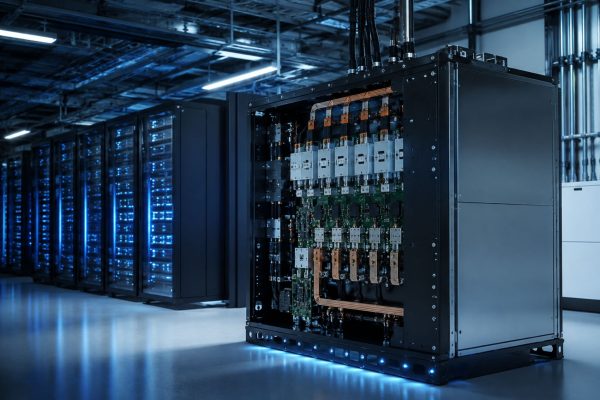
The solid-state transformer (SST) landscape is evolving rapidly in 2026. Once associated primarily with smart grids, distributed energy resources and advanced distribution networks, SST technology is now gaining attention as a potential building block for next-generation AI infrastructure. The focus is shifting toward delivering large amounts of power with fewer conversion stages, higher power density, greater efficiency and tighter control across the electrical architecture.
This shift is significant because AI data centers are putting pressure on almost every layer of the power chain. Rack power levels are increasing, accelerator loads are becoming more dynamic, and the industry is increasingly examining 800 VDC distribution as an alternative to conventional AC-based architectures. In this environment, the SST is gaining attention not simply as a smaller transformer, but as a digitally controlled medium-voltage power-conversion platform.
800 VDC Is Changing the SST Opportunity
One of the clearest technology signals in 2026 is the convergence between SST development and 800 VDC data-center architectures.
In August 2026, Siemens and Reinhausen announced development of a modular SST designed to connect grid voltages up to 36 kV directly to an 800 VDC output for AI-ready data centers. The proposed architecture is intended to reduce intermediate conversion stages between medium-voltage AC and the DC distribution system.
This is an important distinction. The value proposition is no longer simply transformer efficiency. An SST can combine medium-voltage conversion, high-frequency isolation, DC conversion, control and protection into a coordinated power-conversion platform.
That potentially changes the architecture of the entire electrical power path, with the SST providing the medium-voltage interface and direct conversion capability required for 800 VDC distribution and downstream rack-level power conversion.
NVIDIA, Google and Microsoft have also been working through the Open Compute Project ecosystem on 800 VDC architectures, with an LVDC Solid-State Transformer specification reaching version 0.3 in July 2026. NVIDIA says more than 80 equipment and infrastructure companies are already building products around the specification.
For SST suppliers, this creates a much clearer system-level application than the broad “smart grid transformer” opportunity often associated with the technology.
The Technology Is Moving Toward Megawatt-Class Validation
Another important development is the increasing emphasis on hardware validation at meaningful power levels.
In August 2026, North Carolina State University, the New York Power Authority and EPRI reported a 1 MW-class SST demonstration under real-world conditions. The system was demonstrated at EPRI’s laboratory and was described as a megawatt-class SST validated on a live utility distribution feeder.
This matters because SST commercialization is ultimately constrained less by the ability to demonstrate converter functionality and more by questions around reliability, protection, maintainability, thermal performance and lifetime.
The move toward megawatt-scale systems therefore provides a more meaningful engineering benchmark. It also highlights an emerging requirement for SST platforms: modularity and fault tolerance must scale alongside power.
More modules can provide redundancy and serviceability, but they also increase the number of semiconductor devices, gate-drive circuits, sensors, capacitors, magnetic components and control interactions. Recent technical literature continues to identify modularity, fault tolerance and control complexity as important deployment challenges.
SiC Is Becoming a System-Level Enabler
The SST opportunity is closely connected to the evolution of wide-bandgap power semiconductors, particularly silicon carbide (SiC).
Higher switching frequencies allow designers to reduce the size of magnetic components and increase power density. However, simply switching faster does not automatically produce a better SST. Higher dv/dt and di/dt create additional challenges in electromagnetic compatibility, insulation coordination, device packaging and thermal management.
A 2026 review in Nature Reviews Electrical Engineering highlights the difficulty of applying conventional semiconductor packaging approaches to SiC because higher switching speeds, higher temperature operation and increased heat-flux density create new packaging and electro-thermal challenges.
For SSTs, this becomes particularly important because the semiconductor, medium-frequency transformer, cooling system and control architecture cannot be optimized independently.
The medium-frequency transformer (MFT) remains one of the critical engineering elements. A June 2026 IEEE review of modular SST DC-DC converters identifies MFT technology as a key bottleneck and reports experimental validation of converter building blocks reaching 98.55% peak efficiency.
The next stage of SST development is therefore likely to depend as much on magnetics, insulation, packaging and thermal integration as on semiconductor switching performance.
Efficiency Is Only One Part of the Equation
For AI data centers, the more important metric may increasingly be the efficiency and complexity of the complete power-conversion chain, rather than the efficiency of an individual converter.
Removing conversion stages can reduce cumulative losses and potentially simplify the physical infrastructure. At the same time, the SST introduces active semiconductor hardware into a part of the electrical system historically dominated by highly mature passive transformers.
That creates a fundamental trade-off.
Conventional transformers benefit from decades of manufacturing optimization, predictable failure behavior and extremely high efficiency. SSTs introduce controllability, bidirectional power-flow capability, power-quality functions and potentially higher power density—but also greater control complexity, semiconductor dependency and thermal-management requirements.
This is why the commercial question in 2026 is becoming less about whether SSTs can technically work and more about where their additional functionality justifies their additional system complexity.
What Comes Next?
The most interesting SST trend is therefore not simply greater adoption. It is application-driven specialization.
AI data centers provide a demanding environment where high power density, 800 VDC distribution, medium-voltage interfaces and reduced conversion stages can create a strong technical case. At the same time, SST development continues across EV charging, renewable integration, distribution automation and hybrid AC/DC networks.
Recent research also points toward multi-port architectures, advanced magnetic materials, fault-tolerant modular designs and digitally coordinated power conversion as important areas for further development.
The question for the industry is therefore shifting:
Can SSTs move beyond being an advanced power-electronics concept and become a commercially compelling infrastructure platform?
The answer will depend on more than semiconductor efficiency. Cost per kW, lifetime, protection, serviceability, insulation reliability, thermal design, magnetics, standardization and supply-chain maturity will ultimately determine where SSTs gain traction.
WAWT Perspective
WAWT has been monitoring these technology and market shifts as the power-supply ecosystem moves toward higher power density, wider adoption of wide-bandgap semiconductors and increasingly complex AC/DC and DC/DC architectures.
As part of this ongoing market intelligence work, WAWT published the AC-DC and DC-DC Merchant Power Supply Market Report – 2026, providing a broader view of the evolving merchant power-supply landscape and the technology transitions influencing demand.
WAWT is a specialized market intelligence provider focused exclusively on the global power supply ecosystem. Through structured research frameworks and continuous industry monitoring, WAWT delivers actionable insights across AC-DC, DC-DC, SMPS, and application-specific power supply segments.
Our Power Supply Market Intelligence platform offers end-to-end visibility into technology evolution, competitive dynamics, and demand shifts across major verticals including data centers, electric vehicles, telecommunications, industrial automation, medical systems, and transportation infrastructure.
WAWT’s research methodology combines primary industry engagement, vendor benchmarking, supply chain analysis, and technology trend tracking to provide a comprehensive view of market developments. Our reports help stakeholders understand where value is shifting, which technologies are gaining traction, and how regional dynamics are influencing growth opportunities.
Key coverage areas include:
- AC-DC and DC-DC merchant power supply market analysis
- External power adapters and charging ecosystem intelligence
- Vendor market share rankings and competitive positioning
- Technology roadmap tracking including wide-bandgap adoption
- Application-level demand forecasting and use-case analysis
- Regional supply chain and manufacturing trends