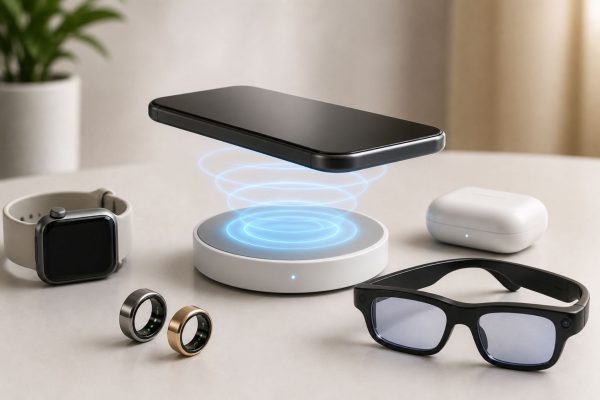
The evolution of NFC Wireless Power is entering a new phase one where charging ports may soon become obsolete. Among the emerging technologies driving this transformation, NFC (Near Field Communication) wireless power stands out as a compact, cost-effective, and design-friendly solution. Traditionally known for enabling contactless payments and data transfer, NFC is now being leveraged to deliver low-power wireless energy, unlocking new possibilities across small battery-powered devices across consumer electronics, healthcare, retail, and public infrastructure sectors.
As devices become smaller, smarter, and more integrated into everyday environments, the shift toward wireless design is no longer a concept feature, it’s a strategic direction. NFC wireless charging is at the forefront of this change.
More than 350 million small battery-powered devices integrated with NFC wireless charging technology are expected to be shipped in the next five years.
NFC wireless charging
NFC wireless charging utilizes the same electromagnetic induction principles as other forms of wireless charging but operates at a much lower power level (typically up to 2W). Unlike ‘tightly coupled’ conventional technologies such as WPC’s Qi, NFC operates over short distances (a few centimeters), making it ideal for compact, low-powered devices.
The key advantage lies in its integration with other technologies in the device, including data and communication. NFC antennas can be embedded into existing components, allowing manufacturers to combine data transfer and power delivery into a single interface. This reduces hardware complexity and supports ultra-thin, sealed, and waterproof device designs.
Market Trends Driving NFC Wireless Power Adoption
The NFC wireless charging market is gaining traction, driven by rapid innovation in miniaturized electronics and IoT ecosystems. Several key trends are shaping its growth:
- Rise of wireless devices: Leading consumer electronics brands are moving toward eliminating physical connectors (like USB and pogo pins) to improve durability and aesthetics.
- Growth in wearables and smart accessories: Devices like smart glasses, smart rings, sports and fitness trackers, and digital stylus pens require compact charging solutions.
- Expansion of IoT and smart environments: NFC charging enables seamless power delivery in smart homes, retail spaces, and public infrastructure.
- Standardization efforts: Standard bodies like NFC Forum are actively developing and advancing standards for wireless charging, improving interoperability.
- Sustainability focus: Reduced reliance on cables and connectors aligns with global sustainability goals and e-waste reduction.
As per WAWT’s recent comprehensive research on wireless power, compared to low-frequency wireless power technologies, this (NFC wireless charging technology), high-frequency (13.56 Mhz) technology is expected grow faster at a five-year CAGR of more than 40%,
Benefits of NFC Wireless Charging
NFC wireless power offers a set of differentiated benefits that align with next-generation product design:
1. True wireless design: Eliminating charging ports reduces mechanical failure points and enables fully sealed devices. This improves durability and enhances resistance to water, dust, and environmental factors.
2. Ultra-compact integration: NFC eliminates the need for large coils and connectors, making it ideal for space-constrained devices such as smart rings, styluses, and compact sensors.
3. System-level efficiency: For low-power applications, NFC offers a more efficient alternative to higher-power wireless systems that are over-engineered for such use cases.
4. Reduced system complexity: By combining communication and charging into a single interface, NFC reduces component count, simplifies design, and lowers cost.
5. Improved user experience: Charging becomes intuitive and frictionless users can power devices simply by placing them near a smartphone or NFC-enabled surface.
Challenges of NFC Wireless Charging
Despite its advantages, NFC wireless power faces several limitations:
1. Limited power output: With power delivery typically capped at around 2W, NFC is not suitable for high-power devices like smartphones or laptops. With further innovation we can push upto 3W using NFC WLC but currently not much.
2. Short Charging Distance: Devices must be placed very close to the NFC source, limiting flexibility compared to other wireless technologies.
3. Slower Charging Speeds: Charging times are longer compared to wired or high-power wireless solutions.
4. Ecosystem Maturity: The NFC charging ecosystem is still developing, with limited device compatibility and infrastructure.
5. Thermal and Efficiency Constraints: Energy transfer efficiency can be lower, especially in misaligned configurations.
Solutions include hybrid charging systems, improved antenna design, and advancements in power management ICs.
Industry-specific use cases
Consumer Electronics & Wearables: NFC wireless charging is particularly impactful in compact consumer devices:
- Smart rings: With extremely limited space, NFC enables fully sealed, port-less designs.
- Smart glasses: Lightweight and ergonomic designs benefit from eliminating charging ports.
- Wireless earbuds (TWS) & sports and fitness trackers: Devices can be charged directly from smartphones or accessories, enhancing convenience.
This creates a device-to-device charging ecosystem, reducing dependency on cables and external chargers.
- Computer Peripherals
- Wireless keyboards and mice
- Digital stylus pens for tablets and laptops
NFC enables wireless, cable-free charging directly from host devices, improving productivity and reducing clutter.
- Healthcare and Public Services
The healthcare sector demands high reliability, hygiene, and minimal maintenance, making NFC an ideal solution:
- Smart glasses in medical environments: Used for real-time diagnostics and assisted surgeries, requiring sealed, sterilizable designs.
- Wearable monitoring devices: Continuous health tracking devices benefit from maintenance-free charging.
- Smart rings: Used for tracking vital parameters such as heart rate, sleep, and activity levels.
Wireless designs eliminate contamination risks and improve device longevity in critical environments.
- Public Services & Smart Infrastructure
- Smart ID wearables and access control devices
- Public infrastructure monitoring systems
NFC wireless charging enables long-term deployment of low-power devices without frequent battery replacement, reducing operational costs.
Future Trends and Innovations
The future of NFC wireless power is closely tied to advancements in IoT, AI, and smart infrastructure:
- Integration with smart surfaces: Tables, desks, and walls embedded with NFC charging zones
- Hybrid charging systems: Combining NFC with Qi or RF for multi-power-level support
- Battery-free devices: NFC-powered sensors and tags eliminating the need for batteries
- AI-optimized power management: Intelligent systems that optimize charging efficiency based on usage patterns
- Expansion into automotive and industrial applications
As the ecosystem matures, NFC wireless charging will play a critical role in enabling frictionless, always-on device experiences.
About WAWT
Wired & Wireless Technologies (WAWT) is a strategic technology analyst and consulting firm specializing in wireless power and power supply markets. Through WAWT’s Wireless Power Intelligence Service, we deliver comprehensive research, trends, analysis, insights, and 10 years annual market estimates and forecasts covering all forms of wireless charging technologies, including inductive, resonance, NFC, RF, infrared and others, and their adoption across applications.
WAWT tracks wireless power adoption across 30+ applications, from consumer electronics and wearables to automotive, industrial automation, robotics, healthcare, retail, smart home and public infrastructure.
Request our brochure and sample reports to explore the full scope of our research solutions.
Contact our analyst team at analyst@wawt.tech to schedule a FREE 30-minute discovery call.
Subscribe to our monthly newsletter “Power Bulletin” and follow WAWT on LinkedIn for the latest insights, trends, and forecasts.