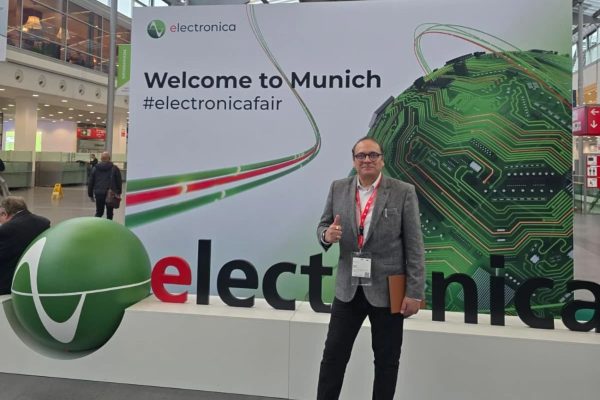
Electronica 2026: The Global Electronics Industry Comes Together
Electronica 2026 took place from 10–13 November 2026 at Messe München, Germany, bringing together the global electronics industry for four days of technology demonstrations, product launches, technical discussions and business meetings.
The 2026 edition established new attendance records, with 3,512 exhibitors and more than 86,000 visitors. Approximately 74% of exhibitors came from outside Germany, while international visitors accounted for 54% of attendance. The exhibition occupied 18 halls and covered the complete electronics value chain, including semiconductors, embedded systems, passive components, power supplies, automotive electronics, wireless technologies, sensors and electronic manufacturing.
Artificial intelligence was one of the dominant themes, but its influence extended well beyond processors and computing platforms. AI workloads are increasing the requirements for power conversion, thermal management, high-efficiency semiconductors, energy infrastructure and high-density electronic systems.
The event also ran alongside SEMICON Europa, adding further semiconductor manufacturing and supply-chain perspectives to the wider technology discussions.
Official event references: Electronica 2026 – Official website | 2026 event results and statistics.
These developments make Electronica 2026 particularly relevant to WAWT’s coverage of wireless power and power supply markets. The exhibition provided an opportunity to assess how component-level innovations are translating into new system architectures and application opportunities.
2. Key Technology Highlights from Electronica 2026
The most significant development at Electronica 2026 was the convergence of power electronics, semiconductor innovation, wireless connectivity and intelligent energy management.
Several technology directions stood out:
- AI-driven power infrastructure: Higher power requirements for AI computing are accelerating development of high-voltage DC distribution, high-density AC-DC conversion and advanced DC-DC architectures.
- GaN and SiC adoption: Wide-bandgap semiconductors are becoming increasingly important for high-frequency switching, reduced conversion losses, compact power stages and high-temperature operation.
- Power density and thermal management: Power supply manufacturers are addressing increasing output requirements within constrained mechanical footprints, with liquid cooling and improved thermal designs gaining importance.
- Wireless power integration: Wireless energy transfer is extending into industrial equipment, connected sensors, smart appliances and applications where conventional connectors create mechanical or maintenance challenges.
- Intelligent power management: Digital monitoring, programmable power supplies, communication interfaces and system-level control are becoming important differentiators.
- Electrification across industries: Automotive, industrial automation, robotics, medical equipment and energy storage are driving demand for application-specific power conversion.
These developments indicate that competition in the power industry is increasingly moving from individual component specifications towards complete power architectures, system integration, efficiency and lifecycle performance.
3. Wireless Power Technology: Developments and Industry News
Wireless power was an important part of the broader technology conversation at Electronica 2026. Although the exhibition was not exclusively focused on wireless charging, developments across RF power, inductive charging and cordless energy transfer highlighted several potential commercial opportunities.
3.1 Powercast: RF Wireless Power for Battery-Free IoT and Connected Sensors
Powercast presented its wireless power capabilities at Hall C6, Booth 621, with a focus on its EDGE platform.
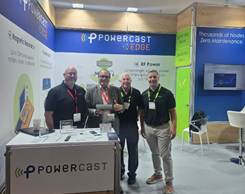
The company’s platform is designed to deliver persistent RF wireless power to electronic devices, supporting battery-free sensing, continuous data collection and connected IoT systems.
This approach is particularly relevant for applications where replacing or recharging batteries creates operational difficulties. Examples include industrial sensors, asset tracking, smart retail, environmental monitoring and distributed monitoring networks.
From a technical perspective, RF wireless power addresses a different requirement from conventional inductive charging. Rather than requiring close coupling between a transmitter and receiver, RF systems can deliver energy over a distance, subject to transmitter power, frequency, antenna configuration, regulatory restrictions and the receiver’s available energy budget.
The commercial opportunity lies in reducing battery maintenance and enabling sensor deployments in locations where wired power is impractical.
As our perspective RF power should be evaluated against the actual energy consumption of the target application. Low-power sensing and intermittent data transmission are more immediately suitable than applications requiring continuous high-power operation.
Source: Powercast – Electronica 2026 exhibition and EDGE platform.
3.2 Delta Electronics: Ki Wireless Power for Cordless Appliances
Delta Electronics demonstrated an interesting application of wireless power through its Ki cordless kitchen technology.

The demonstration was based on the Wireless Power Consortium’s Ki standard, which enables compatible kitchen appliances to receive power wirelessly from a cooking surface.
Unlike traditional mobile-device wireless charging, this application involves transferring significantly more power to appliances. It therefore requires attention to power electronics, electromagnetic compatibility, thermal management, safety and interoperability.
Delta’s demonstration included a cordless cooktop concept in which Ki-enabled appliances can operate without conventional power cables or onboard batteries.
The technology is commercially interesting because it extends wireless power into the home appliance market, creating opportunities for cordless cooking equipment and integrated kitchen platforms.
It also demonstrates that inductive wireless power is not limited to smartphones, wearables and small consumer electronics.
The development of higher-power wireless energy transfer standards could create new opportunities for transmitter and receiver electronics, power conversion modules, coils, control systems and appliance manufacturers.
Source: Delta Electronics – Electronica 2026 technology showcase.
3.3 Delta Electronics: Wireless Charging for AGVs and AMRs
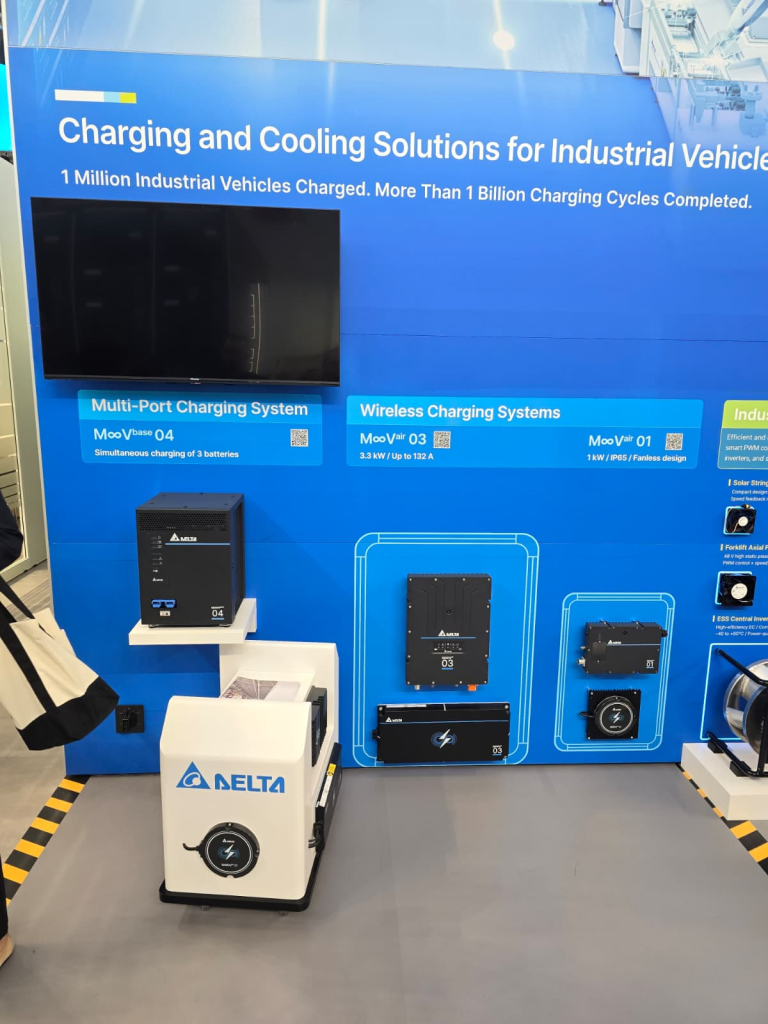
Delta’s MOOVair wireless charging technology uses inductive power transfer to recharge AGVs, AMRs and industrial vehicles without physical electrical connectors.
The system uses a transmitter pad installed at a charging station and a receiver mounted on the vehicle. It supports automated and opportunity charging, allowing vehicles to recharge during operational breaks without interrupting workflow for battery replacement.
Delta’s portfolio includes 1kW and 3.3kW charging solutions, targeting different industrial vehicle requirements.
WAWT perspective: Wireless charging can improve vehicle availability, reduce connector maintenance and support continuous operation in automated warehouses and manufacturing facilities.
Source: Delta Electronics – Industrial Wireless Charging
3.4 Wireless Power: The Wider Technology Direction`
The wireless power opportunity extends beyond individual company demonstrations.
Three areas deserve particular attention:
- Industrial wireless charging: Automated guided vehicles (AGVs), autonomous mobile robots (AMRs) and industrial equipment can benefit from automated charging without exposed electrical contacts.
- RF wireless power: Battery-free or battery-assisted sensors can reduce maintenance requirements in distributed IoT networks.
- Higher-power inductive applications: Standards such as Qi and Ki illustrate how wireless power can move into increasingly diverse device categories.
The key market consideration is no longer simply whether wireless power works. It is whether the technology can meet the required power level, efficiency, operating distance, reliability and total system cost for a particular application.
3.5 Würth Elektronik: Inductive Wireless Power for Industrial Applications
Wireless power transfer is gaining relevance in industrial environments where conventional electrical connectors can introduce mechanical wear, maintenance requirements and reliability concerns. Würth Elektronik’s wireless power portfolio is relevant to this development, particularly through its WE-WPCC transmitter and receiver coils and its published engineering work on higher-power inductive energy transfer.
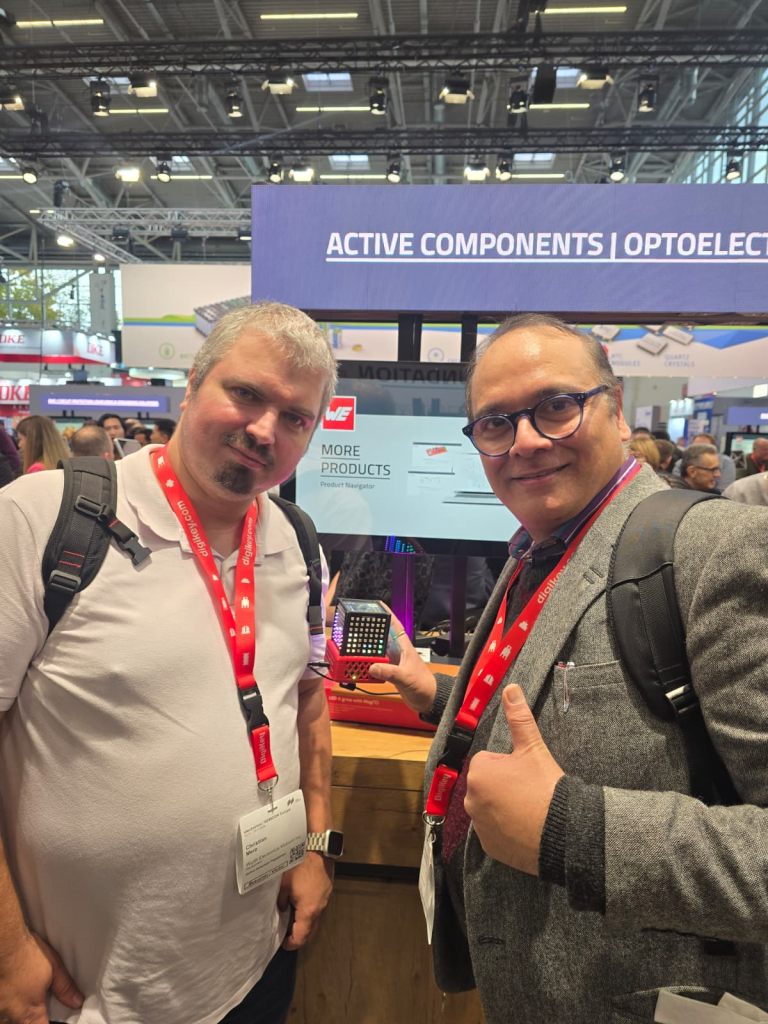
The company’s WE-WPCC product family includes receiver coils designed for inductive wireless charging. These components are available in different dimensions and electrical configurations, with options supporting Qi-based applications. Their potential use extends from portable electronics to equipment operating in environments where repeated connector engagement is undesirable. Würth Elektronik Product Catalog
A particularly relevant technical reference is Würth Elektronik’s application note, High Power Wireless Power Transfer for the Industrial Environment. It describes a zero-voltage-switching (ZVS) differential-mode resonant converter architecture for transferring power across an air gap.
The approach uses a resonant circuit in which the MOSFETs switch close to the zero-voltage crossover point. This reduces switching-related losses and supports operation without requiring a software-controlled switching architecture. According to the application note, the converter concept is scalable across a power range of approximately 1W to 200W, depending on the implementation. Würth Elektronik
The industrial relevance is significant. In applications such as automated machinery, rotating equipment, sealed devices and equipment exposed to demanding operating conditions, conventional contacts and slip rings can become maintenance-sensitive components. Inductive power transfer offers an alternative by transferring energy without a direct electrical connection.
This can be particularly useful in environments where equipment is exposed to dust, moisture, cleaning agents or frequent mechanical movement. It may also support the development of sealed product designs in which eliminating external electrical contacts improves the overall system architecture.
The opportunity for industrial wireless power is not simply a matter of replacing cables with coils. Commercial adoption will depend on the power level required, coil alignment, transfer efficiency, thermal performance, electromagnetic compatibility and the operating distance between transmitter and receiver.
For equipment manufacturers, the key design question is whether wireless power can deliver sufficient energy within the available mechanical space and operating conditions. Würth Elektronik’s coil portfolio and resonant-converter engineering provide relevant building blocks for evaluating these requirements.
Source: Würth Elektronik – Electronica 2026
4. Power Supply Industry: Technology Developments and Company Showcases
Power supplies and power conversion technologies were among the most relevant areas for WAWT at Electronica 2026. Increasing electrification, AI infrastructure and industrial automation are creating new requirements for power density, conversion efficiency, thermal performance and intelligent control.
The following company developments provide an insight into the technologies being presented.
4.1 Powerbox: Custom AC-DC and DC-DC Power Solutions
Powerbox showcased its engineering capabilities under the positioning Engineering Reliable Power.
Its exhibition focused on standard, adapted and customised AC-DC and DC-DC power solutions for industrial, medical, transportation and defence applications.
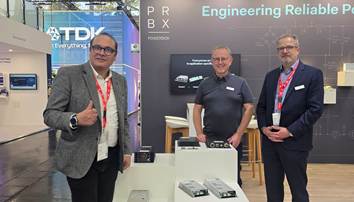
One particularly relevant direction was connected power management. Powerbox highlighted developments intended to improve monitoring, control and visibility of power systems.
This is significant because power supplies are increasingly expected to provide system-level information rather than operate simply as standalone conversion devices.
Digital monitoring, diagnostics and communication can help equipment manufacturers identify abnormal operating conditions, improve maintenance planning and manage power availability.
Powerbox also announced its POWERBOX Digital Interface (PDI) shortly before the exhibition, supporting digital monitoring, diagnostics, fault management and remote control through CAN or I²C on compatible power supplies.
Digital power management is becoming an important differentiation area, particularly in applications where uptime, predictive maintenance and system reliability are critical.
Sources: Powerbox at Electronica 2026 | POWERBOX Digital Interface.
4.2 EPC: GaN Power Conversion for AI Data Centres and Robotics
Efficient Power Conversion (EPC) presented one of the most technically relevant power semiconductor developments for next-generation AI infrastructure.
Its showcase included enhancement-mode GaN FETs, integrated power stages and reference designs for AI, physical AI, robotics, autonomous machines and space electronics.
A major highlight was its focus on 800 VDC power distribution and high-efficiency conversion closer to AI processors.
Among the demonstrated solutions were:
- EPC91123, a 6 kW, 800 V-to-12.5 V ISOP LLC converter.
- A new 6 kW, 800 V-to-6 V converter targeting next-generation AI processor power delivery.
- Gen8 GaN power-stage technology for high-frequency, low-voltage conversion.
- Three-phase integrated GaN motor-drive solutions for robotics and autonomous machines.
The technical significance is the use of GaN to improve switching performance and power density across multiple conversion stages.
At AI rack level, moving towards higher-voltage DC distribution can reduce current for a given power level, potentially lowering conductor losses and distribution requirements. However, the architecture also introduces demanding insulation, protection, isolation and conversion requirements.
EPC’s demonstrations illustrate how GaN could become increasingly important in high-density power conversion, especially between high-voltage distribution buses and low-voltage processor rails.
Source: EPC – Next-generation GaN solutions at Electronica 2026.
4.3 Cincon: Compact High-Power AC-DC Conversion
Cincon Electronics was featured in the Electronica 2026 exhibitor directory with its LFM Series.
The LFM family is particularly relevant to applications requiring compact AC-DC power conversion without compromising electrical performance.
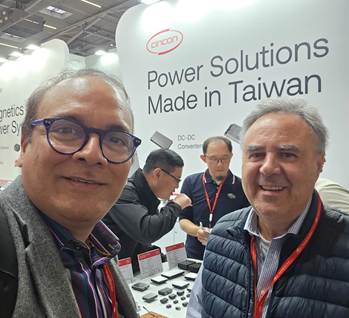
The series includes 200 W, 300 W, 420 W and 550 W configurations, with a low-profile 1-inch height and efficiency specifications reaching approximately 94–94.5%, depending on the model.
The portfolio supports a range of output voltages, including 12 V, 24 V, 48 V and other configurations.
For power supply designers, the engineering challenge is balancing thermal performance, component selection, insulation, electromagnetic compatibility and mechanical constraints within a compact enclosure.
Compact AC-DC platforms in the 200–550 W range are relevant to industrial equipment, embedded systems and distributed power architectures where installation space and thermal performance influence product selection.
The LFM series was identified in the official event directory; we have not independently verified a separate new LFM product launch at the exhibition.
Sources: Electronica 2026 exhibitor directory – Cincon | Cincon LFM Series technical information.
4.4 Würth Elektronik: High-Current Interconnections, Inductors and EMC
Würth Elektronik presented developments across its components, PCB and intelligent power systems businesses.

Several technologies were particularly relevant to power electronics.
The expanded WE-MXGI inductor series addresses higher power-density requirements while maintaining low DC resistance. This is important for modern switching converters, where inductor losses and thermal performance directly affect conversion efficiency.
The company also highlighted nanocrystalline cable cores for broadband EMC filtering, alongside new high-speed optocouplers supporting data rates of up to 10 MBd.
Another important development was the PowerBusbar PF vertical press-fit busbar, designed to improve current distribution on PCBs.
Its LF PowerBasket power elements support pluggable high-current connections up to 150 A.
These developments are relevant as PCB-level power distribution becomes increasingly challenging with higher currents, tighter layouts and greater integration.
Power density is not determined by the converter topology alone. Inductor performance, PCB current paths, busbar design, thermal management and EMC engineering all influence the achievable system-level performance.
Source: Würth Elektronik – Strong Solutions for Modern Electronics at Electronica 2026.
4.5 Infineon: 300 mm SiC Manufacturing and Physical AI
Infineon Technologies attracted attention with a major semiconductor manufacturing development.
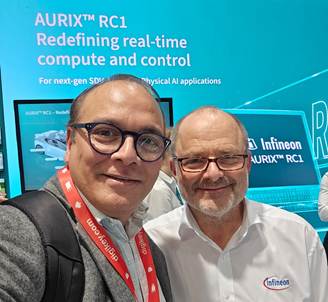
The company presented functional power semiconductor devices processed on 300 mm silicon carbide wafers, a significant development for the SiC manufacturing ecosystem.
Compared with conventional 200 mm wafers, a 300 mm wafer provides approximately 2.3 times the wafer area, potentially enabling more chips per wafer and improving manufacturing economics as the process matures.
Infineon also highlighted its progress in 300 mm GaN manufacturing and its broader portfolio of silicon, SiC and GaN technologies.
Its wider Electronica showcase covered physical AI, robotics, mobility and AI infrastructure. Demonstrations included robotics applications, smart actuators using GaN-based motor control and sensing technologies.
The significance for the power industry is substantial. SiC is relevant to high-voltage and high-power conversion, including EV charging, renewable energy, industrial drives and data-centre infrastructure. GaN offers advantages in high-frequency and compact power conversion.
Scaling 300 mm SiC production could influence future device availability, manufacturing costs and the competitive positioning of power semiconductor suppliers.
Sources: Infineon – 300 mm SiC wafer announcement | Infineon at Electronica 2026.
4.6 MEAN WELL: Industrial Automation, Energy Storage and Bidirectional Power
MEAN WELL presented a broad portfolio of power solutions covering industrial automation, green energy, energy storage, embedded systems, medical equipment and building automation.
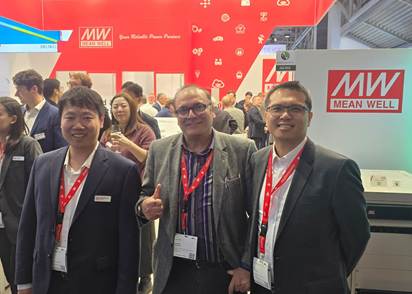
Three developments were particularly noteworthy:
- BIC-5K bidirectional power supply: A 5 kW platform designed for energy storage and battery testing applications.
- FMB and QHB intelligent battery packs: Lithium battery solutions using LFP and NMC chemistries, with CAN-based communication for system integration.
- NTN-5K off-grid inverter: A 5 kW solution combining inverter and charging functionality for portable energy storage applications.
The bidirectional power supply is particularly relevant because energy storage systems increasingly require controlled power flow in both directions. This capability is useful for battery charging, discharging, testing and energy management.
The integration of communication interfaces into battery packs also supports more sophisticated monitoring and coordination between batteries, chargers and external equipment.
The growing integration of power supplies, battery systems and energy management electronics creates opportunities for manufacturers offering complete power platforms rather than individual conversion products.
Source: MEAN WELL – Powering Industrial Automation and Smart Energy at Electronica 2026.
4.7 TRACO POWER: AC-DC and DC-DC Solutions for Demanding Applications
TRACO POWER presented additions to its power supply portfolio
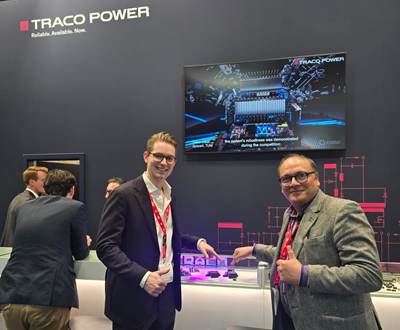
The company focused on AC-DC power supplies and DC-DC converters for industrial, medical, railway and other demanding applications.
An important aspect of its offering is application-specific power supply development. Different end markets impose different requirements concerning input voltage, output power, electromagnetic compatibility, temperature range, mechanical dimensions and safety approvals.
For example, railway applications require attention to demanding input voltage variations, vibration and environmental conditions. Medical applications require compliance with relevant safety and isolation standards.
Rather than focusing exclusively on maximum output power, the direction highlights the importance of application-specific reliability and qualification.
Industrial, medical and railway power supplies remain important specialist markets where certification, reliability, thermal performance and long product lifecycles can provide competitive differentiation.
The company’s exhibition information confirms the presentation of new portfolio additions, although individual new model numbers could not be independently verified.
Source: TRACO POWER – Electronica 2026 exhibition announcement.
4.8 Vox Power: High-Density and Modular Power Supply Architectures
Vox Power highlighted the launch of its latest product
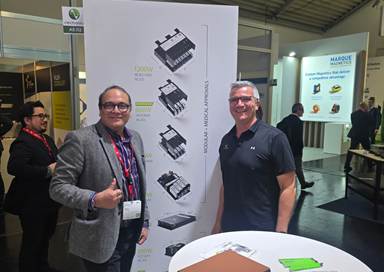
Its exhibition focused on high-density AC-DC and DC-DC power solutions, including modular power supply architectures for healthcare, industrial and technology applications.
Modular power supplies are particularly relevant where equipment manufacturers need to configure multiple output voltages, optimise power distribution and accommodate changing system requirements.
The advantages include:
- Flexible output configuration.
- Higher integration within constrained mechanical spaces.
- Conduction-cooled and convection-cooled options.
- Reduced need for entirely customised power architectures.
In medical and industrial systems, modularity can also simplify equipment development by allowing designers to select power configurations according to application requirements.
The market opportunity for modular power supplies is closely linked to increasing equipment complexity, customisation requirements and the need to reduce product development time.
Source: Vox Power – Electronica 2026 exhibitor information.
4.9 Delta Electronics: AI Data Centre Power and Advanced Liquid Cooling
Delta Electronics presented one of the broader power and thermal management portfolios at Electronica 2026.
Its showcase covered AI data centres, industrial and medical equipment, electric mobility and home appliances.
The AI infrastructure demonstration was particularly relevant to the power supply market.
Key developments included:
- A 4U in-rack liquid-to-liquid Coolant Distribution Unit (CDU) offering up to 140 kW of cooling capacity.
- High-density power architectures supporting 800 VDC and ±400 VDC distribution.
- AC-DC and DC-DC power shelves for AI computing.
- CRPS power solutions rated up to 5,500 W.
- High-efficiency power and thermal management technologies.
The 140 kW CDU is an important example of how thermal management is becoming closely integrated with rack-level power architecture.
As GPU and accelerator power consumption increases, conventional air-cooling approaches face increasing challenges in removing heat from high-density computing systems.
Liquid cooling can improve heat removal, but requires coordinated engineering across pumps, heat exchangers, coolant distribution, sensors, controls and electrical power infrastructure.
Delta also demonstrated industrial power supplies, medical-grade solutions and e-mobility technologies, including a 10 kW motor controller and 1.5 kW onboard charger for electric scooters.
Delta’s showcase demonstrates that the AI infrastructure opportunity extends beyond power supplies. It encompasses power conversion, distribution, thermal management and system integration.
Sources: Delta Electronics – Electronica 2026 | Delta AI data-centre and cooling developments.
5. 800VDC Power Distribution: Developing the Next Generation of AI Data Centre Power Infrastructure
The rapid increase in AI computing capacity is placing pressure on conventional data-centre power distribution architectures. High-performance GPU and accelerator systems are increasing rack-level power requirements, creating demand for architectures capable of delivering substantially more electrical power while controlling distribution losses, conversion stages and thermal constraints.
One technology direction attracting considerable industry attention is 800VDC power distribution.
At higher distribution voltages, the same power can be delivered at a lower current. For example, an ideal 1MW load supplied at 800V requires approximately 1,250A, compared with 2,500A at 400V. This reduction in current can help reduce conductor requirements and resistive distribution losses. Actual system performance will depend on conversion efficiency, cable design, protection devices and operating conditions.
However, moving to an 800VDC architecture is not simply a matter of increasing the bus voltage. It requires coordinated development across AC-DC conversion, isolated DC-DC stages, solid-state protection, high-voltage interconnections, monitoring and thermal management.
Several semiconductor and power technology companies are developing solutions for different stages of this architecture.
5.1 Infineon: GaN Conversion, SiC Power Infrastructure and 800VDC Protection
Infineon’s work on 800VDC power architectures addresses several important stages of the AI data-centre power chain. These include high-voltage DC-DC conversion, power supply infrastructure and protection technologies.
A key development is the company’s collaboration with NVIDIA on gallium nitride-based power conversion for 800VDC AI data centres. The work focuses on the high-voltage intermediate bus converter (IBC), which transfers power from the main DC distribution bus to a lower voltage suitable for subsequent conversion stages.
The IBC is a critical part of the architecture because it must support high power throughput while meeting demanding requirements for efficiency, power density, thermal performance and reliability. Infineon identifies GaN as an important technology for this conversion stage, where high-frequency switching and compact power-stage design are valuable. Infineon Technologies
Infineon’s wider 800VDC development activity also includes high-voltage intermediate bus converter reference designs and battery backup solutions. Its 24kW SiC-based battery backup unit, for example, is designed to connect directly to an 800V bus. The reported design specifications include power density of up to 450W/in³ and efficiency above 99%.
This type of architecture is relevant because AI data centres need more than continuous power conversion. They also require backup systems capable of responding rapidly to load changes and maintaining power availability during interruptions.
Another important development is the use of solid-state circuit breakers (SSCBs) for high-voltage DC protection. Unlike conventional mechanical circuit breakers, solid-state devices use semiconductor switches to interrupt fault currents electronically. This is particularly relevant to DC systems, where there is no natural current zero crossing to assist interruption.
Infineon’s developments illustrate how the 800VDC opportunity extends beyond the main power supply. Semiconductor suppliers can participate in intermediate bus conversion, battery backup, protection and system-level power management.
References:
- Infineon and NVIDIA – GaN-based Power Conversion for 800VDC AI Data Centres
- Infineon – 800VDC Power Architecture and Reference Designs
- Infineon – 24kW SiC Battery Backup Unit
- Infineon – Solid-State Circuit Breaker Collaboration
5.2 STMicroelectronics: Conversion from 800VDC to Intermediate and Low-Voltage Rails
STMicroelectronics is addressing the power conversion requirements associated with high-voltage distribution in AI infrastructure. Its technology direction covers the conversion stages required to move electrical power from the main DC bus towards the voltage levels used by server systems and processors.
One important area is the development of 800VDC-to-12V and 800VDC-to-6V conversion architectures. These stages are intended to support the increasingly demanding power delivery requirements of next-generation AI computing platforms.
The need for multiple conversion stages reflects the electrical requirements of modern processors. A high-voltage distribution bus is suitable for transferring large amounts of power across a data-centre infrastructure, but it cannot directly supply the very low operating voltages required by GPU and CPU cores.
Consequently, the power architecture must progressively reduce voltage while maintaining high efficiency and controlling current. This places significant demands on switching devices, magnetic components, isolation, packaging and thermal design.
At Electronica 2026, ST highlighted its wider power technology portfolio through demonstrations covering the AI data-centre power chain, including AC-DC front-end and DC-DC back-end power distribution. The company’s exhibition information also highlighted its work on power solutions for AI infrastructure. Power Electronics News
The transition towards 800VDC creates opportunities for semiconductor manufacturers across several conversion stages. ST’s developments demonstrate the importance of designing the complete power chain rather than concentrating only on the high-voltage input stage.
References:
- STMicroelectronics – Electronica 2026
- STMicroelectronics – 800VDC Power Solutions for AI Data Centres
5.3 Texas Instruments: Two-Stage Power Conversion for AI Processors
Texas Instruments has outlined a two-stage power architecture developed in collaboration with NVIDIA for future AI data centres.
The proposed approach uses an 800VDC input and converts it to a 6V intermediate bus through an isolated bus converter. A subsequent conversion stage then reduces the voltage from 6V to below 1V using multiphase buck conversion for processor power delivery.
This architecture addresses an important engineering challenge in AI computing: distributing power efficiently at high voltage while supplying extremely high current at the processor.
GPU and accelerator cores operate at low voltages, but their power consumption can be substantial. As a result, the final conversion stages must deliver high current with tightly controlled voltage regulation and fast transient response.
The use of a 6V intermediate bus creates a different design point for the downstream power-delivery network. It places greater importance on converter integration, current handling, PCB design, thermal performance and the placement of voltage-regulation components close to the processor.
The move towards lower intermediate bus voltages and high-current point-of-load conversion is likely to create additional opportunities for integrated power stages, multiphase controllers, power modules and advanced packaging.
Reference:
– Texas Instruments – 800VDC Power Architecture Developed with NVIDIA
5.4 EPC: 6kW GaN Converters for 800VDC AI Power Architectures
Efficient Power Conversion (EPC) presented a particularly relevant set of GaN-based solutions for high-voltage AI data-centre power conversion at Electronica 2026.
The company’s showcase included the EPC91123, a 6kW 800V-to-12.5V isolated series-output-parallel (ISOP) LLC converter, alongside a new 6kW 800V-to-6V converter designed to bring high-voltage power closer to next-generation AI processors.
These designs address the challenge of transferring substantial power from the main distribution bus to lower-voltage stages without introducing excessive conversion losses or increasing the physical footprint of the power system.
EPC also highlighted its Gen8 GaN power-stage technology, targeting high-frequency, low-voltage conversion. This is relevant to the final stages of processor power delivery, where conversion from an intermediate voltage to sub-1V processor rails requires very high switching performance and careful thermal management.
The company’s wider Electronica showcase also covered integrated GaN solutions for robotics, drones and autonomous machines, demonstrating the potential of GaN beyond data-centre infrastructure. Efficient Power Conversion Corporation
EPC’s demonstrations highlight the growing role of GaN across the complete AI power-delivery chain. The commercial opportunity is not restricted to high-voltage conversion; it also includes compact intermediate-bus converters and high-frequency point-of-load stages.
Reference:
– EPC – Electronica 2026 GaN Technology Showcase
5.5 Solid-State Transformers: A New Approach to Grid-to-Data-Centre Power Conversion
The increasing electrical demand of AI data centres is also drawing attention to the infrastructure between the utility grid and the facility’s internal power distribution system.
Solid-state transformers (SSTs) are one technology being explored for this purpose.
Unlike conventional transformers, which rely primarily on magnetic coupling to change voltage levels, an SST uses power semiconductor devices and high-frequency conversion stages. Depending on the architecture, it can integrate voltage conversion, DC links, power control and other functions within a more actively managed electrical system.
This creates potential opportunities for more flexible connections between medium-voltage AC infrastructure and high-voltage DC distribution inside data centres.
Infineon and Eaton have announced collaboration relating to solid-state transformer technology using SiC semiconductor capabilities. The development is relevant to the wider effort to build more efficient and controllable power infrastructure for high-demand applications. Power Electronics News
SST development also creates opportunities for suppliers of SiC power devices, high-frequency magnetics, capacitors, insulation systems, gate drivers and protection components.
SSTs could become an important part of future data-centre power infrastructure, but their commercial deployment will depend on system efficiency, reliability, cost, grid compatibility and the ability to scale to the power levels required by large facilities.
Reference:
– Infineon and Eaton – Solid-State Transformer Collaboration
5.6 Vishay: High-Voltage DC Conversion and Supporting Components
Vishay’s Electronica 2026 showcase demonstrated how passive components and semiconductor devices contribute to the development of high-density AI data-centre power systems.
One of the key reference designs was an 800V HVDC, 12kW full-brick converter with an output voltage equal to one-sixteenth of its input voltage. This represents a conversion from an 800V input to a nominal 50V output.
The company also highlighted a 1.6kW DC-DC converter using 650V GaN MOSFETs to convert a 400V data-centre bus to a regulated 50V intermediate bus.
Further demonstrations included a 3kW, 48V intermediate bus, a 32-phase GPU power-delivery design and a 40-phase core voltage regulator for data-centre CPU and GPU applications.
These examples illustrate the increasingly complex power-delivery requirements inside AI servers. High-voltage distribution must ultimately support low-voltage, high-current processor loads, making the performance of the entire conversion chain important.
Vishay also highlighted electric double-layer capacitor (EDLC) technology for rack-level backup applications. These components can provide short-duration energy support, helping stabilise the bus and support transient power requirements.
In addition, the company presented capacitors and power conversion resistors intended for solid-state transformer designs. Electronica 2026
Vishay’s showcase is significant because it demonstrates that the 800VDC opportunity extends beyond power semiconductor manufacturers. Capacitors, resistors, magnetics and energy-storage components are also essential to the performance and reliability of high-voltage power architectures.
Reference:
– Vishay – Electronica 2026 Technology Showcase
5.7 onsemi: Power Delivery from the Grid to the Processor
onsemi presented its power technology portfolio through the theme of power delivery from the grid to the processor core.
The company’s Electronica 2026 activities included a Power Wall and a virtual AI data-centre demonstration. These highlighted the different technologies involved in delivering electrical power across the infrastructure, from facility-level conversion to the power requirements of computing systems.
This system-level perspective is important because the AI data-centre power challenge cannot be solved by improving a single converter or semiconductor device. The architecture must coordinate power conversion, distribution, switching, protection and processor-level regulation.
Wide-bandgap technologies such as SiC and GaN are relevant to different stages of this chain. SiC is suited to demanding high-voltage and high-power conversion applications, while GaN can support high-frequency switching and compact conversion stages.
The grid-to-core approach reflects a broader shift in the power electronics market. Suppliers are increasingly required to demonstrate how their technologies contribute to complete power systems rather than presenting individual components in isolation.
Reference:
5.8 What the 800VDC Transition Means for the Power Supply Industry
The developments across Infineon, STMicroelectronics, Texas Instruments, EPC, Vishay and other suppliers indicate that 800VDC is becoming an important architectural direction for next-generation AI data centres.
However, the transition will involve several interconnected technology requirements.
1. High-voltage AC-DC conversion
Data centres will require efficient front-end power conversion to connect facility electrical infrastructure with internal DC distribution systems. Power density, isolation, power-factor performance and reliability will remain important design considerations.
2. High-voltage DC-DC conversion
Intermediate bus converters will need to handle high power levels while reducing voltage efficiently. This creates opportunities for GaN and SiC devices, advanced magnetic components and high-density converter designs.
3. Processor-level power delivery
The final stages of power conversion must supply increasingly demanding GPU and CPU loads. High-current multiphase conversion, integrated power stages and improved transient response will be important areas of development.
4. Protection and electrical safety
An 800VDC architecture requires appropriate isolation, monitoring, fault detection and interruption. Solid-state circuit breakers and advanced protection components could become important parts of future power distribution systems.
5. Thermal management
Higher power density increases the heat generated within converters, server racks and distribution equipment. Liquid cooling, improved thermal interfaces and efficient semiconductor packaging will therefore remain closely connected to power system development.
6. Semiconductor technology competition
GaN and SiC will play complementary roles rather than simply replacing one another. The choice of technology will depend on voltage rating, switching frequency, efficiency, thermal performance, packaging and overall system economics.
From a market perspective, the development of 800VDC infrastructure creates opportunities across the power supply value chain. These include AC-DC power supplies, isolated DC-DC converters, power shelves, semiconductor devices, magnetic components, capacitors, protection systems and thermal management solutions.
The speed of commercial adoption will depend on the ability of data-centre operators and equipment suppliers to establish reliable, scalable and cost-effective architectures.
6. Other Important Technology Developments at Electronica 2026
Apart from wireless power and power supplies, several wider developments deserve attention because they influence future component demand and power system design.
6.1 Physical AI and Robotics
Physical AI was a prominent theme, with robotics moving from controlled industrial applications towards more autonomous machines.
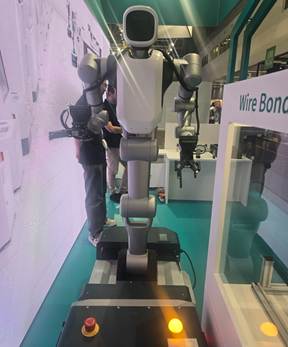
This transition increases demand for compact motor drives, high-efficiency DC-DC converters, battery management systems, sensors and power semiconductors.
GaN-based motor control, integrated power stages and improved sensing technologies are particularly relevant.
Robotics also creates new opportunities for wireless charging, particularly where autonomous systems need to operate continuously without manual battery replacement.
6.2 800 VDC and Higher-Voltage Power Distribution
The increasing power requirements of AI computing are encouraging the industry to reconsider conventional data-centre power distribution architectures.
Higher-voltage DC distribution can reduce current at a given power level, potentially lowering distribution losses and conductor requirements.
However, the transition also requires new approaches to isolation, fault protection, DC circuit interruption, conversion efficiency and power system monitoring.
EPC and Delta’s demonstrations illustrated different parts of this developing ecosystem.
6.3 Wide-Bandgap Semiconductor Manufacturing
The developments from Infineon and EPC highlight the increasing importance of GaN and SiC.
Although both materials are wide-bandgap semiconductors, their application strengths differ.
| Technology | Key application opportunities |
| GaN | High-frequency DC-DC conversion, compact power stages, robotics and fast switching |
| SiC | High-voltage conversion, EV charging, renewable energy and industrial power systems |
| Silicon | Cost-effective power conversion, established industrial applications and mainstream power management |
The competitive landscape will depend on more than semiconductor performance. Manufacturing scale, packaging, thermal resistance, reliability, gate-drive requirements and total system cost will influence adoption.
6.4 Thermal Management as a Power Design Priority
The increasing power density of electronic equipment is making thermal engineering a fundamental part of system design.
This is particularly evident in AI data centres, high-performance industrial equipment and power conversion platforms.
Liquid cooling, improved thermal interfaces, advanced magnetic components, high-current PCB connections and more efficient switching devices are becoming increasingly interconnected areas of innovation.
7. WAWT Key Takeaways from Electronica 2026
Based on the technology developments and company showcases covered at Electronica 2026, WAWT identifies the following strategic market implications.
i. AI infrastructure is creating a new power supply growth opportunity.
The movement towards higher rack power requirements is increasing demand for high-efficiency AC-DC conversion, advanced DC-DC stages, power shelves, high-voltage distribution and thermal management.
ii. GaN and SiC are moving towards broader system-level adoption.
The technology opportunity is shifting from individual semiconductor performance to complete converter architectures. Packaging, switching frequency, reliability and manufacturing capacity will influence market penetration.
iii. Wireless power is expanding into new application categories.
RF-powered sensors, industrial wireless charging and Ki-enabled appliances demonstrate the diversity of wireless energy transfer opportunities. Each application requires a different approach to power level, operating distance, efficiency and system integration.
iv. Digital power management is becoming increasingly important.
Monitoring, diagnostics, programmable outputs and communication interfaces are creating opportunities for more intelligent power supply platforms.
v. Power density is a system-level engineering challenge.
Magnetics, semiconductors, PCB interconnections, thermal management and EMC must be considered together to achieve higher power density without compromising reliability.
vi. Application-specific solutions remain commercially important.
Medical, railway, industrial, defence and mobility applications have different electrical and environmental requirements. Customisation, qualification and lifecycle support remain important competitive factors.
vii. The boundary between power and thermal management is becoming less distinct.
AI infrastructure demonstrates how power conversion and cooling must be developed together. This creates opportunities for suppliers across multiple parts of the infrastructure value chain.
From WAWT’s perspective, Electronica 2026 demonstrated that the power industry is entering a period where semiconductor innovation, system integration and application-specific engineering will increasingly determine market competitiveness.
8. About WAWT
Wired and Wireless Technology (WAWT) is a strategic technology analyst and consultancy firm specialising in the wireless power and power supply industries.
WAWT provides market intelligence, technology analysis, strategic consultancy and bespoke research covering wireless power technologies including inductive, resonant, NFC, RF and infrared power, as well as AC-DC and DC-DC power supplies, external adapters and chargers.
Through its Wireless Power Intelligence Service and Power Supply Intelligence Service, WAWT tracks technology developments, application markets, vendors, power classes, regional trends, market shares, emerging technologies and long-term market opportunities.
WAWT’s analysts regularly engage with companies, technology developers, industry associations and key events across the global power-electronics ecosystem to understand not only what technologies are being demonstrated today, but where they are likely to create commercial opportunities tomorrow.
Discuss Electronica 2026 with WAWT
To discuss the latest market trends, technology developments and insights from Electronica 2026, please contact our subject matter expert Dinesh Kithany Founder & Chief Analyst
Wired and Wireless Technology (WAWT)
Contact WAWT at analyst@wawt.tech to discuss the full Electronica 2026 event-based insight report and the latest wireless power and power-supply market intelligence.
Get deeper insights into the technologies, companies, market developments and competitive landscape discussed at Electronica 2026. Enquire with WAWT for detailed market intelligence and bespoke research.