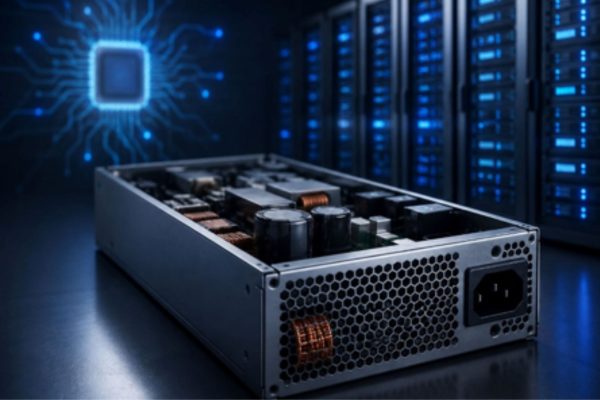
Artificial Intelligence has moved beyond being a software revolution it is now fundamentally reshaping power infrastructure. In 2026, AI datacenters are consuming significantly more electricity than traditional cloud facilities due to the rapid deployment of GPU clusters, AI accelerators, high-bandwidth memory, and advanced networking equipment. This unprecedented demand has made the power supply one of the most critical components inside modern AI infrastructure.
For power supply manufacturers, semiconductor vendors, and hyperscale operators, the conversation is no longer centered around increasing wattage alone. The focus has shifted toward delivering higher efficiency, greater power density, intelligent power management, and scalable architectures capable of supporting next-generation AI workloads. As a result, AC-DC power supply design is undergoing its biggest transformation in decades.
AI Workloads Are Driving Record Power Requirements
Unlike conventional enterprise servers that typically consumed a few hundred watts, today’s AI servers equipped with multiple GPUs can require 5kW to 20kW per rack, with next-generation AI clusters expected to push rack densities beyond 100kW with talks of development and moving towards 200kW. These systems operate continuously during AI model training and large-scale inference, placing enormous stress on power delivery infrastructure.
The traditional AC-DC power architecture, designed primarily for standard enterprise computing, is increasingly unable to meet these performance requirements. Every percentage point of efficiency now translates into substantial energy savings, reduced cooling costs, and improved operational sustainability.
This shift has elevated the power supply from a supporting component to a strategic technology enabler for AI infrastructure.
Efficiency Has Become the Primary Design Priority
Power conversion losses that were once considered acceptable are now financially significant at hyperscale. Datacenters operating thousands of AI servers can lose megawatts of power through inefficient conversion stages.
Consequently, modern AC-DC power supplies are increasingly targeting efficiency levels exceeding 97%, with many vendors optimizing designs to satisfy Titanium and future high-efficiency certification requirements.
Higher efficiency delivers multiple benefits:
- Lower electricity consumption
- Reduced thermal generation
- Smaller cooling infrastructure
- Lower operating expenses
- Improved sustainability metrics
- Higher server reliability
As AI deployment accelerates globally, efficiency is becoming a competitive differentiator rather than simply a regulatory requirement.
High Power Density Is Redefining Mechanical Design
Space inside AI servers has become extremely valuable. GPUs, advanced networking switches, liquid cooling systems, and memory modules occupy far more physical volume than previous-generation hardware. Power supplies must therefore deliver substantially higher output without increasing their physical footprint.
Manufacturers are responding through:
- Higher switching frequencies
- Advanced transformer designs
- Improved thermal materials
- Compact magnetic components
- Optimized airflow architectures
- Digital power control
The result is dramatically higher power density, enabling more computing capability within the same rack space.
Wide-Bandgap Semiconductors Are Also Becoming Mainstream
One of the biggest technological shifts influencing AC-DC power supply design is the adoption of wide-bandgap semiconductor technologies.
Gallium Nitride (GaN) and Silicon Carbide (SiC) solutions offer several advantages over traditional silicon MOSFETs:
- Higher switching frequency
- Lower switching losses
- Improved thermal performance
- Smaller passive components
- Increased efficiency
- Higher power density
For AI data centers operating around the clock, these benefits directly translate into lower operational costs and improved system reliability.
Wide-bandgap devices are expected to become standard components across high-performance AI power platforms throughout 2026 and beyond.
The Industry Is Moving Toward Higher Voltage Power Architectures
AI infrastructure is also accelerating the industry’s transition toward higher-voltage power distribution.
Traditional 12V architectures struggle to efficiently deliver the enormous current demanded by modern AI processors. Higher-voltage systems including 48V power architectures significantly reduce current while minimizing conduction losses across the power delivery network.
Benefits include:
- Lower copper losses
- Improved electrical efficiency
- Reduced cable size
- Better scalability
- Higher rack power capability
- Simplified power distribution
Many hyperscale operators are already investing heavily in next-generation rack-level power architectures to support future AI deployments.
Intelligent Digital Power Management Is Becoming Essential
Power supplies are rapidly evolving into intelligent digital systems. Modern AI data centers require continuous monitoring of voltage, current, temperature, efficiency, and system health to maximize uptime.
Digital AC-DC power supplies increasingly incorporate:
- Predictive diagnostics
- Remote monitoring
- Real-time telemetry
- Adaptive load balancing
- Fault prediction
- Firmware updates
- AI-assisted power optimization
These capabilities enable proactive maintenance while minimizing costly downtime in mission-critical AI environments.
Thermal Management Is Now a Core Power Supply Challenge
Power density and efficiency are closely tied to thermal performance. As rack power continues to rise, conventional air cooling alone is becoming insufficient for many AI deployments.
Power supply manufacturers are redesigning products to support:
- Liquid-cooled server environments
- Immersion cooling compatibility
- Enhanced airflow optimization
- Advanced thermal interface materials
- Higher operating temperatures
- Intelligent fan control
Thermal engineering has become just as important as electrical engineering in next-generation AC-DC power supply development.
Sustainability Is Influencing Product Development
Energy consumption has become a strategic issue for hyperscale operators, governments, and enterprise customers alike. AI datacenters now face increasing pressure to reduce carbon emissions while supporting exponential computing growth.
Power supply innovation contributes directly to sustainability through:
- Higher conversion efficiency
- Reduced standby losses
- Lower cooling requirements
- Longer product lifecycles
- Recyclable materials
- Improved energy utilization
These improvements help operators achieve environmental targets without compromising computing performance.
What This Means for the Power Supply Industry
The rapid expansion of AI infrastructure is creating significant opportunities across the global power supply ecosystem. Manufacturers capable of delivering high-efficiency, high-density, digitally managed AC-DC platforms will be best positioned to serve hyperscale cloud providers, AI infrastructure vendors, and enterprise data centers.
Innovation is no longer limited to increasing output power. Future competitiveness will depend on integrating advanced semiconductor technologies, intelligent control systems, higher-voltage architectures, and optimized thermal management into scalable power platforms.
As AI continues to reshape global computing, power supply design will remain one of the industry’s fastest-evolving technology segments.
About WAWT – Power Supply Market Intelligence
WAWT is a specialized market intelligence provider focused exclusively on the global power supply ecosystem. Through structured research frameworks and continuous industry monitoring, WAWT delivers actionable insights across AC-DC, DC-DC, SMPS, and application-specific power supply markets.
WAWT’s Power Supply Market Intelligence service provides end-to-end visibility into product developments, technology evolution, competitive dynamics, and demand trends across AI data centers, telecommunications, industrial automation, electric vehicles, medical electronics, transportation infrastructure, and consumer power applications.
WAWT’s research methodology combines primary industry engagement, vendor benchmarking, supply chain analysis, technology roadmap tracking, and regional market intelligence to help organizations make informed strategic decisions.
Our flagship research publications the Global AC-DC & DC-DC Merchant Power Supply Market Report and the External Power Adapters & Chargers Report 2026 Edition deliver comprehensive market sizing, vendor rankings, technology forecasts, and competitive insights that support product development, investment planning, and long-term business strategy.
As AI transforms the global electronics industry, WAWT continues to provide the market intelligence needed to understand where innovation is accelerating, which technologies are gaining momentum, and how the power supply industry will evolve over the coming decade.