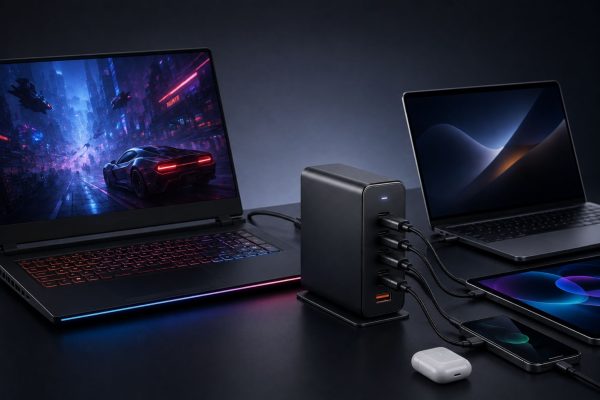
USB Power Delivery (USB PD) 3.1 has pushed USB-C charging into a new power class, supporting power levels of up to 240W. Chargers in the 140W–240W range are now emerging across the market, targeting high-performance laptops, workstations, gaming systems and users who want to power multiple devices from a single charger.
But the more important question is not whether 240W charging is technically possible.
240W Does Not Automatically Mean 240W Demand
The availability of a 240W power delivery standard creates a significant increase in design headroom. However, most users do not continuously require 240W.
A laptop may support a high-power USB-C input while drawing substantially less power during everyday productivity. Similarly, a multi-port charger may advertise a 200W or 240W total output, but the actual power delivered to an individual device depends on the charging architecture, workload and power-sharing strategy.
This creates an important distinction between maximum supported power and actual power consumption.
For the power supply industry, this distinction matters. The growth of 240W-capable chargers should not be interpreted simply as a linear increase in end-device power requirements.
Where Could 240W Actually Make Sense?
The strongest opportunities are likely to come from devices where performance and portability increasingly overlap.
High-performance laptops and mobile workstations are one of the most obvious segments. As processors, GPUs and system components become more powerful, higher input-power capability provides greater flexibility for charging while the system is under demanding workloads.
Gaming laptops could become another important driver. High-performance gaming systems can require substantial power during intensive workloads, making higher-power USB-C charging increasingly relevant as manufacturers look to reduce dependence on proprietary charging solutions.
Multi-device users represent a different opportunity. Instead of requiring separate adapters for a laptop, tablet, smartphone and accessories, users increasingly want a single high-power charger or desktop power solution. In this scenario, the value of 240W is not necessarily that one device consumes 240W it is that the power source can dynamically distribute substantial power across multiple devices.
This makes power allocation and port-level power management just as important as the headline wattage.
The Real Technology Challenge Is Beyond Wattage
Moving from 100W-class charging toward 140W, 180W and 240W introduces more demanding requirements across the power supply design.
Higher power levels place greater emphasis on:
- Power density and thermal management
- Conversion efficiency
- GaN-based power architectures
- High-voltage DC bus design
- USB PD negotiation and protection
- Multi-port power allocation
- Cable and connector capability
- Electromagnetic compatibility
- Compact form-factor design
For charger manufacturers, achieving a higher wattage rating is therefore only one part of the equation. The competitive advantage will increasingly come from delivering high power in a smaller, cooler, more efficient and reliable platform.
GaN Is Helping Change the Equation
Gallium nitride (GaN) technology is an important enabler in this transition.
Higher switching frequencies and improved power density can help designers build smaller and lighter high-power adapters without simply increasing the physical size of the power supply.
However, the move toward 240W also increases the importance of the complete power architecture. The performance of the primary-side switching stage, transformer design, secondary-side conversion, thermal path, control strategy and protection mechanisms all become increasingly important as power levels rise.
This is where the evolution of power semiconductor technology, magnetics, topologies and thermal design will influence the next generation of USB-C power solutions.
Will 240W Become Mainstream?
WAWT believes the market should be careful about interpreting 240W as the next universal charging requirement.
The more likely scenario is a segmented adoption curve.
Lower-power smartphones and tablets will continue to operate well below the 240W ceiling. Mainstream notebooks may increasingly adopt higher USB-C power capabilities, while high-performance laptops, workstations and gaming devices could provide stronger justification for the upper end of the range.
At the same time, high-power desktop chargers and multi-port charging stations could create demand for 200W–240W power supplies even when no individual device requires the full output.
Therefore, the opportunity may not be “240W for every device.”
It may instead be “240W available when the ecosystem needs it.”
What WAWT Is Tracking
For the power supply industry, the development of 240W USB-C charging raises several questions that go beyond product launches:
Which application segments are generating genuine demand for higher charging power?
How quickly are high-performance computing devices moving toward USB-C as a primary power interface?
How are charger architectures evolving to manage 140W–240W efficiently across multiple ports?
What role will GaN, advanced converter topologies and higher power density play in reducing charger size?
Will users pay a premium for higher power capability, or will power-sharing and convenience become the stronger value proposition?
And ultimately, will 240W become a mainstream requirement—or remain a high-end capability for specific applications?
These are the market signals that matter when evaluating the next stage of USB-C power evolution.
How WAWT Can Provide the Market Insight
WAWT tracks developments across the power supply and wireless power ecosystem, combining technology analysis with ongoing industry and market research.
For the 140W–240W charging segment, WAWT can provide insight into technology evolution, application-level demand, market adoption, competitive developments, power architecture trends and emerging opportunities.
Through continuous monitoring of industry developments and engagement with technology companies, manufacturers and industry events, WAWT helps stakeholders distinguish between technology capability and actual market demand.
This enables companies to better understand where higher-power charging is gaining traction, which application markets are likely to drive future growth, and where opportunities may emerge across the power supply value chain.
About WAWT
About WAWT
WAWT is a specialized market intelligence provider focused exclusively on the global power supply ecosystem. Through structured research frameworks and continuous industry monitoring, WAWT delivers actionable insights across AC-DC, DC-DC, SMPS, and application-specific power supply segments. WAWT’s Power Supply Market Intelligence platform provides visibility into technology evolution, competitive dynamics, application-level demand, vendor positioning, and regional supply-chain developments across industries such as industrial automation, telecommunications, datacentres, medical systems, lighting, and other emerging applications. Its research approach combines primary industry engagement, vendor benchmarking, supply-chain analysis, and technology trend tracking to help stakeholders understand where the power supply market is heading, which technologies are gaining traction, and where future opportunities are emerging. WAWT’s flagship research includes the Global AC-DC & DC-DC Merchant Power Supply Market Report – 2026 and the External Power Adapters and Chargers Report – 2026 Edition.