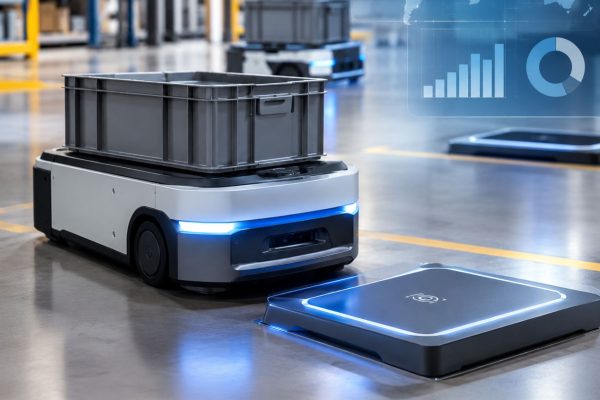
The wireless charging opportunity for Automated Guided Vehicles (AGVs) and Autonomous Mobile Robots (AMRs) is moving beyond the question of whether robots can be charged without connectors. The more important market question is where wireless charging creates enough operational and economic value to replace, complement, or expand conventional charging infrastructure.
The market is entering a more interesting phase. AGV and AMR deployments are expanding across manufacturing, warehousing, logistics and intralogistics, while fleet operators are placing greater emphasis on uptime, autonomous operation and flexible material flow. As robot fleets become larger and more continuously utilized, charging becomes an infrastructure decision rather than simply a battery-management function.
Market Growth Is Real But the Numbers Need Context
Recent market estimates point to substantial growth, although the reported market size varies considerably depending on how the market is defined.
While the overall AGV/AMR market is growing at a five-year CAGR of around 20% in terms of unit shipments, the market for wireless-charging enabled AGV/AMR is growing 50% faster than the overall market. WAWT’s Wireless Power Intelligence Service provides more details forecast with details insights and market intelligence for AGV/AMR as well as industrial and sector application markets. It also provides insights with respect to type of charging situations, opportunity charging, fleet automation, infrastructure integration and the growing importance of charging within production workflows.
These estimates should not be interpreted as contradictory market data. They illustrate an important point for industry participantsmarket sizing depends heavily on the definition of the addressable ecosystem wireless charging equipment alone versus broader charging infrastructure and associated applications.
Having no or minimal stand-by or downtime is the key factor.
For suppliers and investors, understanding that boundary is critical when evaluating TAM, competitive positioning and future opportunity.
The Growth Is Shifting From “Charging” to “Opportunity Charging”
The most important structural change is not simply the adoption of wireless power transfer. It is the movement toward charging during the robot’s normal operating cycle.
Traditional charging typically creates a defined charging event: the vehicle leaves its workflow, reaches a charging station, connects, waits and returns.
Wireless charging enables a different operating model. A robot can potentially receive energy during short dwell periods at staging points, transfer stations or other locations already incorporated into its route. This makes charging part of the production or logistics process rather than a separate activity.
That distinction becomes increasingly important as AMRs move toward higher utilization.
Recent industry developments reinforce this direction. OMRON announced its next-generation LD-150 and LD-300 AMRs in 2026, with payload capabilities of up to 150 kg and 300 kg, respectively, alongside fast wireless charging and fleet-management integration.
The implication for the power industry is significant: higher-payload and higher-throughput robots increase the importance of charging power, charging frequency and infrastructure availability.
Heavy-duty AMRs could become an important value pool
Another interesting development is the migration of AMRs into higher payload applications.
KUKA’s KMP 3000P, for example, is designed to transport loads up to three tonnes and uses a 3 kW inductive charging system. Importantly, charging can occur centrally or at workstations, allowing the platform to operate around the clock.
This is strategically significant for the wireless-power market.
As payload increases, energy consumption and the cost of downtime become more consequential. A large AMR carrying heavy components cannot necessarily be treated like a small warehouse robot that can simply stop for an extended charging cycle.
China is becoming an important ecosystem signal
One of the most interesting developments in 2026 is the integration of inductive charging into broader robotics platforms rather than individual robot models.
SEER Robotics announced a partnership with Wiferion in March 2026 to integrate inductive charging into its robotics platform. Wiferion states that SEER’s ecosystem covers more than 2,100 customers across more than 20 industries and 70 countries, with the initial focus including forklift AMRs.
This has a bigger implication than a single OEM agreement.
When charging technology is selected by a robotics platform provider, the potential market is no longer limited to one robot manufacturer’s installed base. Charging can become part of the ecosystem architecture, potentially influencing multiple robot builders and system integrators.
That is an important transition from product-level adoption to infrastructure-level adoption.
Wireless charging will not replace wired charging everywhere
The market should also avoid an overly optimistic assumption that wireless charging will displace conventional charging across AGV/AMR fleets.
VAHLE’s 2026 LogiMAT demonstration is revealing in this respect. Its concept combines continuous inductive energy transfer with conventional point charging, depending on whether vehicles operate continuously or only require periodic charging.
This suggests that the future market is likely to be hybrid.
Where Is the Market Really Growing?
As per WAWT’s latest report, the adoption of wireless charging technology for AGV/AMRs are expected to reach closer to 50% in next 5-6 years depending on the profile of the AGV/AMR in terms of pricing, power classes, factory/establishment, operator engagement and use-case.
Asia-Pacific is emerging as one of the most important regional markets. The combination of large manufacturing bases, warehouse automation, e-commerce infrastructure and established robotics ecosystems creates a strong environment for AGV and AMR charging deployment. Asia-Pacific is one of the biggest and fastest growing AGV/AMR market as a whole and for its adoption of wireless power.
China, Japan and South Korea have particularly mature robotics and manufacturing ecosystems, while India represents an increasingly important opportunity as industrial automation, fulfillment infrastructure and smart manufacturing expand.
North America remains strategically important because of large-scale warehousing, manufacturing automation and the emphasis on productivity and resilient intralogistics. Europe presents another distinct opportunity, where energy efficiency, safety, automation and interoperability are important purchasing considerations.
The Broader Wireless-Power Trend Is Also Moving Toward Higher Power
Another development worth watching is the expansion of wireless power into higher-power industrial applications.
For example, industrial wireless charging solutions are already moving toward the 1 kW-class power range for AMRs. As per WAWT research, sub 1kW power class market is one of the largest segment in terms of unit shipments and the fastest growing, amongst all types of AGV/AMRs. Current solutions demonstrate that wireless power is no longer restricted to relatively low-power robotic applications.
At the same time, the broader wireless-power industry is exploring charging systems capable of supporting increasingly demanding mobility applications. In October 2026, Honda announced plans to conduct a real-world highway test of wireless charging technology capable of charging electric vehicles, including large trucks, while they are moving.
Honda plans highway test of wireless charging for moving trucks — Reuters
The technology and economics are obviously different between electric trucks and industrial robots. However, the strategic direction is similar wireless power is increasingly being evaluated as infrastructure that can reduce or eliminate dedicated charging interruptions.
Latest market signal: charging infrastructure is becoming strategic
The direction of the industry is increasingly visible in 2026.
Wiferion published analysis in June arguing that charging infrastructure is becoming a strategic priority for AGV/FTS operators, highlighting the fragmented charging architectures that can emerge when individual automation projects specify their own charging systems.
Delta reported in April 2026 that its MOOV wired and wireless charging solutions had powered more than one million industrial vehicles, including AGVs and AMRs. At MODEX 2026, Delta also demonstrated MOOVair 01 wireless charging for AGVs/AMRs, supporting autonomous charging during operation.
Xnergy announced in June 2026 that its 1.5 kW PH Series wireless charger achieved FCC, UL and CE certification, specifically supporting AGV and AMR deployments.The certification is significant for robotics manufacturers because it enables the same wireless-charging solution to be deployed across North America, Europe and Asia without separate regional certification.
OMRON introduced its new LD-150 and LD-300 AMRs in 2026, with payloads up to 150 kg and 300 kg and wireless inductive charging in 30 minutes or less. The development is particularly relevant as higher-payload AMRs increase the need for faster opportunity charging and greater fleet uptime.
At LogiMAT 2026, VAHLE demonstrated its CPS140 system providing continuous contactless power to AGVs while they are moving, alongside conventional point charging.
This is a strong example of wireless power becoming integrated directly into the AGV material-flow process rather than relying only on dedicated charging stops.
LogiMAT 2026 also featured wireless charging solutions specifically for AGVs, AMRs and next-generation warehouse robotics, indicating that charging is becoming increasingly visible within the wider intralogistics technology ecosystem.
For WAWT, this is perhaps the most important market signal charging is gradually moving from an afterthought in robot deployment to a design consideration at the infrastructure level.
How WAWT Helps Navigate This Market
At Wired and Wireless Technologies (WAWT), we look beyond headline market growth to understand where adoption is actually occurring, which technology architectures are gaining traction, and where the next commercial opportunities are emerging.
Through our Wireless Power Intelligence Service, WAWT tracks wireless power technologies, application markets, technology developments, market trends, forecasts and competitive intelligence across 30+ application markets. Our research combines market data, technology analysis and ongoing industry monitoring to help OEMs, technology providers, component suppliers and investors evaluate market opportunities and make informed strategic decisions.
About WAWT
Wired and Wireless Technologies (WAWT) is a strategic technology analyst and consulting firm specializing in wireless power technology and power supply markets.
Through our Wireless Power Intelligence Service, WAWT provides market estimates, long-term forecasts, technology and application analysis, market intelligence and competitive insights across wireless power technologies including inductive, resonant, NFC, RF, infrared and multi-frequency solutions.
WAWT tracks technology adoption across 30+ application markets, spanning automotive, consumer electronics, computing, wearables, healthcare, industrial, robotics, retail, smart home, infrastructure and other emerging sectors.
Our research and strategic intelligence help companies understand where markets are moving, why they are changing, and where the next opportunities are emerging.
For market intelligence, customized research or strategic advisory support, contact WAWT Subject Matter Experts at analyst@wawt.tech.
Follow WAWT on LinkedIn for the latest market trends, forecasts and technology insights