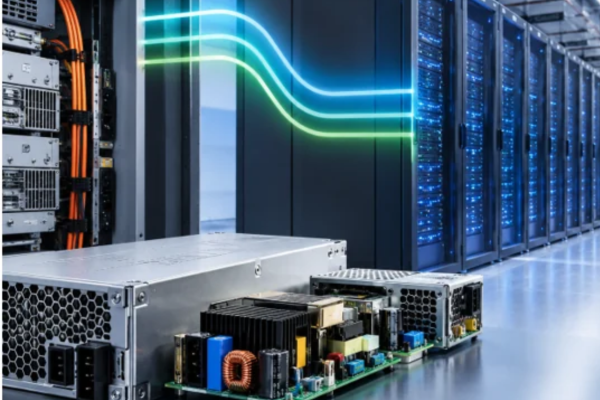
The next constraint on AI infrastructure may not be only about compute availability. It is the ability to deliver, convert and manage electrical power at rack level without compromising efficiency, reliability or deployment economics.
As AI accelerators scale in performance and power consumption, data centre architectures are moving beyond the limits of conventional low-voltage distribution. Rack power levels approaching 1 MW represent a forward-looking design target rather than a universal deployed baseline, but the engineering decisions required to support them are already shaping the power supply industry.
In August 2026, NVIDIA highlighted its 800 VDC roadmap, developed alongside Google, Microsoft and the Open Compute Project (OCP). With more than 80 ecosystem companies working on the architecture, high-voltage DC distribution is progressing from a future concept towards an increasingly standardised infrastructure direction. NVIDIA’s 800 VDC roadmap provides an important indication of where the market is heading.
For switching power supply manufacturers, the central question is no longer simply how to deliver more watts. It is which conversion stages, components and product architectures will remain commercially viable as rack power moves towards the megawatt range?
1. Power Distribution Changes Before the PSU Simply Gets Bigger
At 1 MW, the limitations of low-voltage distribution become difficult to ignore. Delivering 1 MW at 54 V would theoretically require approximately 18,500 A, compared with 1,250 A at 800 V, before accounting for conversion losses.
This difference has consequences for busbar dimensions, conductor material, resistive losses, connector design and thermal management. Simply increasing the capacity of conventional power supplies cannot address the wider distribution challenge.
The transition towards 800 VDC therefore changes the role of the switching power supply within the system. Rather than distributing extremely high currents across the rack, power can be transported at higher voltage and converted closer to the loads.
However, this does not mean that every existing 54 V or 48 V architecture will disappear immediately. Hybrid deployments, retrofit requirements and differences between hyperscalers will sustain multiple architectures during the transition.
For suppliers, the opportunity lies in understanding which conversion stages will be central to each architecture and which established product categories may lose relative importance as high-voltage distribution expands.
2. AC-DC Power Supplies and DC-DC Converters Face Different Challenges
The shift to 800 VDC will not affect every part of the power conversion chain equally.
At the facility interface, high-power AC-DC conversion must support the required DC bus while maintaining power quality, protection and operational reliability. Depending on the architecture, this could involve conventional AC-DC stages, modular rectification or direct medium-voltage-to-DC conversion.
At rack and row level, high-voltage DC-DC converters must deliver power efficiently while managing isolation requirements, fault protection and transient behaviour. Further downstream, converters must supply the much lower voltages required by processors and accelerators.
For example, Texas Instruments demonstrated the direction of this development in March 2026, unveiling a 30 kW, 800 V AC-DC power supply alongside an 800 V-to-6 V DC-DC reference design. The latter reported 97.6% peak efficiency and power density exceeding 2,000 W/in³. These are reference-design specifications, not guarantees of performance across all operating conditions. Source: Texas Instruments.
The commercial implication is significant: demand may increasingly favour suppliers capable of supporting multiple stages of the power chain rather than competing solely on individual PSU ratings.
3. GaN and SiC: Architecture Will Determine the Winners
Gallium nitride (GaN) and silicon carbide (SiC) are becoming increasingly important in high-density power conversion, but their opportunities should not be treated as interchangeable.
GaN is attractive for high-frequency switching stages where compact magnetics, reduced conversion losses and integration can improve power density. SiC offers advantages in high-voltage and high-power applications, including stages exposed to demanding voltage and thermal conditions.
The choice depends on switching frequency, voltage rating, topology, cooling, electromagnetic interference, cost and reliability requirements. Higher switching frequency can reduce passive component size, but it also increases the importance of switching losses, parasitic effects, gate-drive design and EMI control.
For example, a notable development came from Infineon in June 2026. Its 24 kW SiC-based battery backup unit reference design connects a battery stack directly to an 800 V DC bus, reporting efficiency above 99% and power density of 450 W/in³. The design illustrates how high-voltage power conversion is extending beyond the primary supply into energy storage and backup infrastructure. Source: Infineon Technologies.
For the semiconductor ecosystem, the opportunity extends beyond chip sales. Suppliers that combine suitable switches with drivers, protection, control, packaging and reference designs may be better positioned to capture value as architectures mature.
4. Thermal Management and Dynamic Loads Become Design Priorities
Efficiency figures alone will not determine which solutions succeed at megawatt-scale racks.
At 97% efficiency, a 1 MW power delivery system would dissipate approximately 30 kW of heat; at 99%, the loss would still be around 10 kW. These simplified illustrations assume 1 MW of input power and constant efficiency, but they demonstrate why even small efficiency improvements matter at scale.
The location of these losses is equally important. Heat concentrated in a converter, magnetic assembly or tightly packed power shelf can create local thermal constraints even when the overall facility has sufficient cooling capacity.
AI workloads also introduce rapid changes in power demand. Switching power supplies must respond to load transients while maintaining output regulation, avoiding protection trips and coordinating with energy storage and system-level controls.
Consequently, thermal design, transient response, telemetry, redundancy and serviceability are becoming differentiators alongside peak efficiency and power density. Liquid cooling may help manage system-level heat, but it does not eliminate the need to address component junction temperatures, insulation, hotspots and cooling compatibility within power conversion equipment.
5. Reliability, Protection and Standardisation Will Shape Supplier Selection
An 800 VDC architecture creates new engineering and qualification requirements. Insulation coordination, creepage and clearance, arc-fault management, safe isolation, connector design and maintenance procedures become critical considerations.
Redundancy and fault containment also matter more as power concentration increases. A failed conversion stage should not create disproportionate downtime across an expensive compute installation.
Standardisation is therefore commercially important. NVIDIA, Google and Microsoft are working through OCP to establish common interfaces and requirements for 800 VDC infrastructure. This could reduce fragmentation and help equipment suppliers develop products for a broader customer base rather than relying entirely on proprietary implementations.
Nevertheless, standardisation does not remove the need for customer-specific engineering. Qualification cycles, installed infrastructure, procurement strategies and system integration will influence the pace of adoption.
6. What This Means for the Switching Power Supply Market
The transition towards megawatt-scale AI racks could redistribute market value across AC-DC power supplies, high-voltage DC-DC converters, semiconductor devices, protection circuits, backup power systems and advanced thermal solutions.
However, higher rack power does not automatically translate into proportionate growth in merchant power supply revenue. Integration, fewer conversion stages, improved efficiency and changes in sourcing models may alter the number of units required and the value captured by individual suppliers.
WAWT’s market perspective: Understanding this opportunity requires looking beyond headline AI infrastructure investment. Product-level demand, power ratings, application segmentation, supplier market shares and the pace of architectural adoption will determine which manufacturers benefit most.
WAWT’s research connects these factors through its global AC-DC and DC-DC merchant power supply market analysis, helping manufacturers, component suppliers and investors assess competitive positioning and identify emerging opportunities across the power conversion ecosystem.
Conclusion: The First Change Is Architectural, Not Just Electrical
As AI racks move towards 1 MW, the first major change is the way power is distributed and converted not simply an increase in conventional PSU capacity.
Higher-voltage distribution, advanced AC-DC and DC-DC conversion, GaN and SiC adoption, dynamic load management and system-level reliability will influence the next generation of power supply products.
For manufacturers, the strategic challenge is to identify where conversion stages are changing, which technologies are gaining traction and where differentiation can translate into sustainable market share. The companies best positioned to benefit will be those that align product roadmaps with emerging system architectures while meeting demanding requirements for efficiency, reliability, manufacturability and cost.
About WAWT
Wired and Wireless Technologies (WAWT) is a strategic technology analyst and consultancy firm specialising in the power supply and wireless power technology industries. WAWT provides critical market data, in-depth market insights, market intelligence and competitive analysis across AC-DC and DC-DC power supplies and wireless power and charging technologies.
WAWT has published its latest AC-DC and DC-DC Merchant Power Supply Market Report – 2026 Edition. The report provides market sizing for 2019–2025, a 2026 base year and annual forecasts through 2030, alongside analysis by product type, application, geography, package type, form factor and power rating. It also includes competitive market share analysis of regional and global suppliers. The subscription package combines a detailed Excel market database with an analysis and insights report in PDF format.
The report supports strategic planning across data centres, servers, storage, networking, telecommunications, medical electronics, industrial systems and other application sectors.
Subscribe to the latest report: Contact enquiry@wawt.tech to request the brochure, sample report and subscription details.
For research and advisory support, contact analyst@wawt.tech to arrange a free 30-minute discovery call with WAWT’s analyst team.
Subscribe to WAWT’s monthly newsletter, Power Bulletin, and follow WAWT on LinkedIn for the latest market trends, technology developments, competitive intelligence and forecasts across power supply and wireless power industries.