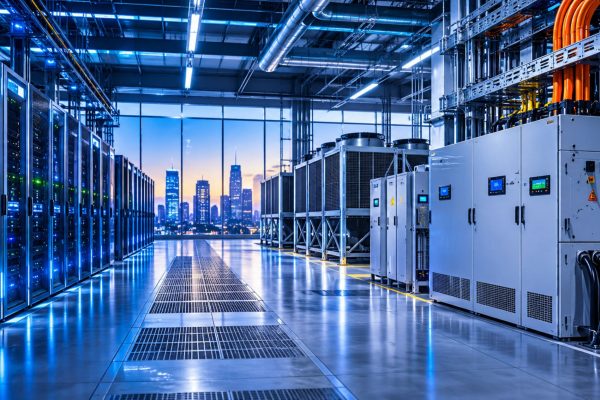
The rapid expansion of artificial intelligence infrastructure is creating a significant opportunity for the global power supply industry. Hyperscalers, cloud service providers and AI infrastructure developers are investing in large-scale facilities designed to accommodate increasingly powerful GPU clusters. Among these developments, 100 MW AI data centres represent an important scale at which power availability, conversion efficiency, distribution architecture and thermal management become critical investment considerations.
For power supply manufacturers, this expansion is not simply about supplying more equipment. It is creating demand for higher-capacity AC-DC conversion, advanced DC-DC systems, modular power shelves, high-voltage DC distribution and integrated energy infrastructure. The transition could also change the competitive positioning of established power electronics manufacturers.
100 MW AI Infrastructure: Why Power Architecture Matters
A 100 MW AI data centre requires considerably more than conventional server power infrastructure. It must support high-density computing loads, dynamic GPU power consumption, continuous operation and increasingly complex cooling requirements.
An important distinction is whether 100 MW represents IT capacity or total facility power. At a hypothetical PUE of 1.15, a 100 MW IT load would require approximately 115 MW of total facility power. This additional demand creates opportunities across electrical distribution, cooling infrastructure and backup power systems.
As AI rack power requirements move towards several hundred kilowatts and ultimately megawatt-class configurations, traditional rack-level power architectures face limitations in current handling, physical space and thermal performance. Manufacturers must therefore develop power systems that can scale alongside computing infrastructure without compromising efficiency or reliability.
800 VDC: A Major Architectural Shift for Power Manufacturers
One of the most important developments is the transition towards 800 VDC and ±400 VDC power distribution.
Conventional data centres typically use multiple conversion stages between incoming AC power and the DC voltage required by computing equipment. As rack power increases, these stages introduce additional conversion losses, heat and infrastructure complexity.
Higher-voltage DC distribution offers an opportunity to reduce current for equivalent power delivery, potentially lowering conductor requirements and simplifying high-density electrical infrastructure. However, the transition also introduces requirements for high-voltage protection, isolation, monitoring and purpose-designed DC power equipment.
This creates opportunities for manufacturers across medium-voltage conversion, solid-state transformers, high-power AC-DC rectifiers, DC-DC converters, power shelves, battery backup systems and protection equipment.
Industry Developments: Manufacturers Are Building for AI Power Demand
Recent developments from leading technology companies demonstrate how quickly the infrastructure supply chain is evolving.
Delta Electronics: Delta is developing an integrated grid-to-chip portfolio spanning power conversion, energy storage and thermal management. At Data Center World Asia in September 2026, it showcased an AI Modular Data Centre incorporating 800 VDC in-row power and liquid cooling for NVIDIA Vera Rubin-based infrastructure. Its showcased 660 kW in-row power architecture supports up to 98% AC-DC efficiency and includes 480 kW of battery backup capacity. In November 2026, Delta also highlighted a 2.5 MW liquid-to-liquid cooling distribution unit designed for emerging 800 VDC and ±400 VDC architectures. These developments position Delta across both electrical and thermal infrastructure.
Vertiv: In November 2026, Vertiv expanded its 800 VDC portfolio across rack, compute pod and data hall configurations. Its PowerDirect architecture combines power conversion, distribution, battery backup and protection. The company’s approach is particularly relevant because it supports different deployment pathways rather than requiring every data centre operator to replace its existing AC infrastructure simultaneously.
Schneider Electric: Schneider Electric introduced software-defined medium-voltage switchgear in September 2026, extending its portfolio for high-density AI data centres. Its technology developments also encompass UPS systems, power shelves, 800 VDC sidecars, busways and digital infrastructure management. This illustrates the increasing importance of intelligent electrical distribution alongside power conversion.
Lite-On Technology: At Electronica 2026, Lite-On showcased a 110 kW power shelf supporting NVIDIA Vera Rubin NVL72 architecture and a 72 kW power shelf in a compact 1U form factor. Its demonstrations also covered 330 kW, 880 kW and 1.2 MW power configurations, highlighting the industry’s progression towards megawatt-scale rack infrastructure.
Flex: Flex introduced an 800 VDC Power Rack in March 2026, developed in collaboration with NVIDIA for next-generation AI infrastructure. Its approach combines power products with manufacturing capabilities, addressing the growing requirement for scalable and rapidly deployable data centre systems.
Eaton: Eaton is expanding its focus on integrated electrical and thermal infrastructure. Its August 2026 collaboration with Trane Technologies introduced a reference design for NVIDIA DSX AI Factory infrastructure, combining electrical distribution and advanced thermal management. This reflects a growing industry focus on designing power and cooling as interconnected systems.
Where Will the Market Opportunities Emerge?
The expansion of 100 MW AI facilities creates several potential growth areas for power supply manufacturers.
High-power AC-DC systems: Medium-voltage conversion, modular rectifiers and high-capacity power systems will become increasingly important as facilities move towards higher electrical loads.
DC-DC conversion: Higher-voltage distribution creates additional requirements for efficient downstream conversion to the operating voltages required by GPUs, processors and other computing subsystems.
Power shelves and rack systems: Increasing rack densities will encourage demand for modular, high-capacity power shelves, battery backup units and integrated power distribution solutions.
Power semiconductors: SiC and GaN technologies offer opportunities in high-efficiency and high-frequency conversion applications, although adoption will depend on cost, reliability and application-specific performance.
Energy storage and cooling integration: Battery systems, supercapacitors, liquid cooling and intelligent power management are becoming important elements of next-generation infrastructure design.
WAWT Analyst Perspective: Competition Is Moving Towards Integrated Power Architectures
The 100 MW AI data centre opportunity represents a structural development for the power supply industry. The strongest commercial opportunities may not necessarily belong to manufacturers supplying the highest number of individual power units, but to those capable of delivering efficient, scalable and reliable power architectures.
Delta Electronics, Vertiv, Schneider Electric, Eaton, Lite-On and Flex illustrate different approaches to this opportunity, ranging from power conversion and electrical distribution to rack-level systems and integrated infrastructure.
However, the transition towards 800 VDC will not happen at the same pace across all facilities. Existing AC infrastructure, retrofit economics, safety requirements, grid availability and operator investment priorities will influence adoption. Hybrid architectures are therefore likely to remain important during the transition.
WAWT believes that the next phase of AI data centre expansion will create opportunities across the entire power supply value chain, with high-density AC-DC, advanced DC-DC conversion and integrated power infrastructure emerging as particularly important areas of competition.
About WAWT
WAWT is a technology analyst and consultancy firm specialising in wireless power and power supply industries. We provides market intelligence, technology analysis, competitive insights and strategic consultancy across AC-DC and DC-DC power supplies, external power adapters, chargers and emerging power technologies.
For market intelligence, bespoke research and strategic enquiries, contact analyst@wawt.tech.