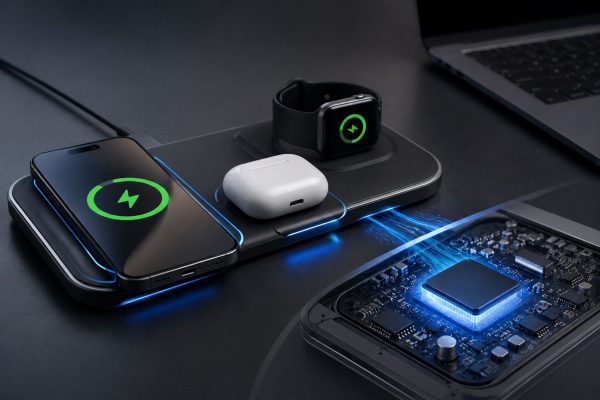
The rapid evolution of consumer electronics, smart wearables, power tools, portable medical devices, intelligent home ecosystems, industrial and retail, applications, are transforming the global charging industry. As users demand faster charging, smaller adapters, multi-device charging convenience, and higher energy efficiency, conventional silicon-based charging architectures are reaching their performance limits. This shift is accelerating the adoption of Gallium Nitride (GaN) technology in compact multi-device wireless chargers, making GaN one of the most disruptive innovations in the wireless power ecosystem.
For manufacturers, semiconductor companies, wireless power solution providers, and OEMs, GaN is no longer just a next-generation semiconductor material. It has become a strategic enabler for ultra-compact, high-efficiency, thermally optimized wireless charging systems designed for the future connected world.
The wireless power transmitters market, in terms of shipments, is expected to grow at a five-year CAGR of 42% from 2026 to 2031, while the wireless power receiver market is expected to grow at 38%.
How and Why is GaN Technology Reshaping The Adoption of Wireless Charging
Gallium Nitride is a wide-bandgap semiconductor material that offers significantly higher switching frequencies, lower power losses, faster electron mobility, and superior thermal performance compared to traditional silicon semiconductors. These characteristics allow power electronics designers to develop smaller, lighter, and more efficient charging systems without compromising performance.
In compact multi-device wireless chargers, space optimization and thermal management are critical engineering challenges. Traditional silicon-based designs often require larger transformers, capacitors, heat sinks, and cooling solutions. GaN technology reduces these constraints by enabling higher power density and lower heat generation.
As a result, OEMs can now develop sleek wireless charging pads, foldable charging stations, magnetic charging docks, automotive wireless charging consoles, and desktop charging hubs capable of simultaneously charging smartphones, smartwatches, earbuds, tablets, and other connected devices.
The growing integration of Qi2 wireless charging standards, magnetic alignment systems, and intelligent power-sharing algorithms is further strengthening the demand for GaN-enabled charging architectures, more so from transmitters perspective.
The Rise of Compact Multi-Device Wireless Chargers
The modern consumer increasingly owns multiple battery-powered devices. A single user may simultaneously rely on a smartphone, smartwatch, wireless earphones/TWS, tablet, gaming accessories, fitness trackers, portable productivity devices, computer and furniture peripherals. This growing device ecosystem is creating strong market demand for consolidated charging solutions capable of powering multiple products through a single compact charger.
This trend is pushing manufacturers toward:
- Multi-coil wireless charging architectures
- Smart dynamic power distribution
- High-efficiency power conversion systems
- Ultra-thin charging form factors
- Travel-friendly compact chargers
- Fast wireless charging support
- Simultaneous charging capabilities
GaN technology enables all these requirements by improving switching efficiency and reducing component size. The result is a new generation of compact wireless charging stations that deliver higher output power while maintaining thermal reliability and user safety.
Latest Innovations in the Wireless GaN Chargers Market
The wireless GaN charger market is witnessing rapid innovation across both consumer and industrial applications. Several technology trends are currently shaping product development and competitive differentiation.
- Integration of Qi2 and Magnetic Wireless Charging
The emergence of Qi2 wireless charging standards is significantly influencing the next generation of GaN-powered chargers. Qi2 introduces improved magnetic alignment capabilities that increase charging efficiency while minimizing energy losses caused by coil misalignment.
Manufacturers are integrating GaN power stages with magnetic charging ecosystems to deliver faster and more stable wireless charging experiences for smartphones and wearable devices.
- High-Power Multi-Port Hybrid Chargers
One of the biggest innovations in the market is the rise of hybrid charging systems combining USB-C Power Delivery (PD), wireless charging, and multi-device charging functionality into a single compact device.
GaN semiconductors allow these chargers to support high wattage outputs while maintaining compact industrial designs. Several leading charger brands are now launching products capable of charging laptops, smartphones, earbuds, and wearables simultaneously.
- Advanced Thermal Management Systems
Thermal optimization remains a major challenge in wireless charging systems, especially in compact designs. GaN technology significantly reduces thermal stress, but manufacturers are also implementing:
- Graphene cooling layers
- AI-driven thermal control systems
- Smart temperature monitoring
- Dynamic power throttling
- Advanced heat dissipation materials
These innovations are improving charging safety, efficiency, and product lifespan.
- AI-Based Intelligent Power Allocation
Artificial Intelligence is increasingly being integrated into advanced wireless charging systems. AI-powered charging controllers dynamically allocate power based on device priority, battery status, thermal conditions, and charging protocols.
GaN-enabled architectures support these intelligent systems by providing fast switching performance and efficient real-time power conversion.
- Expansion Into Automotive and Industrial Applications
GaN-based wireless charging is moving beyond consumer electronics into automotive interiors, industrial automation, robotics, healthcare, and smart retail systems.
Automotive OEMs are increasingly deploying compact wireless charging consoles within vehicle cabins, while industrial robotics and medical equipment manufacturers are exploring cable-free charging solutions for operational efficiency and reliability.
Key Market Trends Driving GaN Wireless Chargers
Several long-term market trends are accelerating the adoption of GaN technology in wireless charging ecosystems.
- Growing Adoption of Fast Charging Standards
Consumers increasingly expect fast charging capabilities across all devices. GaN enables higher power transfer efficiency, making it ideal for fast wireless charging systems supporting advanced protocols and high-wattage outputs.
- Demand for Sustainable and Energy-Efficient Charging
Energy efficiency has become a critical priority for governments, enterprises, and consumers. GaN technology helps reduce power loss and improve energy conversion efficiency, aligning with global sustainability initiatives and energy regulations.
- Miniaturization of Consumer Electronics
The trend toward thinner and lighter consumer devices is driving demand for compact charging infrastructure. GaN’s high-frequency switching capabilities enable significant charger miniaturization while maintaining performance.
- Growth of Smart Home and IoT Ecosystems
The expansion of smart homes and IoT-connected devices is increasing the number of rechargeable products in daily use. Compact multi-device charging stations are becoming essential household infrastructure, creating strong market opportunities for GaN-enabled wireless charging platforms.
- Increased Investment in Power Electronics Innovation
Major semiconductor vendors, power supply manufacturers, and wireless charging solution providers are heavily investing in GaN research and development to enhance efficiency, reliability, and scalability across power conversion systems.
- Strategic Importance of GaN for Industry Stakeholders
For power supply companies, semiconductor manufacturers, OEMs, and wireless charging solution providers, GaN technology represents more than a performance upgrade. It is becoming a core competitive differentiator.
Companies that successfully integrate GaN into wireless charging ecosystems can achieve:
- Higher power density products
- Improved thermal efficiency
- Reduced product footprint
- Enhanced charging speeds
- Lower energy consumption
- Premium product positioning
- Better integration with next-generation wireless standards
As the wireless charging market becomes increasingly competitive, companies must closely monitor technology advancements, regulatory developments, market demand shifts, and competitive product strategies.
This is where market intelligence and technology insights become essential.
How WAWT Supports the Wireless Power and GaN Charging Ecosystem
WAWT’s website provides critical market data, strategic market intelligence, technology insights, and competitive analysis for companies operating across the wireless power and power supply ecosystem.
At WAWT’s LinkedIn, industry stakeholders can access the latest developments in wireless charging, power electronics, GaN power semiconductors, EV charging, NFC wireless charging, and advanced power supply technologies.
WAWT delivers deep insights into:
- Wireless power market trends
- GaN charger technology developments
- Competitive landscape analysis
- Market size estimates and forecasts
- Emerging applications and verticals
- Regulatory and standards developments
- Power supply ecosystem intelligence
- OEM and supplier strategies
Its flagship research solutions help companies identify market opportunities, evaluate technology adoption trends, benchmark competitors, and make informed strategic decisions.
About Wired and Wireless Technologies (WAWT)
Wired and Wireless Technology (WAWT) is the leading and most trustworthy strategic technology analyst and consulting firm focusing on the wireless power and power supply industry. No one covers these market segments as WAWT does, with our subject matter experts attending around 15 key industry events and trade shows across the year and across regions, to capture the latest trends, news, and announcements and deliver high-value market insights and intelligence to our esteemed customers and industry associates.
WAWT’s Wireless Power Intelligence Service is the most comprehensive research offering on the wireless power market, covering all types of wireless power technology solutions and their adoption across more than 30 key application markets, irrespective of power levels. The service provides critical market data, trends, insights, and competitive intelligence, helping businesses make informed decisions and stay competitive in this fast-evolving industry.
Its research spans more than 30 application verticals including smartphones, wearables, smart home devices, medical equipment, industrial automation, robotics, retail systems, automotive applications, and emerging IoT ecosystems.
WAWT provides regular updates on market trends, competitive developments, technology evolution, regulatory activities, market forecasts, and emerging business opportunities within the rapidly evolving wireless power industry.
Businesses seeking to stay ahead in the GaN wireless charging market and broader power electronics ecosystem can request sample reports and brochures to better understand the scope and coverage of WAWT’s research solutions.
For more information, companies can connect with WAWT’s subject matter experts by emailing analyst@wawt.tech and following WAWT on LinkedIn for the latest market intelligence, insights, and technology updates across wireless power and power supply industries.