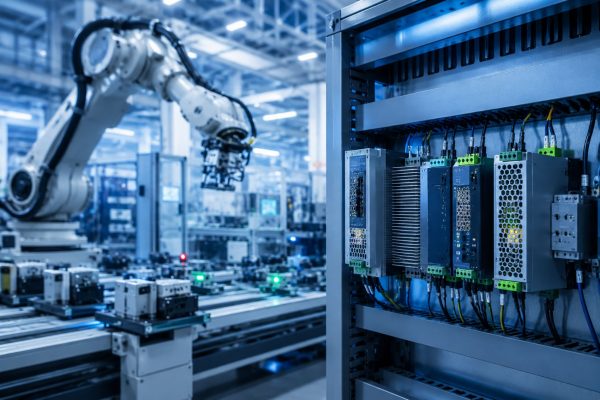
Industrial automation is changing the way factories operate and it is also changing the requirements for power supplies.
The expansion in use of robotics, programmable logic controllers (PLCs), sensors, machine vision, servo systems, industrial networking, smart (IIoT) machinery and automated production equipment is creating a growing need for reliable and efficient power conversion. As manufacturing environments become more connected and automated, power supplies are moving from being a supporting component to becoming an increasingly important part of the overall industrial system.
The opportunity is not simply about selling more power supplies. The more important shift is in what industrial customers now expect from them and need for innovation.
Automation Is Increasing the Importance of Power Reliability
Modern production lines can contain hundreds or even thousands of electronic devices operating together. PLCs control production processes, sensors continuously collect information, actuators perform physical operations, and communication systems connect machines across the factory. Automated Guided Vehicles (AGVs) and Autonomous Mobile Robots (AMRs) and Industrial IoT (IIoT) devices are adding more value to the operations.
All of these systems depend on stable and reliable power.
A power supply failure that affects a critical control system can potentially interrupt an entire production process. As automation increases, the consequences of downtime can become more significant, making reliability a key purchasing consideration alongside price and efficiency.
This is creating demand for industrial power supplies designed to provide stable output under changing loads, protection against electrical disturbances, long operating lifetimes, and dependable performance in demanding environments.
The result is a gradual shift in purchasing priorities from “Does the power supply provide the required output?” toward “Can it reliably support the complete automation system?”
More Electronics Are Creating More Distributed Power Requirements
Industrial automation is also changing where power is required within a factory.
Traditional industrial systems often concentrated power conversion around larger pieces of equipment. Modern automated facilities increasingly distribute electronics throughout production lines. Sensors, controllers, communication modules, cameras, motors, robotic systems, and edge devices may all require different voltage and power levels.
This creates opportunities across both AC-DC and DC-DC power conversion. Based on WAWT, the power supply solutions for industrial applications are seeing wider use cases expanding beyond factory automations, robotics, semiconductor manufacturing, test & measurement equipment, railways and others. WAWT provides estimates and forecast of industrial power supply covering all these applications.
Instead of relying on a single large power source, industrial systems can use multiple conversion stages positioned closer to individual loads. This can improve system flexibility while creating additional demand for compact and application-specific power solutions.
For power supply manufacturers, this means that automation growth can expand the addressable opportunity across multiple power levels and form factors rather than simply increasing demand for larger-capacity units.
Efficiency Is Becoming a System-Level Requirement, as in Sustainability
Energy efficiency has always been important in industrial power supplies, but its significance is increasing as factories deploy more electronic equipment.
Every conversion stage generates some level of power loss. When hundreds or thousands of power conversion devices operate continuously, even relatively small efficiency differences can accumulate into meaningful energy consumption and heat generation.
This is pushing manufacturers to develop power supplies that combine high efficiency with reliable thermal performance.
However, efficiency cannot be viewed in isolation. Increasing power density, reducing physical size, maintaining reliability, managing heat, and achieving cost targets all need to be balanced.
This creates an increasingly complex product-development equation:
Higher efficiency + higher power density + lower thermal stress + longer lifetime = greater engineering challenge.
For industrial customers, the value proposition is therefore moving beyond the initial purchase price toward the overall operating cost and reliability of the system.
Intelligence Is Entering the Industrial Power Supply
Another important development is the increasing integration of monitoring and communication capabilities into industrial power systems.
Power supplies can increasingly provide information about operating conditions such as voltage, current, temperature, load, and system status. When connected with industrial control and monitoring systems, this information can provide greater visibility into the health of the power infrastructure.
This opens the door to more proactive maintenance strategies.
Instead of waiting for a power supply to fail, manufacturers can potentially monitor operating conditions and identify abnormal behavior earlier. In highly automated production environments, this capability can become particularly valuable because preventing an unexpected interruption can be considerably more valuable than simply replacing a failed component.
The industrial power supply is therefore evolving from a power conversion device into a more connected element of the automation infrastructure.
Different Automation Applications Require Different Power Architectures
One of the most important market dynamics is that industrial automation does not represent a single application.
Robotics, machine tools, warehouse automation, semiconductor manufacturing, food processing, packaging, automotive production, and process industries all have different operating environments and electrical requirements.
A robotic system may prioritize compactness, dynamic load response, and high reliability. A factory control cabinet may emphasize redundancy and ease of maintenance. Equipment operating in harsh environments may require greater protection against temperature, vibration, dust, or electrical disturbances. As mentioned, Automated Guided Vehicles (AGVs) and Autonomous Mobile Robots (AMRs) and Industrial IoT (IIoT) devices are adding more value to the operations.
This creates opportunities for manufacturers that can provide application-specific power solutions rather than one-size-fits-all products.
It also means that understanding end-user requirements is becoming increasingly important for power supply companies.
The Competitive Landscape Is Becoming More Application Driven
As industrial automation expands, competition in power supplies is likely to move beyond traditional specifications.
Efficiency, output power, size, and price will remain important, but customers are increasingly likely to evaluate products based on a broader set of factors including reliability, thermal performance, monitoring capabilities, certifications, customization, availability, and lifecycle support.
This creates opportunities for suppliers that can differentiate through technology and application expertise.
At the same time, manufacturers need to understand where the strongest demand is developing. Growth in factory automation does not necessarily translate equally across every power supply category. Different automation technologies can create very different requirements for AC-DC and DC-DC conversion.
Therefore, application-level demand analysis becomes critical for identifying the real areas of opportunity.
What This Means for the Power Supply Market
Industrial automation is creating a structural opportunity for the power supply industry.
The growth is not being driven by one technology alone. It is the combined effect of increasing machine intelligence, greater electronic content, distributed control architectures, robotics, connected factories, energy-efficiency requirements, and the need for higher operational reliability.
For power supply manufacturers, this creates several strategic questions:
- Which industrial automation applications are growing fastest?
- What power levels and architectures are being adopted?
- How are customer specifications changing?
- Which AC-DC and DC-DC technologies are gaining traction?
- Where is demand shifting geographically?
- Which suppliers are strengthening their competitive position?
- How are product requirements evolving across different industrial verticals?
Answering these questions requires more than monitoring overall market growth. It requires understanding the relationship between technology adoption, application demand, supplier activity, and power architecture.
How WAWT Helps Identify These Opportunities
This is where WAWT’s Power Supply Market Intelligence provides value.
WAWT tracks the global power supply ecosystem across AC-DC, DC-DC, SMPS, and application-specific power supply segments, connecting technology developments with real-world application demand. Through vendor benchmarking, competitive analysis, industry engagement, technology tracking, and supply-chain monitoring, WAWT helps identify where demand is emerging and how power supply requirements are changing.
For industrial automation specifically, this enables stakeholders to look beyond the headline market size and understand which applications are driving demand, what specifications are becoming important, which technologies are gaining momentum, and where suppliers can find new growth opportunities.
For power supply manufacturers, component suppliers, investors, and strategic decision-makers, this intelligence can support product planning, technology roadmaps, competitive positioning, market-entry strategies, and investment decisions.
About WAWT
WAWT is a specialized market intelligence provider focused exclusively on the global power supply ecosystem. Through structured research frameworks and continuous industry monitoring, WAWT delivers actionable insights across AC-DC, DC-DC, SMPS, and application-specific power supply segments. WAWT’s Power Supply Market Intelligence platform provides visibility into technology evolution, competitive dynamics, application-level demand, vendor positioning, and regional supply-chain developments across industries such as industrial automation, telecommunications, datacentres, medical systems, lighting, and other emerging applications. Its research approach combines primary industry engagement, vendor benchmarking, supply-chain analysis, and technology trend tracking to help stakeholders understand where the power supply market is heading, which technologies are gaining traction, and where future opportunities are emerging. WAWT’s flagship research includes the Global AC-DC & DC-DC Merchant Power Supply Market Report – 2026 and the External Power Adapters and Chargers Report – 2026 Edition.