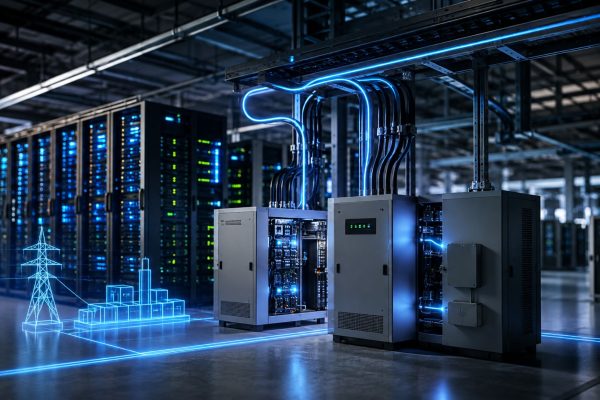
The rapid expansion of artificial intelligence is creating a new challenge for data centers: how to deliver enough power to increasingly dense computing infrastructure without making electrical systems larger, hotter, and more complex. As AI workloads push rack power requirements from traditional levels toward hundreds of kilowatts and, eventually, megawatt-scale systems, the limitations of conventional power architectures are becoming increasingly visible.
This is driving growing industry attention toward 800VDC power distribution, a high-voltage DC architecture that could significantly reshape the way electricity is converted, distributed, and delivered inside next-generation AI data centers. The transition is also creating a new opportunity landscape for manufacturers of AC-DC and DC-DC power supplies, power electronics, semiconductors, protection equipment, and related infrastructure.
Why AI Is Pushing Data Centers Toward 800VDC
Traditional data centers have generally relied on AC distribution and lower-voltage DC architectures. However, AI infrastructure is changing the power equation. According to another secondary source, AI-focused data-center racks that historically required less than 50 kW can now reach approximately 200–600 kW, with requirements potentially approaching 1 MW per rack in the next two-three years.
At these power levels, delivering electricity at lower voltages requires extremely high currents. Higher current means larger cables, connectors, breakers, busways, and other electrical infrastructure, while also increasing resistive losses and heat generation. Based on external research estimates, a 500 kW-plus rack could require 700+ amps per phase under conventional 480/415 VAC architectures.
800VDC addresses part of this challenge by delivering the same amount of power at a substantially lower current. This can reduce conductor requirements, electrical infrastructure footprint, and I²R losses while creating more space for computing equipment.
From Multiple Conversions to a More Efficient Power Path
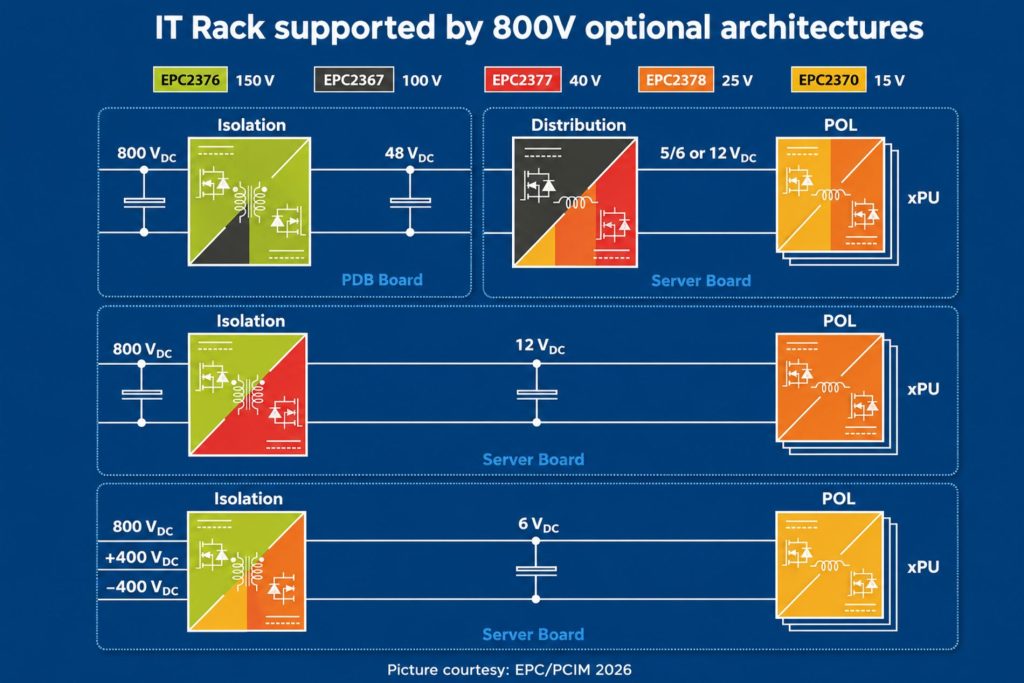
The significance of 800VDC goes beyond voltage. It can fundamentally change the power-conversion chain between the grid and AI accelerators.
Conventional architectures require electricity to pass through multiple conversion stages before reaching the low-voltage DC levels required by processors and servers. Every conversion introduces losses and generates additional heat. At the gigawatt scale of modern AI campuses, even relatively small efficiency improvements can translate into significant reductions in energy consumption and infrastructure requirements.
NVIDIA is now actively promoting 800VDC as an architecture for scaling AI factories. Its August 2026 announcement describes a roadmap spanning hybrid 800VDC power racks, centralized 800VDC distribution, and future facility-scale power blocks. NVIDIA also states that more than 80 equipment manufacturers and infrastructure companies are building products around the emerging specifications developed through the Open Compute Project ecosystem.
This indicates that 800VDC is moving beyond a technology concept toward an emerging power infrastructure ecosystem.
A New Opportunity for Power Supply Manufacturers as well as Semiconductor Companies
For the power-supply industry, this transition could create demand for an entirely different mix of products.
Instead of concentrating power conversion within individual racks, emerging architectures can move AC-to-DC conversion into dedicated power racks, power sidecars, centralized power systems, or facility-level conversion equipment. Schneider Electric identifies rack-level power conversion as one practical near-term pathway because it can integrate with existing AC infrastructure while enabling higher-density computing.
This creates opportunities across several product categories, including:
- High-efficiency AC-DC rectifiers
- High-voltage DC-DC converters
- Rack-level power systems and power sidecars
- DC-rated busways, connectors, breakers, and protection systems
- Solid-state transformers
- Battery and energy-storage interfaces
- SiC- and GaN-based power conversion systems
- Digital power-management and monitoring solutions
That the shift could gradually move value away from traditional copper- and iron-intensive electrical infrastructure toward power semiconductors, power electronics, digital controls, and DC-native protection technologies.
The Economics Could Accelerate Adoption
The business case for 800VDC is becoming another important part of the discussion. Based on primary and secondary research sources, the native 800VDC architectures could potentially reduce non-IT capital expenditure by up to 20% and power-related operating expenditure by 10%, although actual savings will vary by architecture and deployment model. Its analysis also indicates that copper consumption could potentially fall around 50% in some SST-based architectures.
Another resource similarly highlights the potential for 800VDC to alter the economics of AI data-center power infrastructure, particularly as operators seek to maximize compute density while managing grid constraints, electrical losses, and construction costs.
Challenges Remain Before 800VDC Becomes Mainstream
Despite its potential, 800VDC adoption will not happen overnight. Higher-voltage DC systems introduce new requirements around fault protection, grounding, isolation, safety, connectors, maintenance, and energy storage integration. Schneider Electric notes that protection coordination and fault containment require a system-level approach, while technologies such as solid-state circuit breakers are still developing and can add cost and integration complexity.
Standardization and supply-chain maturity will therefore be critical. The growing participation of hyperscalers, power companies, semiconductor manufacturers, and infrastructure suppliers in industry initiatives could help address these barriers and establish common interfaces and specifications.
What This Means for the Power Supply Market
The 800VDC transition represents more than a change in data-center voltage. It could become a structural shift in the power-supply ecosystem.
As AI compute density continues to rise, the competitive focus is likely to move toward higher efficiency, greater power density, advanced thermal management, modular architectures, and intelligent power conversion. Companies capable of combining power electronics, semiconductors, protection, controls, and system-level integration could be particularly well positioned.
For power-supply manufacturers, the key question is no longer simply whether AI will increase demand for power. The more important question is what kind of power architecture that demand will create.
With NVIDIA, hyperscalers, industry organizations, and major electrical infrastructure companies now actively developing 800VDC solutions, the technology is emerging as one of the most important areas to watch in the evolution of AI data-center power.
Based on WAWT’s recent research on the power suuply market, especially focussing on AI/Data centre application, the AC-DC and DC-DC power supply market for data centres is expected to grow by more than 10% in the next few years, and its allied markets including Solid-State Transformers (SSTs), semiconductors (Sic, SiG, GaN), Liquid cooling solutions, and others.
About WAWT – Power Supply Market Intelligence
WAWT is a specialized market intelligence provider focused exclusively on the global power supply ecosystem. Through structured research frameworks and continuous industry monitoring, WAWT delivers actionable insights across AC-DC, DC-DC, SMPS, and application-specific power supply markets.
WAWT’s Power Supply Market Intelligence service provides end-to-end visibility into product developments, technology evolution, competitive dynamics, and demand trends across AI data centers, telecommunications, industrial automation, electric vehicles, medical electronics, transportation infrastructure, and consumer power applications.
WAWT’s research methodology combines primary industry engagement, vendor benchmarking, supply chain analysis, technology roadmap tracking, and regional market intelligence to help organizations make informed strategic decisions.
Our flagship research publications, the Global AC-DC & DC-DC Merchant Power Supply Market Report-2026 and the External Power Adapters & Chargers Report 2026 Edition, provide market sizing, vendor rankings, technology forecasts, and competitive insights supporting product development, investment planning, and long-term business strategy.
As AI transforms the global electronics industry, WAWT continues to provide the market intelligence needed to understand where innovation is accelerating, which technologies are gaining momentum, and how the power supply industry will evolve over the coming decade.