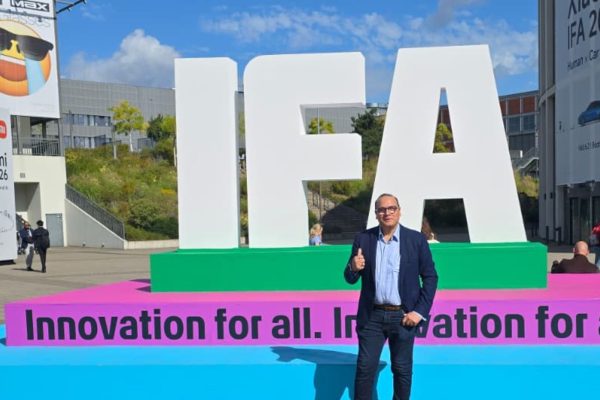
IFA 2026 once again demonstrated why Berlin remains one of the most important meeting points for the global consumer electronics, home appliance and future-technology industries. Held from 4–8 September 2026 at Messe Berlin, the event brought together more than 2,000 exhibitors and around 240,000 visitors from 155 countries, according to the official post-event figures released by IFA. (Source: IFA Berlin 2026 – Innovation For All)
For Wired and Wireless Technology (WAWT), IFA 2026 offered particularly interesting signals across wireless power, charging infrastructure, power supplies, smart appliances, wearables, robotics and AI-enabled consumer devices.
The most important observation from our perspective was that AI is no longer being presented simply as a feature added to an existing product. It is increasingly becoming part of the underlying architecture of consumer technology.
At the same time, wireless power appears to be entering another important stage. Qi2 25W is moving from technology announcement towards broader product deployment, while multi-device charging, magnetic alignment, active thermal management and modular charging ecosystems are becoming increasingly important.
IFA 2026 therefore provided an interesting picture of where consumer technology is heading: AI is becoming more invisible and proactive, while power delivery is becoming faster, more intelligent, more integrated and increasingly wireless.
NEWS RELATED TO WIRELESS POWER
Wireless Charging at IFA 2026: Qi2 25W Takes Centre Stage
For WAWT, one of the most important technology developments at IFA 2026 was the increasing visibility of Qi2 25W.
The Wireless Power Consortium’s Qi2 25W specification is based on Qi v2.2.1 and provides substantially higher wireless charging power than the original 15W Qi2 implementation. WPC states that Qi2 25W provides nearly 70% more power than the original Qi2. (Source: Wireless Power Consortium)
IFA 2026 showed that this is now translating into a broader product ecosystem.
UGREEN showcased its MagFlow Pro 3-in-1 Magnetic Wireless Charging Stand, officially listed by IFA as a featured 25W product. (Source: IFA Berlin 2026 – Innovation For All)
The broader MagFlow range also demonstrates another important trend: wireless charging is increasingly being designed around complete device ecosystems rather than individual devices.
A typical charging setup is now expected to support a smartphone, smartwatch and earbuds within a single compact charging system.
This is becoming particularly relevant as consumers increasingly own several connected devices.
Wireless Power for the Smart Kitchen: Ki Takes Another Step Forward
One of the most strategically interesting developments for WAWT was the growing visibility of the Ki Cordless Kitchen Standard from the Wireless Power Consortium.
The WPC’s Ki standard is designed to deliver up to 2,200W of inductive power to kitchen appliances without conventional power cords or batteries. (Wireless Power Consortium)
At IFA 2026, Ki was specifically featured in the programme session:
“Wireless Power and the Future of Smart Kitchens.”
The WPC also announced demonstrations of Ki at IFA 2026, highlighting its potential to change kitchen design and appliance interaction. (PR.com)
This is potentially much more significant than simply removing a cable.
A cordless kitchen could allow:
- More flexible appliance placement
- Concealed power transmitters
- Cleaner countertops
- Easier cleaning
- Intelligent appliance identification
- Automatic power delivery
- New appliance form factors
- Better integration between kitchen surfaces and appliances
The WPC’s Ki ecosystem is particularly interesting because the standard is designed around interoperability and safety, rather than relying exclusively on proprietary implementations. (Wireless Power Consortium)
WAWT View: WPC’s Ki could eventually become to kitchen appliances what Qi has become to mobile-device charging a standardised wireless power architecture capable of creating an entirely new product ecosystem. Saying so, WAWT’s witnessed other wireless power solutions related to kitchen appliances i.e. Kitchenery and BeCordless.
Resillion Strengthens Ki Cordless Kitchen Ecosystem: Resillion demonstrated the Ki Cordless Kitchen technology at IFA 2026, showcasing how compatible appliances can receive power wirelessly through the worktop without traditional cables or exposed electrical contacts. The company also highlighted its Ki testing and development tools, which enable manufacturers to test and validate Ki-enabled products during development. Resillion’s role is particularly significant as it supports Ki conformance and certification, helping manufacturers address performance, interoperability and compliance requirements as cordless kitchen appliances move towards commercial deployment.
Motorola Brings Qi2.2 25W Into the Smartphone Accessory Ecosystem
Motorola introduced its moto snap wireless charger alongside the new Motorola edge 70 plus.
The charger supports up to 25W wireless charging on Qi2.2-compatible devices, with magnetic alignment and cooling-oriented design considerations. Motorola also states that supported Motorola devices can reach higher speeds using its proprietary wired charging protocol. (Source: Global Blog)
This is significant because it illustrates how Qi2 25W is increasingly becoming part of the mainstream Android ecosystem rather than remaining primarily associated with a limited group of devices.
The important development is not simply the increase from 15W to 25W. It is the emergence of a more standardised high-power wireless charging ecosystem across Android devices and accessories.
Multi-Device Charging Becomes the New Default
Another clear direction at IFA was the continued development of 3-in-1 and multi-device charging platforms.
Rather than selling a charger for one device, manufacturers are increasingly creating charging hubs designed around an entire personal technology ecosystem.
This creates a new competitive dimension for wireless power.
Charging Accessories Evolve Beyond Wattage: IFA 2026 showed that the next phase of charging innovation is not simply about increasing power output. Products such as Anker MagGo Power Bank Pro 2, Belkin UltraCharge Pro Slim Magnetic Power Bank 5K, Scosche GoBat Pro 10K 4-in-1, Zens Fold Charger Pro 3 and MOMAX 1-Power S / Pass Air demonstrate a broader convergence of magnetic attachment, portable power, multi-device charging, higher-power wireless charging and compact form factors. Zens’ latest products are particularly notable, combining Qi2.2-certified 25W charging with foldable designs and simultaneous charging for multiple devices. At the same time, Hyper and CUKTECH reinforce the continued push toward high-power GaN charging.
For WAWT, this is an important market signal: competition is increasingly moving beyond headline wattage toward thermal performance, form factor, power management, portability and the ability to serve multiple devices within a single charging ecosystem.
Wireless Power Expands Beyond Smartphones
Wireless power applications at IFA 2026 were not limited to smartphones.
The broader wearable ecosystem continues to create opportunities for wireless charging.
For example, RingConn Gen 3 uses a universal wireless charging case, demonstrating how wireless power is becoming integrated into smaller wearable ecosystems rather than relying exclusively on proprietary charging docks. (Source: RingConn)
Smart rings such as Circular Ring 3 are also pushing wireless charging into increasingly compact form factors, while NFC capabilities are adding additional functionality to these small devices.
Ultrahuman, The Next Ring and few others also exhibited their range of smart rings, with added features
The implication is important.
As wearable devices become smaller, designers face increasing constraints around:
- Battery size
- Connector durability
- Waterproofing
- Mechanical interfaces
- Charging convenience
- Common Wireless Charger compatible across sizes
Wireless charging can address several of these simultaneously.
Smart Glasses: A New Miniaturised Power Challenge
IFA 2026 highlighted smart glasses as an emerging interface between humans and technology. IFA Next featured smart glasses alongside AI wearables, robotics and smart living technologies.
For the power industry, smart glasses present a particularly demanding form-factor challenge. Designers must accommodate batteries, sensors, processors, connectivity and power-management electronics within extremely limited physical space.
As smart glasses become more capable and increasingly incorporate AI functions, power efficiency and thermal management will become increasingly important.
This could create opportunities for:
- Miniaturised power-management systems
- Higher energy-density batteries
- Efficient DC-DC conversion
- Compact wireless charging solutions
- Advanced thermal management
WAWT View: As smart glasses evolve from simple wearable accessories into continuously connected AI devices, power efficiency, miniaturisation and charging convenience could become important technology differentiators.
Source: IFA Next 2026 – Humanoid Robotics, Smart Glasses and AI Wearables
Wireless Power Powers Automotive Cabin
Wireless charging also continues to expand inside vehicles.
Automotive in-cabin charging is increasingly focused on magnetic alignment, higher power and thermal management, with 25W Qi2.2-compatible charging creating a more standardised path for future vehicle integration.
The emergence of Qi2.2-certified automotive modules is also noteworthy. For example, the WPC certification database includes automotive-grade Qi2.2 25W modules, indicating that the ecosystem is moving beyond consumer accessories towards automotive integration. (Source: JPS API)
WAWT View: In-cabin wireless charging is likely to evolve from a simple charging pad into a broader smartphone-to-vehicle interface, combining charging, positioning, thermal management and device integration.
Modular Wireless Charging: Daily Objects NODE
One particularly interesting concept was NODE from Daily Objects.
Daily Objects describes NODE as a modular wireless charging ecosystem built around a dock-and-go concept. Its modules can be attached to a central dock and can also operate independently. The ecosystem supports Qi2.2 25W charging, with modules including a phone charging stand, wireless charging disk, Apple Watch charging stand and portable lamp. (Source: IFA Berlin 2026 – Innovation For All)
This is an interesting evolution of wireless charging.
Instead of treating wireless power as a single fixed charging surface, NODE treats it as an ecosystem architecture.
WAWT View: Modular wireless power could become an interesting product strategy as consumers demand more flexibility between home, office, travel and other environments.
Cooling Becomes Increasingly Important in High-Power Wireless Charging
One of the other trends observed around Qi2 25W products is the increasing emphasis on thermal management.
As wireless charging power increases, thermal management becomes increasingly important because coil losses, power electronics losses and battery temperature can affect charging performance.
ESR’s Cyclone 25W Magnetic Charging Pad with CryoBoost is an example of this direction, combining Qi2 25W charging with active cooling and an adjustable stand.
Similarly, UGREEN’s IFA 2026 portfolio included a 25W magnetic power bank using micro-pump liquid cooling, demonstrating how thermal-management technology is beginning to become part of portable wireless charging product design. (Source: UGREEN DE)
WAWT View: The next competitive battleground for high-power wireless charging may not simply be higher wattage. It could increasingly be a combination of power, efficiency, thermal management and charging consistency.
NEWS RELATED TO POWER SUPPLY
Power Supplies: Higher Power and Redundancy Remain Important
IFA 2026 also had interesting developments in traditional power supplies.
Products such as the Chieftec Titan 1650W and redundant ATX PSU solutions demonstrate that conventional power conversion remains critical even as consumer electronics become increasingly intelligent.
The growth of AI-enabled PCs, high-performance graphics and gaming systems continues to increase demand for higher-power desktop and workstation power supplies.
This creates a parallel trend: AI increases computing capability, which increases power demand, driving the need for power supplies with greater efficiency, capacity and thermal performance.
For the power-supply industry, therefore, the AI transition represents a significant hardware opportunity rather than merely a software opportunity.
GaN Chargers: Higher Power in Smaller Form Factors
IFA 2026 also reinforced the continued evolution of GaN-based power adapters.
Although these are primarily wired charging solutions, they remain highly relevant to the power-supply industry because they provide the upstream power infrastructure for many wireless charging systems.
Vention showcased its Dash Pro 140W GaN 5.0 charger, featuring four ports and a smart display capable of showing power, current and temperature information. (Source: Vention)
The significance is not merely the 140W rating. The combination of GaN, USB-C PD 3.1, multi-port power and intelligent monitoring is becoming an increasingly common architecture for premium consumer power adapters.
Other high-power charging products highlighted around IFA included smart-display chargers from Anker and Baseus, alongside compact multi-port GaN solutions.
WAWT View: GaN chargers are increasingly transitioning from “small fast chargers” into intelligent multi-device power-management platforms.
AI-Enabled Appliances: From Smart Appliances to Autonomous Appliances
The AI theme was also strongly visible in traditional home appliances.
Miele introduced its G8 Diamond dishwasher, incorporating a camera and AI-based recognition to identify the types of items inside the dishwasher and adjust programmes accordingly. (Source: IFA Berlin 2026 – Innovation For All)
Meanwhile, LG Electronics introduced ThinQ Claw, positioning it as a conversational AI agent capable of understanding context and coordinating connected devices and services. (Source: LG)
This represents a fundamental change in smart-home architecture. The earlier smart-home model was based on the user interacting with an app to control an individual device. The emerging model is closer to user intention being interpreted by an AI agent, which can coordinate multiple devices and services to complete an action.
That transition could significantly increase the number of devices participating in an intelligent home ecosystem.
Physical AI Brings Robotics Into the Smart Home
IFA 2026 highlighted Physical AI as an emerging direction in which intelligent machines interact directly with the physical world. Robotics was presented alongside smart-home technologies as part of the broader development of increasingly autonomous consumer technology.
IFA also explored how future household robots could understand families, including their habits and preferences around cooking and eating.
For WAWT, this creates an important convergence between robotics, smart appliances, wireless connectivity and power infrastructure.
As household robots become more autonomous, charging can no longer be treated simply as a user-operated activity. Automated docking, contactless charging and other autonomous charging approaches could become part of the physical infrastructure of the intelligent home.
Source: IFA 2026 – Humanoid Robots, Physical AI and Intelligent Helpers
Source: IFA 2026 – Visionary Voices and Physical AI Programme
OTHER NEWS RELATED TO ALLIED TECHNOLOGIES
IFA 2026: From AI as a Feature to AI as Infrastructure
One of the strongest themes observed at IFA 2026 was the changing role of AI.
The industry appears to be moving away from the earlier model of “AI-enabled product” towards a much broader concept of AI-enabled environment.
AI is increasingly being embedded into PCs, smartphones, appliances, wearables, robots, home-management systems and connected ecosystems. Rather than waiting for a user to provide a command, these systems are increasingly designed to understand context, anticipate requirements and coordinate actions.
This was strongly reflected in AMD’s opening keynote, “The Era of Personal AI: Future of Imagination.” AMD positioned Personal AI around computing that understands the individual, works locally and proactively, and increasingly operates as an extension of the user rather than simply as a conventional software application.
This has important implications for the hardware ecosystem.
As AI moves closer to the device, demand will increase for:
- Higher-performance processors and AI accelerators
- On-device and edge computing
- More efficient power management
- Higher energy-density batteries
- Faster wired and wireless charging
- Advanced thermal management
- Intelligent power distribution
Our POV is AI adoption is consequently not only an AI/semiconductor story. It is also becoming a power electronics story.
More computing at the edge means more processing power at the device level. More processing means more energy consumption and thermal challenges. This creates additional opportunities for advanced power supplies, GaN-based chargers, efficient DC-DC conversion, battery-management technologies and wireless power systems.
Robotics Moves Closer to Everyday Applications
IFA 2026 also placed considerable attention on robotics.
IFA Next brought together around 300 exhibitors in 2026, with humanoid robotics forming one of the strongest themes of the innovation area. The robotics focus was complemented by smart glasses, AI wearables, exoskeletons and smart-living technologies.
The scale of the showcase is significant because it indicates that humanoid and autonomous robotics are increasingly being positioned as a broader technology platform rather than remaining primarily demonstration technologies.
Source: IFA Next 2026 – Around 300 Exhibitors and Humanoid Robotics
IFA Next highlighted humanoid and other robotic platforms from companies including Unitree, EngineAI, Agibot, DEEP Robotics, Dobot and others, with dedicated demonstrations such as “Robots on the Runway.” IFA itself described the trend as robotics moving closer to practical applications in homes, healthcare, services and industry. (IFA Berlin 2026 – Innovation For All)
This is an important transition.
The robotics opportunity is gradually moving beyond demonstrations of movement and humanoid form factors towards:
- Autonomous household tasks
- Elderly-care assistance
- Cleaning and maintenance
- Industrial and service applications
- Human-machine interaction
- Autonomous mobility
- AI-powered decision making
The combination of AI, robotics, wireless connectivity and autonomous operation creates another potential growth area for wireless power.
Robots cannot always rely on conventional plug-in charging. Autonomous robots, AMRs and service robots increasingly require charging strategies that minimise downtime and human intervention.
As robot fleets expand, the charging architecture itself can become a competitive differentiator. Contactless charging, automated docking, magnetic alignment and potentially resonant wireless power could increasingly become part of robotic infrastructure.
Physical AI introduces a different power requirement from conventional consumer electronics.
An autonomous robot may need to continuously sense its environment, process information, communicate and respond to physical changes. This creates a closer relationship between energy availability, system autonomy and operating time.
For WAWT, the opportunity extends beyond the battery itself to power-management electronics, DC-DC conversion, motors and actuators, sensors, AI computing and autonomous charging.
As autonomous machines become more capable, efficient power conversion and automated charging could become increasingly important to maintaining uptime.
Source: IFA 2026 – Humanoid Robots, Physical AI and Intelligent Helpers
China’s Growing Influence on the Global Consumer Technology Landscape
Another significant observation at IFA 2026 was the scale of Chinese participation.
According to reporting from the event, approximately 931 of around 1,900 exhibitors were from China, while other post-event figures from IFA put total exhibitors above 2,000. (Source: Beckmann)
Chinese brands were visible across a broad range of categories including:
- Smartphones
- Smart home
- Robot vacuums
- Robotics
- Wearables
- Charging accessories
- Power products
- Appliances
- AI-enabled consumer electronics
Xiaomi was particularly prominent, with its IFA presence covering its broader Human, Car and Home ecosystem. IFA describes Xiaomi’s platform as connecting personal devices, smart-home products and smart vehicles through its AIoT ecosystem. (IFA Berlin 2026 – Innovation For All)
The significance goes beyond the number of exhibitors. Chinese companies are increasingly competing through ecosystem integration, rapid product cycles, aggressive pricing and vertical technology integration.
This could put further pressure on established consumer-electronics brands, while simultaneously accelerating adoption of technologies such as wireless charging, GaN power supplies, smart appliances and AI-enabled devices.
WAWT’s Key Takeaways from IFA 2026
From WAWT’s perspective, IFA 2026 highlighted several important market directions:
1. AI is becoming infrastructure
AI is moving from a differentiating feature to an underlying capability embedded across consumer electronics, appliances, computing and robotics.
Source: IFA 2026 – Record Results and Technology Trends
2. Edge AI will increase power requirements
More intelligence at the device level means greater requirements for efficient processors, power management, thermal solutions and batteries.
Source: IFA 2026 – Record Results and Technology Trends
3. Qi2 25W is entering a broader deployment phase
The growing number of 25W products suggests that high-speed standardised wireless charging is moving towards wider adoption.
Source: Wireless Power Consortium – Qi2 and Qi2 25W
4. Multi-device charging is becoming the norm
Consumers increasingly expect one charging ecosystem for smartphones, watches, earbuds and other accessories.
Source: Wireless Power Consortium – Qi2 Wireless Charging
5. Thermal management is becoming critical
Higher wireless charging power increases the importance of cooling, efficiency and charging consistency.
Source: Wireless Power Consortium – Qi2 Wireless Charging
6. Wireless power is expanding beyond smartphones
Wearables, automotive cabins, robotics and potentially kitchen appliances represent increasingly important application opportunities.
Sources:
Wireless Power Consortium – Qi2 Wireless ChargingWireless Power Consortium – Ki Cordless KitchenIFA 2026 – Humanoid Robots and Physical AI
7. GaN is becoming smarter
The next generation of GaN adapters is combining high power density with multiple ports, USB-C PD, displays and intelligent power management.
Source: Vention – Dash Pro 140W GaN5.0 Charger with Smart Display
8. Ki could create a new wireless-power category
The cordless kitchen represents one of the most ambitious opportunities for wireless power beyond mobile electronics.
Source: Wireless Power Consortium – Ki Cordless Kitchen
9. Robotics creates new charging requirements
As autonomous robots become more common, automated and contactless charging could become increasingly valuable.
Source: IFA 2026 – Humanoid Robots, Physical AI and Intelligent Helpers
10. Ecosystem competition is intensifying
IFA 2026 showed that companies are increasingly competing not just through individual products but through interconnected ecosystems spanning devices, software, AI and power.
Source: IFA 2026 – Record Results and Technology Trends
11. Smart Glasses Create New Miniaturised Power Challenges
AI-enabled smart glasses introduce tighter constraints around battery capacity, power electronics, thermal management and charging. Miniaturised power architectures could become increasingly important as functionality expands.
Source: IFA Next 2026 – Humanoid Robotics, Smart Glasses and AI Wearables
12. Physical AI Is Creating New Power Requirements
As AI moves into autonomous machines that continuously sense, compute and act, power availability and energy efficiency become increasingly linked to system autonomy and operating time.
Source: IFA 2026 – Humanoid Robots, Physical AI and Intelligent Helpers
13. Power Infrastructure Is Moving Into the Environment
Across robotics, smart homes, creator workflows and multi-device charging, power is increasingly becoming part of the physical environment and ecosystem rather than a standalone accessory.
Sources:
IFA 2026 – Humanoid Robots and Physical AIWireless Power Consortium – Ki Cordless Kitchen
Footnote
WAWT has endeavoured to capture the key technology developments, product launches, demonstrations, announcements and industry discussions observed during its presence and engagement around IFA 2026 in Berlin.
This insight represents a summarised version of WAWT’s event-based market intelligence, with particular focus on wireless power, power supplies, charging technologies, smart appliances, AI-enabled consumer electronics, wearables, robotics and related emerging applications.
The above observations are not intended to represent an exhaustive list of all IFA 2026 announcements. Product specifications and market availability can vary by region and may change following initial announcements. WAWT has also referenced company announcements, IFA information and industry sources to support the observations presented above.
For WAWT, the key message from IFA 2026 is clear that AI is making consumer technology increasingly autonomous, while advanced power technologies are enabling that intelligence to operate everywhere.
From Qi2 25W smartphones and wearable charging to GaN adapters, automotive wireless charging, robotic systems and the emerging Ki cordless kitchen, the role of power is expanding from a supporting function to a fundamental part of the product experience.
About WAWT
Wired and Wireless Technology (WAWT) is a strategic technology analyst and consultancy firm specialising in the wireless power and power supply industries.
WAWT provides market intelligence, technology analysis, strategic consultancy and bespoke research covering wireless power technologies including inductive, resonant, NFC, RF and infrared power, as well as AC-DC and DC-DC power supplies, external adapters and chargers.
Through its Wireless Power Intelligence Serviceand Power Supply Intelligence Service, WAWT tracks technology developments, application markets, vendors, power classes, regional trends, market shares, emerging technologies and long-term market opportunities.
WAWT’s analysts regularly engage with companies, technology developers, industry associations and key events across the global power-electronics ecosystem to understand not only what technologiesare being demonstrated today, but where they are likely to create commercial opportunities tomorrow.
To discuss the latest market trends, technology developments and insights from IFA 2026, please contact our subject matter expert Dinesh Kithany Founder & Chief Analyst Wired and Wireless Technology (WAWT) analyst@wawt.tech
Contact WAWT to discuss the full IFA 2026 event-based insight report and the latest wireless power and power-supply market intelligence.