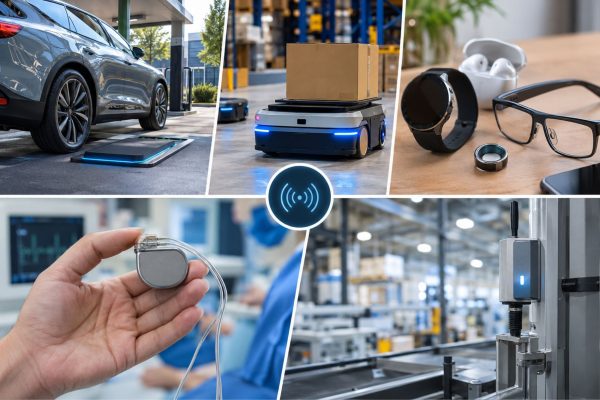
Wireless power is entering a new phase of market development. While smartphones remain a key volume driver, the next wave of opportunities is emerging in electric mobility, autonomous robotics, advanced wearables, medical devices and industrial automation. These application markets are not following the same adoption curve as each of them has a distinct combination of power requirements, integration challenges, design constraints, deployment economics and commercial readiness.
For technology developers, component suppliers and investors, the strategic question is no longer simply where wireless charging can be implemented. It is where removing the physical charging connection/ports creates enough operational or product-design value to justify the additional system cost.
1. e-Mobility: Moving from Convenient Charging to Charging Infrastructure
Electric vehicle (EV) wireless charging is progressing beyond experimental demonstrations, although commercial adoption remains dependent on vehicle availability, infrastructure investment and interoperability. The near-term opportunity is likely to be concentrated in stationary charging for passenger vehicles, commercial fleets, taxis, buses and vehicles operating on predictable routes.
The economics become particularly attractive where vehicles return repeatedly to the same locations. Automated charging can reduce driver intervention, simplify fleet operations and potentially improve vehicle utilisation. For autonomous vehicles, eliminating manual plug-in operations is especially relevant because charging becomes part of the vehicle’s automated operating cycle.
Developments in dynamic wireless power transfer also warrant attention. In October 2025, VINCI Autoroutes reported real-traffic trials on a 1.5 km section of France’s A10 motorway. The project demonstrated instantaneous power transfer above 300 kW and average transfer above 200 kW under optimal steady-state conditions. These are significant technical milestones, but they should not be interpreted as evidence of widespread commercial deployment.
Latest development (E.G.): In October 2026, Honda announced foundational technology for in-motion EV wireless charging developed with Taisei and Taisei Rotec, with demonstration testing planned from Japan’s fiscal year 2027.
2. Robotics: Wireless Charging Becomes an Operational Advantage
Autonomous mobile robots (AMRs), automated guided vehicles (AGVs), warehouse robots and industrial material-handling systems represent a particularly compelling application for wireless power. Here, charging downtime affects throughput, labour requirements and fleet utilisation.
Wireless charging can allow robots to recharge automatically at designated locations during operational pauses, without requiring exposed contacts or manual cable connections. For industrial environments, the value proposition extends beyond convenience to charging automation, reduced connector wear and simplified fleet management.
The market has an important advantage over some emerging consumer applications: robots already operate within controlled environments, often following repeatable routes and returning to predictable charging locations. This makes it easier to integrate charging infrastructure into facility layouts and operating schedules.
Latest development (E.G.): In April 2026, Delta Electronics announced that its MOOV Series wired and wireless charging solutions had collectively charged more than one million industrial vehicles worldwide, including AGVs, AMRs, forklifts and other material-handling vehicles. The figure covers wired and wireless solutions together, so it should not be treated as a wireless-only installed-base statistic.
Similarly other wireless power technology companies like Wiferion (Part of PULS), MultiPowr, Xnergy, ENRX, Conductix-Wampfler, CaPow, WiBotic, B&Plus, ZoneCharge, PowerWave, and others are building innovative wireless power solutions catering to wide profile of customers and their specific needs.
3. Wearables: Solving the Charging Problem in Smaller Devices
Wearables are creating a different wireless power opportunity and becoming an integral part of the total solution and customer experience. Smart rings, hearables, portable health-monitoring devices and AI-enabled smart glasses have limited space for batteries, connectors and charging hardware. Product designers must balance operating time, size, comfort, thermal constraints and industrial design. Design optimisation is the key as well as battery/power management.
Smart glasses illustrate this tension particularly well. Exposed charging contacts can complicate sealing and affect the appearance of a product intended to resemble conventional eyewear. Wireless power could offer manufacturers more flexibility in frame design and charging-case integration.
Latest development (E.G.): In June 2026, NuCurrent, innovative wireless power technology company, demonstrated its Fast Frames NFC wireless charging technology for smart glasses at Augmented World Expo. According to reporting by Digital Trends, the company said its system could charge to 50% in 20 minutes while removing exposed charging contacts.
The wider opportunity is not limited to glasses. NFC-based wireless power, compact inductive receivers and specialised charging cases could support increasingly diverse wearable designs. However, low available power, coil or antenna integration, charging alignment and heat dissipation remain important constraints.
4. Medical Devices: High-Value Applications with Demanding Requirements
Medical applications offer a different commercial profile: volumes may be lower than consumer electronics, but the value of reliable, compact and sealed power delivery can be substantially higher. Implantable devices, specialised therapeutic equipment and selected wearable medical products can benefit from reduced dependence on exposed connectors.
However, medical wireless power is not a straightforward extension of consumer charging. Tissue interaction, thermal limits, electromagnetic compatibility, packaging, biocompatibility and regulatory requirements all influence system design. Reliability and safety validation can lengthen development cycles, while the cost of failure is considerably higher.
Latest development (E.G.): On 29 September 2026, Resonant Link Medical announced Vivigo 2.0, a wireless power and data platform for implantable medical devices. The company positioned the platform around integration support and reducing development risk for device manufacturers.
The significance is the move towards platforms that help medical-device companies integrate wireless power and data transfer without developing every subsystem from scratch. This could lower engineering barriers, although individual applications will still require appropriate validation.
5. Industrial Automation and Infrastructure: Powering Devices Beyond the Charging Pad
Industrial sensors, distributed monitoring equipment, smart infrastructure and automated facilities create opportunities for wireless power were replacing or maintaining electrical connections is costly. Applications may include sensors installed in hard-to-access locations, rotating equipment and selected battery-powered monitoring systems. Wireless power technology (RF and others) are enabling large profile of Industrial IoT (IIoT) sensors, which otherwise wouldn’t have been present or solve key problems.
The business case depends on the operating environment. Wireless power may reduce maintenance requirements or enable new installation locations, but it must compete against wired power, battery replacement and energy-harvesting alternatives. For low-power devices, RF or other specialised approaches may be relevant; higher-power applications are more likely to require carefully engineered near-field systems.
Industrial adoption is therefore likely to be application-specific rather than a uniform transition across factories and infrastructure.
Tracking the Wireless Power Market Opportunity
For companies assessing where to invest, the challenge is distinguishing technical momentum from commercially addressable demand. Announced demonstrations, patent activity and product launches provide useful signals, but they need to be evaluated alongside adoption forecasts, supplier positioning, application requirements and realistic deployment timelines.
WAWT’s Wireless Power Market Tracker Report 2026 supports this assessment with market intelligence for organisations evaluating wireless power opportunities, emerging applications and competitive developments.
Between 2026 and 2030, the most important question will not be which application generates the most headlines. It will be which applications can translate technical progress into repeatable deployments, sustainable economics and scalable demand for wireless power components and systems.
About WAWT
Wired and Wireless Technologies (WAWT) is a strategic technology analyst and consulting firm specializing in wireless power technology and power supply markets.
Through our Wireless Power Intelligence Service, WAWT provides market estimates, long-term forecasts, technology and application analysis, market intelligence and competitive insights across wireless power technologies including inductive, resonant, NFC, RF, infrared and multi-frequency solutions.
WAWT tracks technology adoption across 30+ application markets, spanning automotive, consumer electronics, computing, wearables, healthcare, industrial, robotics, retail, smart home, infrastructure and other emerging sectors.
Our research and strategic intelligence help companies understand where markets are moving, why they are changing, and where the next opportunities are emerging.
For market intelligence, customized research or strategic advisory support, contact WAWT Subject Matter Experts at analyst@wawt.tech.Follow WAWT on LinkedIn for the latest market trends, forecasts and technology insights.