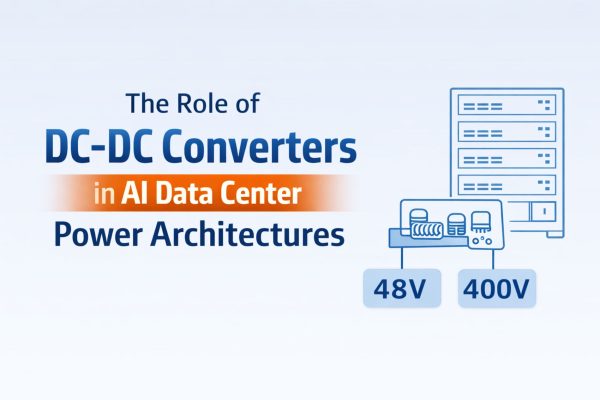
The rapid rise of artificial intelligence (AI) workloads is fundamentally transforming data center power architectures. From training large language models (LLMs) to supporting real-time inference, AI servers particularly GPU-accelerated systems demand significantly higher power density, efficiency, and reliability. At the heart of this transformation lies a critical yet often overlooked component: the DC-DC Converter.
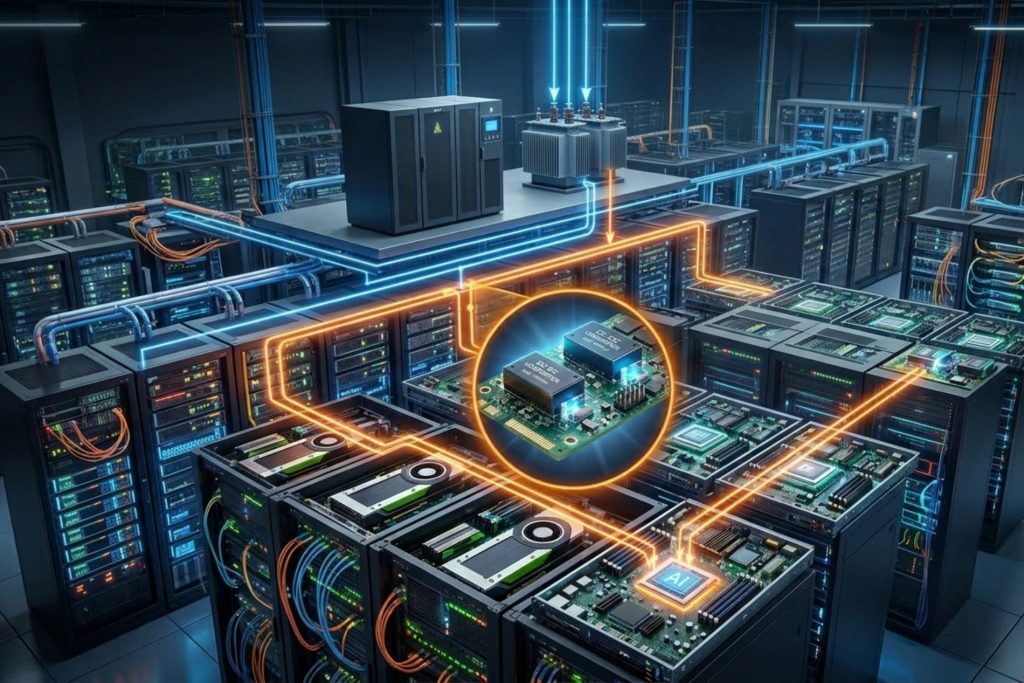
DC-DC Converters play an important role in stepping down and regulating voltage levels within data centers, ensuring that power is delivered efficiently from the grid to the processor. As AI workloads push infrastructure to new limits, the importance of advanced DC-DC power solutions has never been greater.
Key Roles of DC-DC Converters in AI Data Center Power Supply
1. Efficient Voltage Conversion for High-Performance Processors
AI processors such as GPUs, TPUs, and custom accelerators operate at very low voltages (often below 1V) but require extremely high current. DC-DC converters step down higher distribution voltages (such as 48V) to these low levels with high efficiency, minimizing power loss and heat generation.
2. Enabling High Power Density Architectures
Modern AI data centers are designed for maximum compute per rack. DC-DC converters enable compact and highly efficient power delivery networks (PDNs), supporting increased rack power densities without compromising performance or thermal stability.
3. Point-of-Load (PoL) Regulation
DC-DC converters are typically deployed close to the load (processors and memory), known as Point-of-Load (PoL) converters. This proximity ensures tight voltage regulation, fast transient response, and reduced distribution losses critical for dynamic AI workloads.
4. Improving Energy Efficiency and Reducing Operational Costs
Energy efficiency is a top priority in hyperscale data centers. High-performance DC-DC converters, especially those using advanced topologies and wide bandgap semiconductors, significantly reduce conversion losses, helping operators lower total cost of ownership (TCO).
5. Supporting Scalability and Modularity
AI data centers are increasingly adopting modular architectures. DC-DC converters enable scalable power systems, allowing operators to expand compute capacity without redesigning the entire power infrastructure.
Evolution to Higher Voltages in Data Centers
One of the most significant trends in AI data center power design is the shift toward higher voltage distribution systems. Traditionally, 12V architectures dominated server power delivery. However, as power demands increased, inefficiencies in distributing high current at low voltages became evident.
Transition from 12V to 48V Architectures
The industry is rapidly moving towards 48V power distribution. This transition offers several advantages:
- Reduced Current Losses: Higher voltage means lower current for the same power, reducing I²R losses.
- Improved Efficiency: Less power is wasted as heat during transmission.
- Simplified Cabling: Lower current allows for thinner cables and improved system design.
DC-DC converters play a crucial role in this transition by efficiently stepping down 48V to intermediate bus voltages and eventually to sub-1V levels required by AI chips.
Emerging Trends: +/- 400V DC Distribution
Looking ahead, some hyperscale operators are exploring +/- 400V DC distribution within data centers to further improve efficiency and reduce infrastructure complexity. This evolution will require next-generation DC-DC converters capable of handling higher input voltages while maintaining safety and performance.
Rack Power Density: A New Benchmark in AI Data Centers
Rack power density has become a key metric in evaluating data center performance. Traditional enterprise data centers typically operated in the range of:
- 5 kW to 10 kW per rack
However, with the rise of AI and high-performance computing (HPC), this range has dramatically increased:
- Modern AI Data Centers: 20 kW to 50 kW per rack
- High-Density AI Clusters: 100 kW to 200 kW+ per rack
Some cutting-edge deployments are even exceeding 100 kW per rack, driven by GPU-intensive workloads.
This surge in rack density places immense pressure on power delivery systems. DC-DC converters must now handle higher currents, faster load transients, and stricter efficiency requirements all within smaller form factors.
Advanced Technologies Driving DC-DC Innovation
Wide Bandgap Semiconductors (GaN and SiC)
The adoption of Gallium Nitride (GaN) and Silicon Carbide (SiC) is revolutionizing DC-DC converter performance. These materials enable higher switching frequencies, reduced losses, and improved thermal performance, making them ideal for AI data center applications.
Digital Power Management
Digital control techniques are enhancing the flexibility and intelligence of DC-DC converters. Features such as real-time monitoring, adaptive voltage scaling, and predictive maintenance are becoming increasingly important in AI-driven environments.
Thermal Management and Cooling Integration
As power densities increase, effective thermal management becomes critical. DC-DC converters are being designed with advanced cooling solutions, including liquid cooling compatibility, to maintain performance under extreme conditions. Liquid cooling technology has almost become a mainstream technology integrated with such high-power solutions / rPDUs (rack power distribution units).
Integration and Miniaturization
To meet space constraints, manufacturers are integrating multiple power stages into compact modules. This trend supports higher efficiency and simplifies system design.
Challenges in AI Data Center Power Design
Despite their advantages, DC-DC converters face several challenges in AI data centers:
- Thermal Constraints: Managing heat in high-density environments
- Efficiency vs. Size Trade-offs: Balancing compact design with performance
- Dynamic Load Handling: Supporting rapid changes in AI workloads
- Reliability Requirements: Ensuring continuous uptime in mission-critical systems
Addressing these challenges requires continuous innovation in converter design, materials, and system integration.
The Future of DC-DC Converters in AI Infrastructure
As AI continues to evolve, data center power architectures will become even more sophisticated. DC-DC converters will play a central role in enabling:
- Higher efficiency power delivery networks
- Scalable and modular infrastructure
- Integration with renewable energy and energy storage systems
- Intelligent, software-defined power management
The convergence of AI and advanced power electronics will drive the next wave of innovation, making DC-DC converters indispensable to the future of digital infrastructure.
About WAWT
Wired and Wireless Technologies (WAWT) is a strategic technology analyst and consultancy firm specializing in power supply and wireless power technology industries. WAWT provides critical market data, delivers, in-depth market insights and market intelligence, and competitive analysis across AC-DC and DC-DC power supplies, and various wireless power/charging technologies.
WAWT’s flagship research offerings the AC-DC and DC-DC Merchant Power Supply Market Report and the External Power Adapters and Chargers Market Report is industry’s most comprehensive research on the power supply market and provides market sizing (historic and current), five-year annual forecasts, technology trends, and competitive intelligence. These insights support organizations across data centers, servers, storage, networking, telecom, medical, industrial, lighting, military and civil defence, and railway sectors in aligning strategies with rapidly evolving power requirements, including those driven by AI workloads.
Request our brochure and sample reports to explore the scope and coverage of our research solutions.
Contact our analyst team at analyst@wawt.tech to schedule a FREE 30-minute discovery call for research and advisory support.
Subscribe to our monthly newsletter, “Power Bulletin,” and follow WAWT on LinkedIn for the latest market trends, insights, updates, and forecasts across power supply and wireless power technologies.