Key Takeaways
- AI is driving a shift from 48V to 800V DC power architectures
- Power supply is becoming a strategic layer in AI infrastructure
- Delta Electronics is emerging as a key player in NVIDIA’s ecosystem
- High-density PSU (3kW–10kW+) demand is accelerating
- Solid-State Transformers are promising but not yet scalable
The rapid rise of AI infrastructure is redefining not just compute, but the entire power delivery ecosystem behind it. As GPU-driven workloads are scaling aggressively, companies like NVIDIA are pushing the boundaries of server architecture creating unprecedented demand for high-density, high-power, high-efficiency, and scalable power solutions.
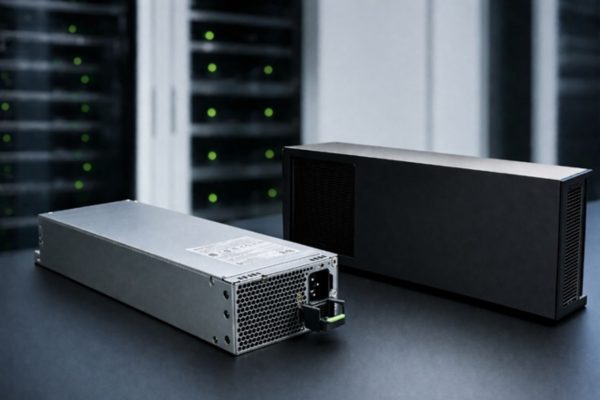
Delta Electronics is emerging as a key power supply partner in NVIDIA AI servers, driven by its early investment in 800V DC architecture, high-efficiency power systems, and strong system-level integration capabilities.
Delta Electronics in NVIDIA AI Servers: 800V Power Shift Explained (2026)
Within this fast-evolving landscape, Delta Electronics, world’s leading power supply company (#1 as per WAWT’s Power Supply Intelligence Service),has emerged as a key contender, successfully carving out a position in NVIDIA’s AI server power supply ecosystem. This achievement is not accidental, it is the result of long-term R&D, strategic timing, and a focused push into emerging power architectures such as the 800V (+/- 400V) DC era.
| Architecture | Voltage | Efficiency | Use Case |
|---|---|---|---|
| Traditional | 12V | Low | Legacy servers |
| Intermediate | 48V | Medium | Current data centers |
| Next-gen | 800V DC | High | AI & hyperscale |
The Shift Towards the 800V (=/- 400V) DC Era
AI data centers are undergoing a structural transformation. Traditional 12V and even 48V architectures are increasingly being challenged by the need for higher efficiency and lower transmission losses at scale. This has accelerated interest in 800V (+/- 400V) DC power distribution, particularly at the rack and data center level.
The move toward 800V DC is driven by several factors:
- Reduced current for the same power level, minimizing I²R losses
- Improved power density and cable efficiency
- Better alignment with renewable energy and energy storage systems
- Simplified integration with next-generation power conversion topologies
For companies like NVIDIA, which are deploying high-performance GPUs across hyperscale environments, these benefits are critical. However, transitioning to 800V DC requires a completerethink of power architectures, including conversion stages, insulation, safety, and system integration.
Delta Electronics’ early investments in high-voltage power conversion and advanced power electronics positioned it ahead of many competitors as this transition began gaining momentum.
Moving Into the “Gray Space” Dominated by Foreign Brands
Historically, the high-end server power supply market especially for hyperscale and HPC applications has been dominated by a small group of established global players. These companies built their leadership through decades of specialization in:
- High-efficiency PSU design
- Deep integration with server OEMs and ODMs
- Proven reliability at scale
This created a “gray space” a segment of the market that is technically demanding, relationship-driven, and difficult for new entrants to penetrate.
Delta Electronics’ strategy to enter this space was deliberate:
1. Long-Term R&D Commitment: Rather than competing on commoditized power supplies, Delta Electronics focused on:
- High-density server PSUs (3kW–5kW-10kW and beyond, so far)
- Titanium-level efficiency platforms
- Advanced thermal and cooling compatibility (including liquid cooling readiness)
2. System-Level Understanding: Delta Electronics evolved from a component supplier to a system-aware power solutions provider, aligning closely with:
- AI server architectures
- Rack-level power distribution
- Hyperscaler requirements
3. Strategic Timing: As AI workloads began reshaping infrastructure requirements, incumbents faced the challenge of adapting legacy designs. Delta Electronics leveraged this transition window to introduce next-generation designs optimized for AI workloads, rather than retrofitting older platforms.
By doing so, Delta Electronics effectively entered a segment long dominated by foreign brands and positioned itself as a credible alternative in the AI power supply value chain.
Integration Challenges for Solid-State Transformers (SSTs)
As the industry explores higher voltage architectures like 800V (+/- 400V) DC, Solid-State Transformers (SSTs) are gaining attention as a potential enabler for future data center power systems.
SSTs offer several theoretical advantages:
- High-frequency operation enabling compact designs
- Improved voltage regulation and control
- Potential for direct integration with DC distribution systems
- Enhanced compatibility with renewable energy sources
However, integrating SSTs into AI data center environments presents significant challenges:
1. Thermal Management Complexity
AI servers already generate extreme thermal loads. Adding SSTs introduces additional heat sources that must be managed without compromising system efficiency.
2. Efficiency at Scale
While SSTs are promising, maintaining high efficiency (>96–97%) at large power levels remains a challenge, especially under dynamic AI workloads.
3. Cost and Commercial Viability
SSTs are still relatively expensive compared to traditional transformer-based systems, making large-scale deployment economically challenging.
4. Standardization Gaps
The lack of standardized architectures for SST integration in data centers creates uncertainty for OEMs and hyperscalers.
Delta’s Strategic Advantage in This Context
Delta’s competitive edge lies in its ability to bridge current and future architectures:
- It continues to deliver high-performance traditional and 48V-based solutions for immediate deployment
- Simultaneously, it is investing in next-generation technologies aligned with 800V DC and SST integration pathways
This dual approach allows Delta to:
- Meet current hyperscaler demands
- Stay prepared for future architectural shifts
- Reduce risk associated with rapid technology transitions
Moreover, Delta Electronics’ strengths in power electronics, thermal design, and manufacturing scale give it a unique advantage in addressing the complexities of AI infrastructure.
Industry Implications
Delta’s rise within NVIDIA’s ecosystem reflects broader shifts in the industry:
- Power supply is becoming a strategic enabler of AI performance, not just a supporting component
- The transition to higher voltage architectures (like 800V DC) is inevitable for scaling AI infrastructure
- New entrants with strong R&D capabilities can disrupt traditionally closed ecosystems
- Integration of advanced technologies like SSTs will define the next phase of innovation in data centers
Conclusion
Delta Electronics’ journey into NVIDIA’s AI server power ecosystem is a powerful example of how long-term R&D, strategic foresight, and technological alignment can unlock high-barrier markets.
By investing early in high-density power solutions and positioning itself for the 800V DC transition, Delta Electronics has successfully moved into a competitive space long dominated by established players. At the same time, its forward-looking approach to emerging technologies like SSTs ensures it remains relevant as the industry evolves.
As AI continues to reshape global infrastructure, the companies that can innovate at the intersection of power, performance, and efficiency will define the future and Delta Electronics is now firmly part of that conversation.
“Power architecture is becoming as critical as compute architecture in AI systems.”
WAWT Insight: Power architecture is becoming as critical as compute architecture in AI infrastructure, with high-voltage DC systems set to redefine data center efficiency.
“800V DC is not an upgrade, it is a necessity for scaling AI infrastructure.”
About WAWT
Wired and Wireless Technologies (WAWT) is a strategic technology analyst and consultancy firm specializing in power supply and wireless power technology industries. WAWT provides critical market data (current estimates and next five-year annual forecast), delivers in-depth market insights and market intelligence, and competitive analysis across AC-DC and DC-DC power supplies, and various wireless power/charging technology markets.
WAWT’s flagship research offerings the ‘Global AC-DC and DC-DC Merchant Power Supply Market Report’ and the ‘External Power Adapters and Chargers Market Report’ are the industry’s most comprehensive research studies on the power supply market. These reports provide market sizing (historic and current), five-year annual forecasts, technology trends, and competitive intelligence. The 2026 Edition of these two core reports on power supply market are scheduled to be published around July 2026. If interested please contact us at the earliest, for pre-publication discounted offer to subscribe.
These insights support organizations across data centers, servers, storage, networking, telecom, medical, industrial, lighting, military and civil defence, and railway sectors in aligning strategies with rapidly evolving power requirements, including those driven by AI workloads.
Request our brochure and sample reports to explore the scope and coverage of our research solutions.
Contact our analyst team at analyst@wawt.tech to schedule a FREE 30-minute discovery call for research and advisory support.
Subscribe to our monthly newsletter, “Power Bulletin,” and follow WAWT on LinkedIn for the latest market trends, insights, updates, and forecasts across power supply and wireless power technologies.