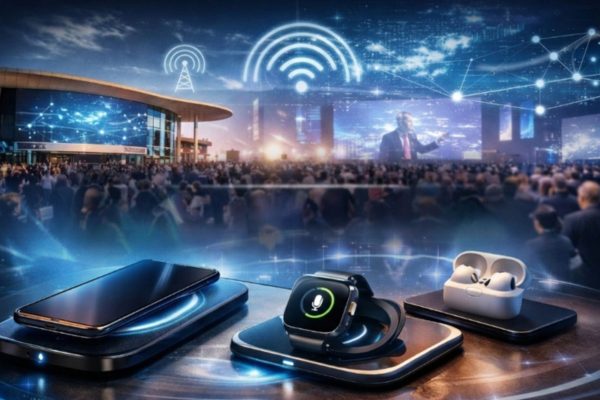
Each year, MWC offers a glimpse into what the mobile ecosystem will prioritize next. In 2026, one theme is becoming increasingly clear: wireless power is evolving from a convenience feature into a foundational infrastructure layer for connected devices. What began as a wireless charging alternative is now shaping device architecture, user experience, and ecosystem design across smartphones and wearables.
Beyond technology demonstrations at MWC Barcelona 2026, the most important signal for stakeholders is the market trajectory of wireless power. The industry is transitioning from early adoption to structured commercialization, driven by ecosystem alignment across device manufacturers, infrastructure providers, and component suppliers.
Wireless Power Is Moving Up the Value Stack
Historically, wireless charging competed with wired charging on efficiency and speed. That comparison is now becoming less relevant. The strategic value of wireless power lies in enabling new device design frameworks and ecosystem-level energy management.
Smartphone and wearable manufacturers are increasingly designing products assuming wireless power availability as a baseline capability. This shift is visible in three structural trends:
1. Port minimization and sealed device architecture
As manufacturers pursue higher durability standards and design simplification, reducing physical connectors has become a priority. Wireless power supports sealed architectures that improve water resistance, mechanical reliability, and manufacturing efficiency. Over time, this design logic supports fully portless devices, which depend on wireless energy transfer as a primary power pathway.
2. Battery optimization rather than battery expansion
Instead of continuously increasing battery size, device makers are optimizing battery capacity around predictable wireless energy access. This enables thinner form factors and reduces material requirements while maintaining user-perceived endurance.
3. Energy as a continuous service
Charging is shifting from an event-based activity to an environmental condition. Devices are being designed to opportunistically receive energy throughout the day rather than rely on dedicated charging sessions.
These changes signal that wireless power is transitioning from a feature embedded within devices to an infrastructure capability embedded within environments.
Smartphones: Power Architecture as a Differentiation Lever
In the smartphone market, hardware performance improvements are increasingly incremental. As a result, differentiation is moving toward system-level design decisions, and power architecture is becoming one of the most influential factors.
Wireless power integration enables manufacturers to rethink internal layout constraints. Eliminating reliance on wired charging interfaces allows more flexible component placement, improved thermal pathways, and expanded space for sensors and imaging systems. This has implications not only for performance but also for long-term product reliability and lifecycle cost.
Another emerging dimension is accessory ecosystem expansion. Wireless power facilitates seamless interoperability between smartphones and complementary devices such as earbuds, styluses, and external modules. Energy sharing and multi-device charging capabilities strengthen ecosystem lock-in and create new revenue channels through accessory innovation.
Wearables: Enabling Persistent Operation
Wearables represent the most immediate beneficiary of wireless power infrastructure. Unlike smartphones, wearables operate within extreme physical and energy constraints. Battery capacity is inherently limited, yet usage expectations increasingly demand continuous sensing, connectivity, and processing.
Wireless power integration addresses this constraint by enabling frequent micro-charging or ambient energy replenishment. The result is a shift from battery-limited operation to availability-driven operation.
This transition supports several high-value applications:
- Continuous health and biometric monitoring
- Industrial safety wearables with uninterrupted operation
- Always-on communication and location tracking
- Medical and therapeutic wearable devices
In these contexts, wireless power is not a convenience feature; it is an enabling condition for product viability.
The Emergence of Shared Power Environments
A key insight from the current innovation cycle is the expansion of wireless power beyond device-centric charging to environment-centric energy delivery.
Manufacturers and infrastructure providers are exploring integrated power surfaces in homes, workplaces, vehicles, and public spaces. These environments are designed to support simultaneous energy delivery across multiple device categories with improved spatial tolerance and efficiency.
This shift has several strategic implications:
Ecosystem convergence: Devices from different categories and manufacturers must operate within shared energy environments, increasing the importance of standards and interoperability.
Infrastructure investment: Wireless power deployment becomes part of physical infrastructure planning, similar to connectivity deployment.
New business models: Energy availability can be embedded into services, spaces, and platforms rather than remaining a purely hardware feature.
Technology Convergence and Market Acceleration
Wireless power innovation is accelerating through the parallel advancement of multiple technology approaches. Inductive and resonant systems continue to improve efficiency and alignment tolerance, while near-field and radio-frequency approaches are expanding use cases that require flexibility and distance.
Rather than a single dominant technology, the market is moving toward a layered technology landscape in which different wireless power methods serve distinct application requirements based on range, power level, and efficiency constraints.
This convergence is critical because infrastructure-level adoption depends on technology diversity. Smartphones, wearables, industrial sensors, and infrastructure devices operate under different energy profiles, and scalable wireless power ecosystems must accommodate this variation.
Strategic Implications for the Device Ecosystem
Wireless power’s evolution into infrastructure carries broader implications for the mobile and connected device markets:
- Device design will increasingly assume ambient energy availability.
- Battery capacity will become a system optimization variable rather than a primary differentiation metric.
- Energy delivery will influence ecosystem competition alongside connectivity and computing performance.
- Infrastructure providers will play a more central role in enabling device functionality.
In effect, wireless power is following a trajectory similar to wireless connectivity transitioning from a feature embedded in products to an environmental capability that enables entire device categories.
Opportunity to Meet & Greet WAWT at MWC 2026
WAWT will be on-site at MWC Barcelona (1–5 March 2026, Fira Gran Via) to capture key announcements, technology demonstrations, and strategic shifts shaping the wireless power ecosystem. Our SME, Dinesh Kithany, Founder & Chief Analyst WAWT will be attending the event to engage with industry leaders, discuss market developments, and share expert perspectives
Schedule a meeting with Dinesh Kithany to discuss wireless power trends, partnership opportunities, and tailored market insights.
Register / Book a Meeting: analyst@wawt.tech
1st–5th March 2026 | Fira Gran Via, Barcelona
WAWT would also be meeting companies across ecosystem to learn about the advancement in the power electronics ie power supply solution more specific to telecom sector and datacentre application markets. The data, insights and market reports would be part of WAWT’s Power Supply Intelligence Service
About Wired and Wireless Technologies (WAWT)
Wired and Wireless Technologies (WAWT) delivers comprehensive research data, insights, and market intelligence on the global wireless power ecosystem through its Wireless Power Intelligence Service. The service provides deep analysis of wireless power technology solutions across multiple frequency domains, including inductive, resonance, NFC, RF, and infrared-based approaches.
WAWT tracks the deployment and adoption of wireless power solutions across more than 30 application markets, including automotive, consumer electronics, computing, wearables, hearables, medical and healthcare, smart home, industrial systems, robotics, retail, infrastructure, and defence and space sectors. This cross-market visibility enables stakeholders to understand technology evolution, competitive dynamics, and commercialization pathways.
To request the brochure and sample reports outlining the scope and coverage of WAWT’s research solutions, please contact: analyst@wawt.tech
Follow WAWT on LinkedIn for ongoing market updates, trends, and insights across wireless power, wireless charging, and allied technologies.