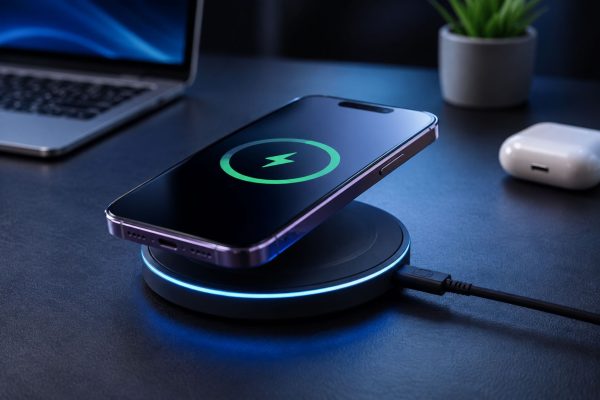
The wireless charging industry is entering a new phase. After moving from the original Qi standard to Qi2 and then Qi2 25W, the Wireless Power Consortium (WPC) is now working toward a significantly higher-power generation of wireless charging. A recent WPC Qi Plugfest and Systems Requirements Testing (SRT) event held at Xiaomi’s Beijing headquarters from June 22–25, 2026 brought major industry participants together to advance the next generation of Qi technology. Reports indicate that a 50W wireless charging target is now being developed, with the technology potentially reaching the market around 2028.
Based on WAWT’s Wireless Power Intelligence Service, ”Cumulatively, on a conservative basis, more than 3 billion smartphones-enabled with wireless charging are expected to be shipped in the next five years, and more than 7 billion in the next ten years. With the introduction of standard-based 50W solution the adoption would be much larger. And would extend beyond smartphones”.
The development represents more than a simple increase in charging power. It could mark an important transition for wireless charging from a convenience feature primarily associated with smartphones and accessories toward a more competitive power-delivery platform.
From 15W to 25W and Now 50W
Qi2 launched in 2023 with 15W wireless charging and introduced magnetic alignment through the Magnetic Power Profile (MPP). The objective was not only to improve charging convenience but also to improve alignment, efficiency and interoperability across manufacturers.
In July 2025, WPC introduced Qi2 25W, increasing power by nearly 70% compared with the original Qi2 specification. WPC says Qi2 25W can charge a smartphone from 0% to 50% in around 30 minutes under appropriate conditions. More than 1,200 Qi2 and Qi2 25W products were certified during 2025, demonstrating the acceleration of the standardized wireless charging ecosystem.
The proposed move toward 50W would therefore represent another major step effectively doubling the power level of Qi2 25W.
This is where the competitive dynamics become interesting.
Several smartphone manufacturers, particularly in China, have already demonstrated proprietary wireless charging technologies at significantly higher power levels. Xiaomi, for example, has pushed high-power wireless charging beyond the limits of today’s mainstream Qi ecosystem. The WPC’s challenge is now to bring some of this performance into a globally interoperable standard.
Why 50W Matters
The significance of 50W is not simply faster charging.
At this power level, wireless charging begins to approach the performance expectations traditionally associated with wired fast charging. That could change consumer perceptions of wireless power.
Today, users often accept wireless charging for convenience but continue to use cables when they need rapid charging. A standardized 50W solution could narrow that performance gap substantially.
For smartphone manufacturers, this creates an opportunity to make wireless charging a more prominent feature of flagship devices. For accessory manufacturers, it opens opportunities for higher-power charging pads, stands, power banks and multi-device charging systems.
However, achieving 50W consistently will be considerably more difficult than simply increasing the transmitter’s rated output.
Thermal Management Becomes the Critical Challenge
The biggest question surrounding 50W wireless charging may be how much power can actually be delivered and sustained without excessive heat.
Wireless power transfer involves losses in the transmitter, receiver, coil, magnetic materials and power electronics. As power increases, thermal management becomes increasingly important. Higher temperatures can reduce charging performance, trigger power throttling and potentially affect battery longevity.
This means the next generation of wireless charging will require improvements across the complete power-delivery architecture not just the charging IC.
Coil design, magnetic materials, resonant components, switching devices, power-management ICs, foreign-object detection and thermal-management systems will all become increasingly important.
This could create a significant opportunity for the broader wireless power supply chain.
A New Opportunity for Power Electronics
The transition toward 50W could also increase the importance of high-efficiency power electronics.
Higher switching performance, improved power density and better thermal characteristics will become increasingly valuable. Technologies such as GaN could therefore become more relevant in wireless charging transmitters as manufacturers attempt to reduce losses and shrink the size of higher-power charging systems.
At the same time, the industry will need better control algorithms and power-negotiation mechanisms to dynamically manage charging based on device temperature, battery condition, alignment and system efficiency.
In other words, 50W wireless charging is likely to become a system-level engineering challenge rather than simply a higher-power specification.
Standardization Could Be the Biggest Market Catalyst
Perhaps the most important aspect of the development is standardization.
Proprietary wireless charging systems can deliver impressive power, but their limitation is interoperability. A globally adopted Qi-based 50W standard could allow manufacturers across the ecosystem to compete on a common platform.
The June 2026 Beijing WPC event is significant in this context. The participation of major technology companies indicates that higher-power wireless charging is increasingly being treated as an industry-wide development rather than a single-company technology race.
The WPC has not yet released the complete Qi 50W specification, so questions around final architecture, certification requirements, efficiency targets and commercial implementation remain open.
What Comes Next?
The industry is now moving from “Can wireless charging become faster?” to “How far can standardized wireless charging scale?”
Qi2 25W established that higher-speed standardized wireless charging is commercially viable. The proposed 50W generation could take the next step by bringing wireless charging closer to the performance of wired solutions.
For WAWT, the bigger opportunity is not simply tracking the eventual launch of a 50W charger. The more important market question is how this transition will reshape the surrounding ecosystem from wireless charging ICs and coils to magnetic materials, GaN power devices, thermal management and power supplies.
If the WPC can successfully standardize 50W while maintaining safety, efficiency and interoperability, the wireless power market could enter a new competitive cycle.
The race is no longer just about making wireless charging convenient. It is becoming a race to deliver more power, more efficiently, while maintaining the interoperability that proprietary solutions have historically lacked.
Contact WAWT for detailed estimates and forecast and insights on the wireless power market, covering various wireless power technologies, including Qi 50W.
About WAWT
Wired and Wireless Technology (WAWT), a leading strategic technology analyst and consulting firm specializing in the wireless power and power supply industry, continues to track the rapid evolution of wireless charging technologies and their adoption across global markets. Through its extensive industry engagement, including participation in around 15 key industry events and trade shows annually, WAWT captures the latest technology developments, announcements, market trends, and competitive dynamics.
As part of its ongoing research, WAWT has published its H1 2026 Wireless Power Market Report, providing the latest market estimates, trends, technology developments, and strategic insights across the wireless power ecosystem and more than 30 application markets.
The report offers valuable market intelligence to help industry stakeholders understand emerging opportunities, assess competitive developments, and make informed business decisions in the rapidly evolving wireless power market.
For more information, contact WAWT’s subject matter experts at analyst@wawt.tech or follow WAWT on LinkedIn for the latest wireless power, wireless charging, and power technology insights.